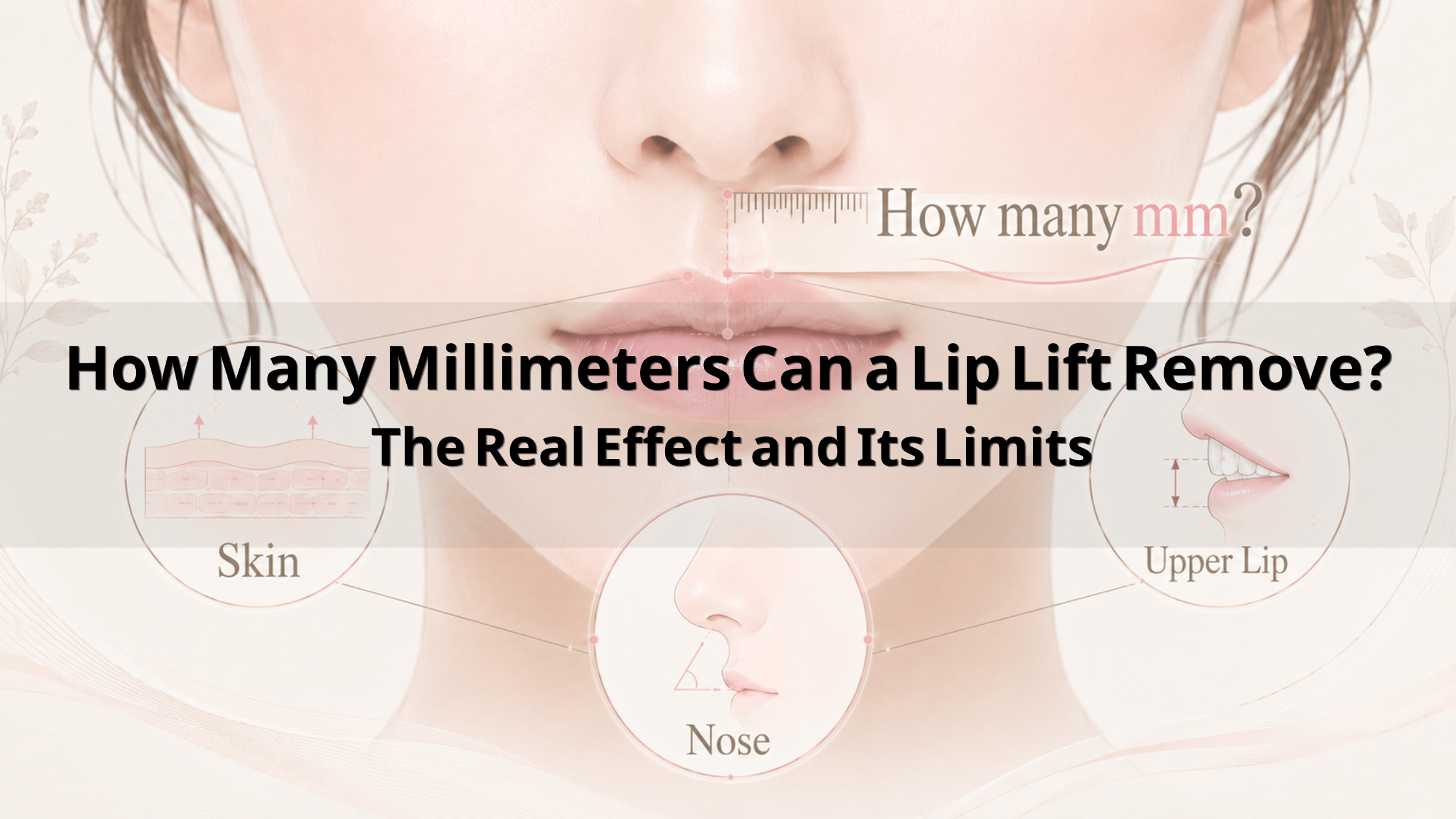
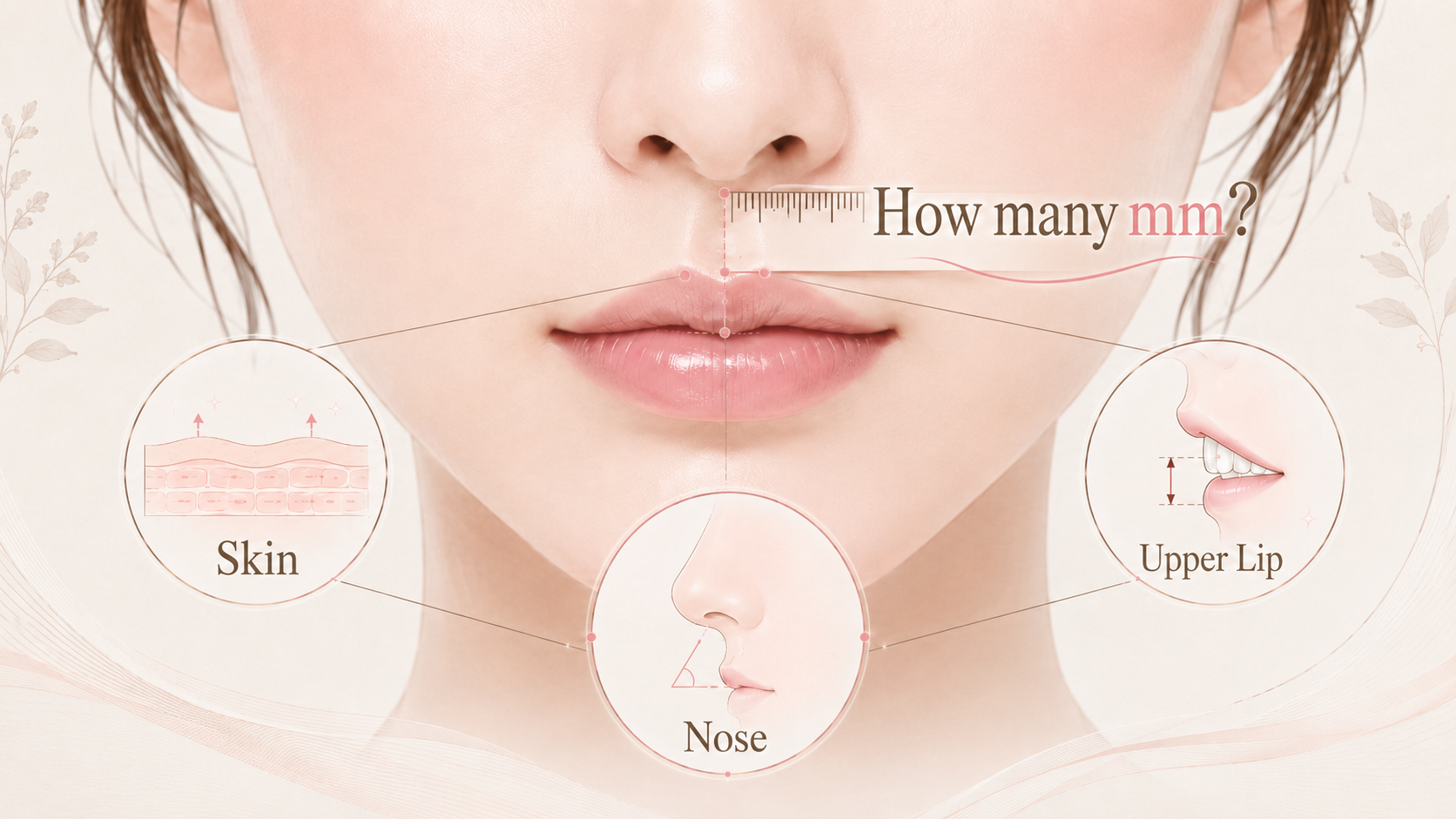
Once you start considering a lip lift, the first thing most people want to know is a number: how many millimeters can it shorten? The honest answer is that there is no one-size-fits-all figure. The amount that can be removed in a lip lift is not set by your wish alone; it is determined, within a range that differs for every face, by three conditions: the laxity of the skin, the state of the nasal tip and nasolabial angle, and how your upper lip and teeth show. This article explains how to think about the "how many mm" question, the realistic size of the effect, and the limits, including the risk of over-resection, so you can set your expectations correctly before a consultation.
The Short Answer: The Three Conditions That Decide the Number
In other words, the design does not start from your desired number of millimeters; the removal amount is worked backward from the finished balance that suits your face. The sections below take the conditions in order.
The Realistic Scale: A Lip Lift Is a "Few Millimeters" Operation
The skin removed in a lip lift is generally on the order of a few millimeters. That may sound small, but the area under the nose sits at the center of the face, where even a slight change in length shifts the impression of the entire midface. A few millimeters is enough to erase the stretched look under the nose, gently evert the upper lip, and make the whole mouth appear tighter.
The flip side is that in an area where a few millimeters changes everything, a single millimeter separates a good result from a poor one. "More removal means more effect" is simple arithmetic that does not hold here; what determines the result is a design that finds the optimal amount within each person's conditions. 【要確認|院内で切除量の目安レンジ(例:◯〜◯mm)を提示している場合はここに反映してください】
Condition 1: Skin Laxity. Is There Anything to Work With?
The first condition is the raw material itself: the skin. Someone whose philtrum skin is clearly long has more slack to work with, so even a several-millimeter reduction can be finished naturally, with room to spare. Someone whose philtrum is of standard length to begin with has far less margin.
Forcing a large removal on skin without slack puts heavy tension on the suture line, which can widen the scar or pull the nostrils and alar bases out of shape. Removal beyond what the skin allows produces risk, not effect. That is the first limit.
Condition 2: The Nose. The Cases More Millimeters Cannot Solve
The second condition is the nose. When the nasal tip droops, or the angle between the columella and the upper lip (the nasolabial angle) is acute, the tip hangs over the upper philtrum and the philtrum merely looks longer than it is.
In these cases the cause of the long appearance is not the philtrum skin, so increasing the removal amount will not deliver the expected change. Worse, the harder you try to solve a problem of appearance by removing skin, the more over-resection risk you stack up. When the cause lies with the nose, the limit of a lip lift is not the amount but the method itself; the fundamental fix starts with correcting the nasal tip and nasolabial angle. Before asking how many millimeters can be cut, the essential first step is a diagnosis that isolates which side the cause is on.
Condition 3: Upper Lip and Tooth Show. "What Can Be Cut" vs. "What Should Be Cut"
The third condition is the one that most strongly sets the practical limit. When skin is removed and the area sutured upward, the upper lip lifts, and the amount of front tooth visible at rest changes. With the right amount, the result is a youthful mouth where the front teeth peek through slightly. With too much, teeth and gums become visible even at rest, creating an unnatural, "can't quite close the mouth" impression.
In short, the amount that physically can be cut and the amount that should be cut for a good result are two different things. Anyone whose front teeth already show at rest, or whose gums show easily when smiling, has little room for removal in the first place, and in some cases another approach fits better than a lip lift at all. This condition is the single biggest reason a requested number of millimeters cannot simply be granted.
The Risk of Over-Resection: Because This Cannot Be Undone
Skin removed in a lip lift cannot be put back. Gum exposure, distorted nostrils, and an unnaturally flipped upper lip caused by over-resection are all extremely difficult to revise, and even when revision is possible, it is a more complex operation than the original.
That is why the guiding principle of the design is not "aim for the maximum you hoped for" but "stay within the amount that your current skin, nose, and upper lip allow, and that keeps the face in harmony." Prioritizing your current condition over your desired design, and not forcing an aggressive change, may feel underwhelming at first, but it is the most reliable way to avoid regret in an irreversible procedure.
Work Backward from "How It Should Look," Not "How Much to Cut"
At a consultation, opening with "please remove X millimeters" is less productive than sharing the finished image you want: "this kind of mouth, this kind of balance." The surgeon then diagnoses your skin laxity, the state of your nose, and your tooth show against that target, and works backward to the number of millimeters that is right for your face.
Two people with the identical complaint of "my philtrum is long" will have different appropriate removal amounts. The number is a result, not a starting point. That is the most accurate answer to the "how many mm" question.
Frequently Asked Questions
Q1. Will I know in advance how many millimeters will be removed?
A. Generally, yes in range terms: after examining your skin laxity, nose, and tooth show, the surgeon presents an appropriate removal range and the finished look it corresponds to. The final visible change is also influenced by swelling and individual healing, so rather than fixating on the number, align with your surgeon on the kind of mouth you are aiming for.
Q2. What happens if I ask for the maximum possible removal?
A. Cutting to the maximum that skin laxity alone allows raises the risks of excessive tooth and gum show, nostril distortion, and an unnatural upper lip. A trustworthy clinic will propose the harmonious amount, not the maximum. In fact, be cautious of any consultation that accepts your requested amount unconditionally.
Q3. Can I start conservatively and remove more later if it is not enough?
A. If slack remains in the skin, additional removal can sometimes be considered. Compared with how difficult it is to fix over-resection, "start conservative, add if needed" is the lower-risk order of operations. That said, a second operation brings its own considerations, such as scarring and tissue condition, so the most important step is still aligning thoroughly on the finished image at the first design stage.
Conclusion: The Number Is a Diagnosis, Not a Starting Point
How much a lip lift can shorten is decided not by your desired millimeters but by three conditions: skin laxity, the state of the nasal tip and nasolabial angle, and how your upper lip and teeth show. Precisely because a few millimeters transforms this part of the face, the path to the best result is not cutting more but staying within the amount that suits your face, while over-resection leaves only irreversible risk. If you find yourself wondering how many millimeters are possible, start with the diagnosis that determines that number.
If you would like to know the appropriate removal amount for your own face, feel free to reach out through Respect Plastic Surgery's official WhatsApp for an online consultation.

 Google Maps