You know every angle that works.
The ones you use in photos — slightly down, hair forward, never straight-on. The hairstyles you've kept for years not because you love them, but because they do a job. The way you position yourself on video calls without thinking about it anymore.
A wide forehead isn't something most people talk about openly. But it shapes choices quietly — what you wear, how you style your hair, which photos you keep and which you delete.
Here's the thing: a wide forehead isn't a feature you have to manage around forever. It's a proportion issue — and proportion issues have structural solutions.
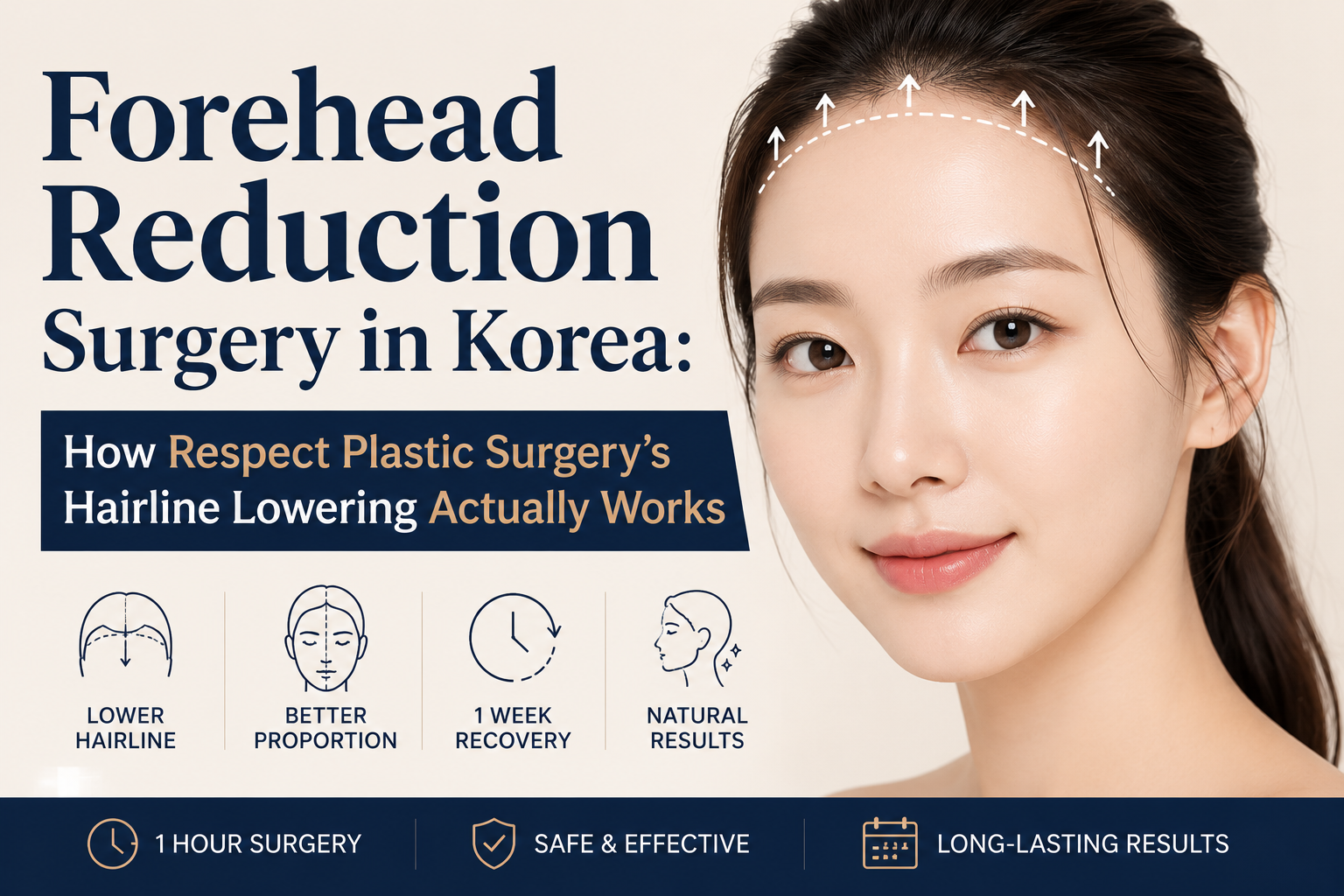
Forehead reduction surgery lowers the hairline by surgically advancing the scalp forward, reducing the vertical height of the forehead to create a balanced, natural-looking result. No implants. No temporary fixes. No hair transplant waiting period.
At Respect Plastic Surgery in Gangnam, the procedure is built around one key principle: the ideal forehead height isn't a universal number. It's the number that's right for your face — your facial ratio, your scalp elasticity, your existing hairline shape. Getting that calculation right is what makes the result look natural instead of done.
This guide covers how it works, what makes Respect's technique different, and everything you need to know before considering the procedure.
What Is Forehead Reduction Surgery — And How Is It Different From a Hair Transplant?
This is the first question worth clearing up, because the two procedures get confused constantly.
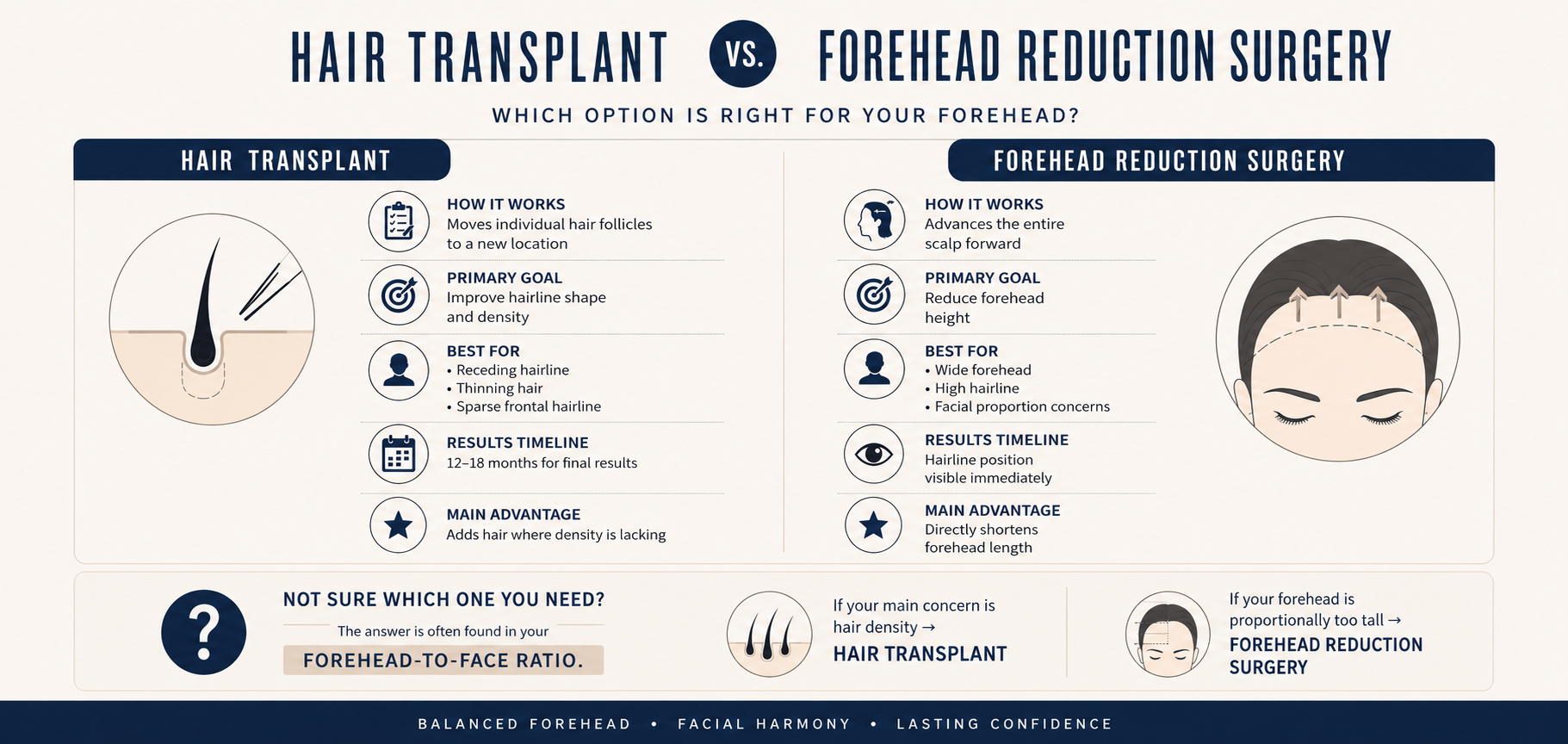
Hair transplant: Individual follicles are moved from a donor area to fill in a receding hairline. Results take 12–18 months to fully appear. Best for hairline density issues, not forehead height.
Forehead reduction (hairline lowering surgery): The scalp is surgically advanced forward, physically moving the hairline down and reducing the vertical height of the forehead. Results are immediate in terms of position. Best for forehead height — when the issue is how much forehead is visible, not how dense the hairline is.
The key difference: a hair transplant fills. Forehead reduction surgery moves. If your hairline position is the issue — not the density — a transplant won't solve it. Forehead reduction will.
The Ideal Forehead Ratio — What "Balanced" Actually Means
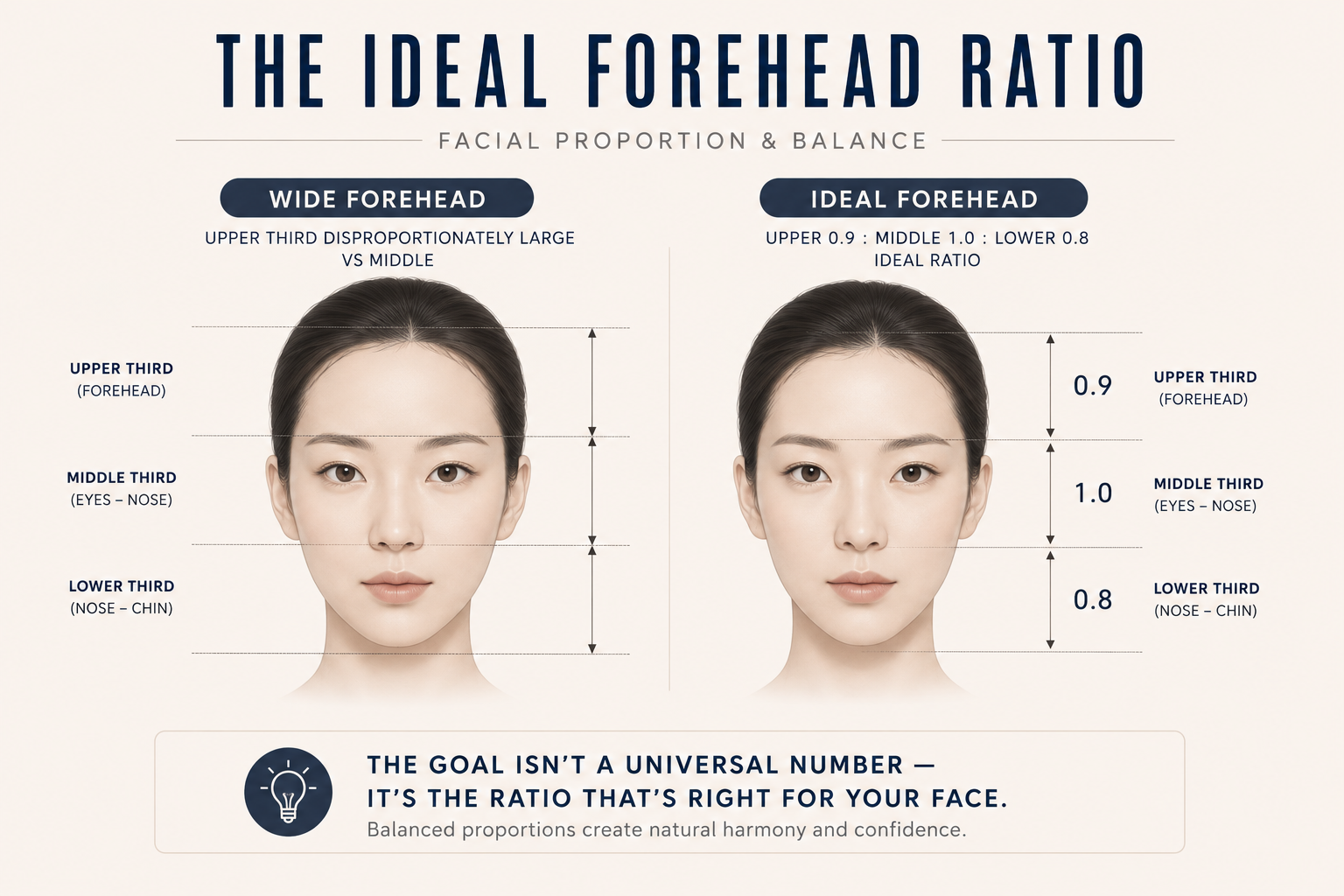
Before planning any forehead reduction, Respect uses 3D CT analysis to assess the patient's facial proportions. The goal isn't to hit a universal "ideal" number — it's to find the right forehead height for this face.
That said, there is a useful reference point:
The face is typically divided into three horizontal thirds — upper (hairline to brow), middle (brow to nose base), and lower (nose base to chin). In a balanced face, these thirds sit in roughly equal proportion.
The upper third — the forehead — should ideally measure approximately 0.8 to 0.9 relative to the middle third (set at 1.0). When the forehead is significantly larger than this ratio, the face reads as top-heavy, and the forehead draws attention in a way the patient finds unflattering.
Forehead reduction surgery doesn't aim for an arbitrary result. It aims for your ratio — taking into account your face shape, your scalp elasticity, and what will look natural on your specific features.
The Respect Technique: What Makes It Different
Most forehead reduction procedures follow the same basic approach — make an incision along the hairline, advance the scalp, close. The difference between a natural-looking result and a visible one comes down to three things: where exactly the incision is made, how the scalp is repositioned, and how it's fixed and closed.
01 — Customised to Your Facial Ratio
The forehead height is calculated based on each patient's individual facial proportions — not a fixed template. The hairline shape is also adjusted as part of the procedure: where the original hairline curves, the repositioned line is designed to follow the same natural arc, customised to the patient's face shape and overall balance.
02 — Angled Incision to Preserve the Hair Follicles
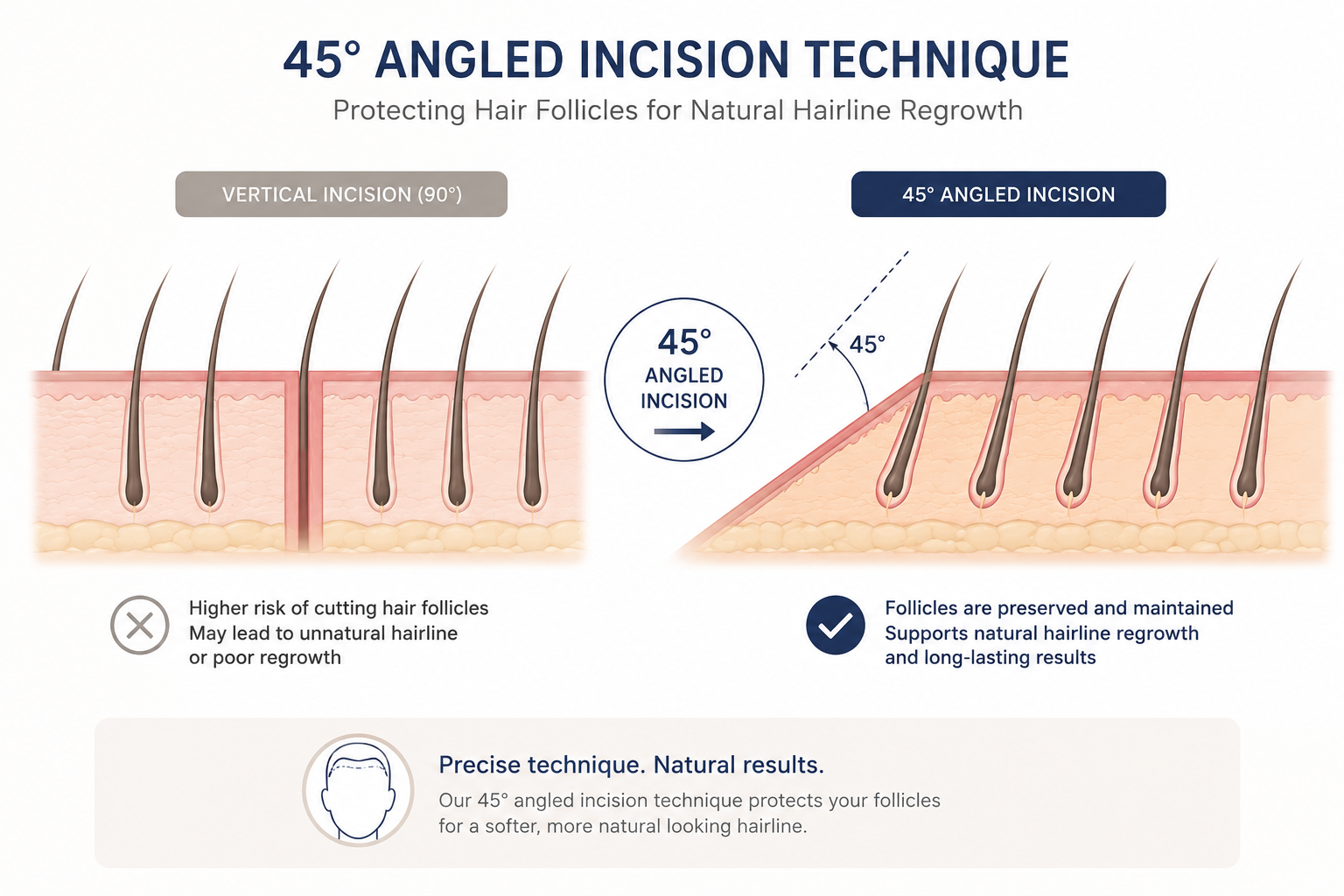
This is the technical detail that determines whether hair grows back naturally along the scar line — or doesn't.
A standard straight incision cuts through hair follicles at the hairline, damaging the roots directly beneath the cut. At Respect, the incision is made at a 45-degree angle, following the direction of hair growth. This preserves the follicles immediately behind the incision line, allowing new hair to grow naturally through and in front of the scar.
The result: within a few months post-surgery, hair grows through the incision line and covers it naturally. The scar becomes invisible not because it's hidden — but because hair literally grows over it.
03 — 7-Point Fixation + Triple-Layer Closure
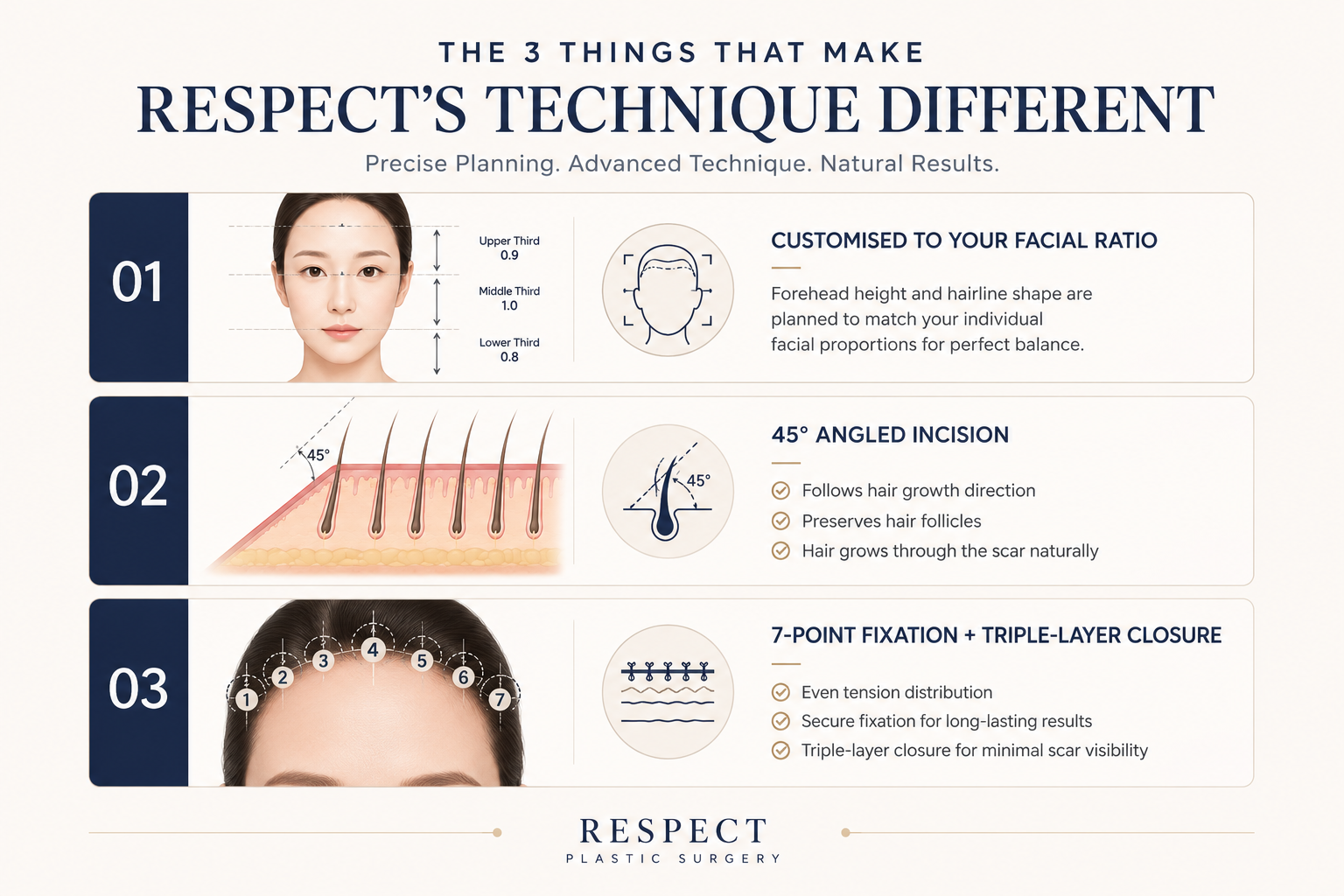
Two things determine how long a forehead reduction result holds — and how minimal the scarring is.
7-point fixation: The repositioned scalp is secured at 7 or more points, distributing tension evenly across the entire hairline rather than concentrating it at the closure points. This maximises the stability of the result and minimises the risk of the scalp drifting back over time.
Triple-layer closure: The wound is closed in three layers — deep tissue, mid-layer, and surface — rather than in a single pass. This dramatically reduces surface tension on the scar, which is the primary factor in how visible a scar becomes. Less tension at the surface = finer, less visible scar line.
How the Surgery Works: Step by Step
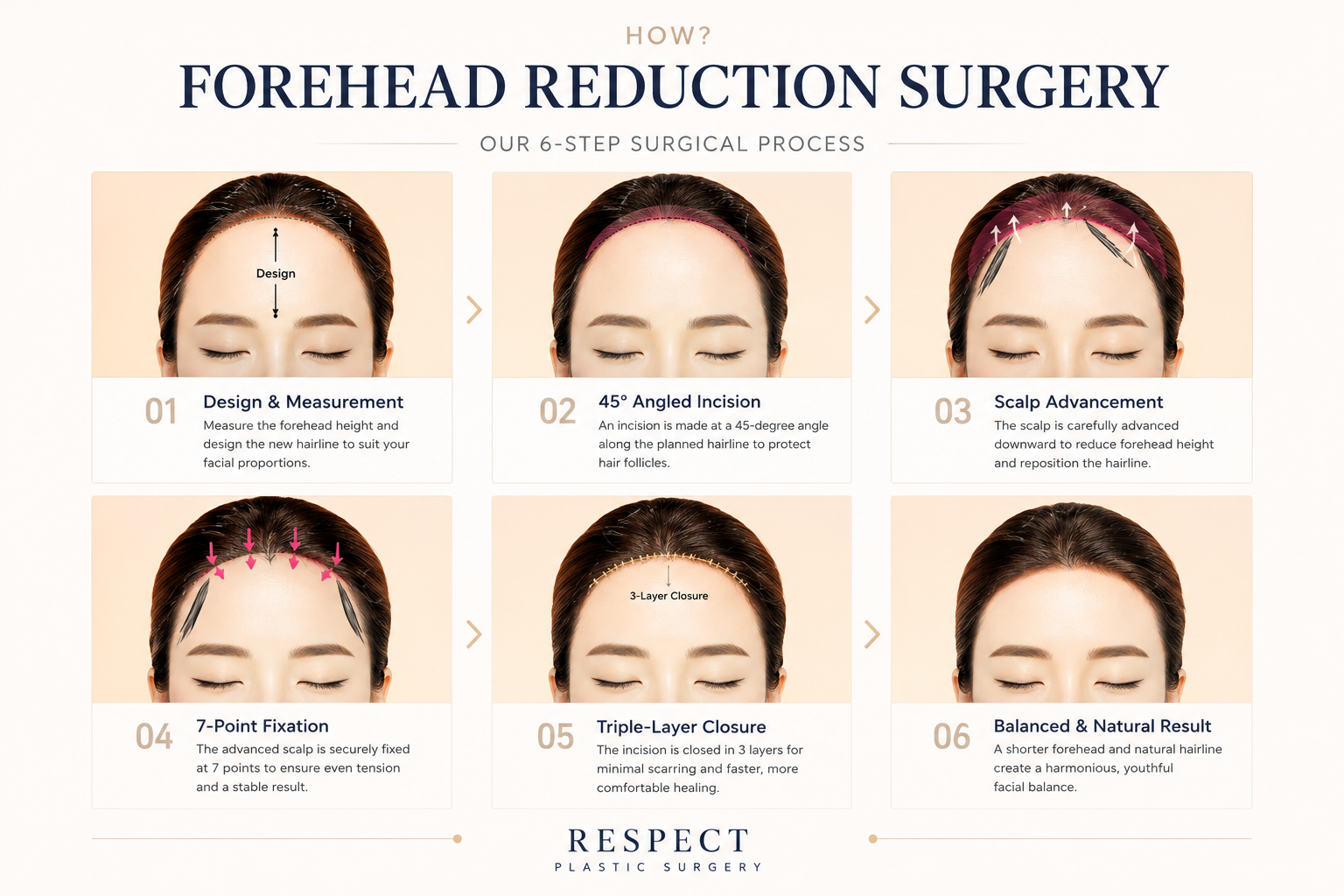
The surgery follows a precise 6-step sequence — each stage designed to preserve the structures that determine whether the result looks natural:
Step 1 — Assessment The starting point: a wide forehead with a high hairline. Facial proportions and scalp elasticity are assessed to determine the correct amount of advancement.
Step 2 — Hairline marking The new hairline position is mapped precisely along the front hairline, with the supraorbital nerve pathway identified and preserved.
Step 3 — Scalp preparation The scalp tissue is carefully released so it can be advanced forward without excess tension — protecting nerves and blood vessels throughout.
Step 4 — Scalp advancement The scalp is brought forward to the new hairline position. The excess forehead skin is removed. This is the step that physically reduces the forehead height.
Step 5 — 7-point fixation and triple-layer closure The repositioned scalp is secured at 7+ points. The wound is closed in three layers to minimise surface tension and scar visibility.
Step 6 — Result A balanced forehead with a natural, lower hairline — proportionate to the face, with hair that will grow through the incision line naturally over the following months.
The Recovery Journey: Week 1 to Month 3
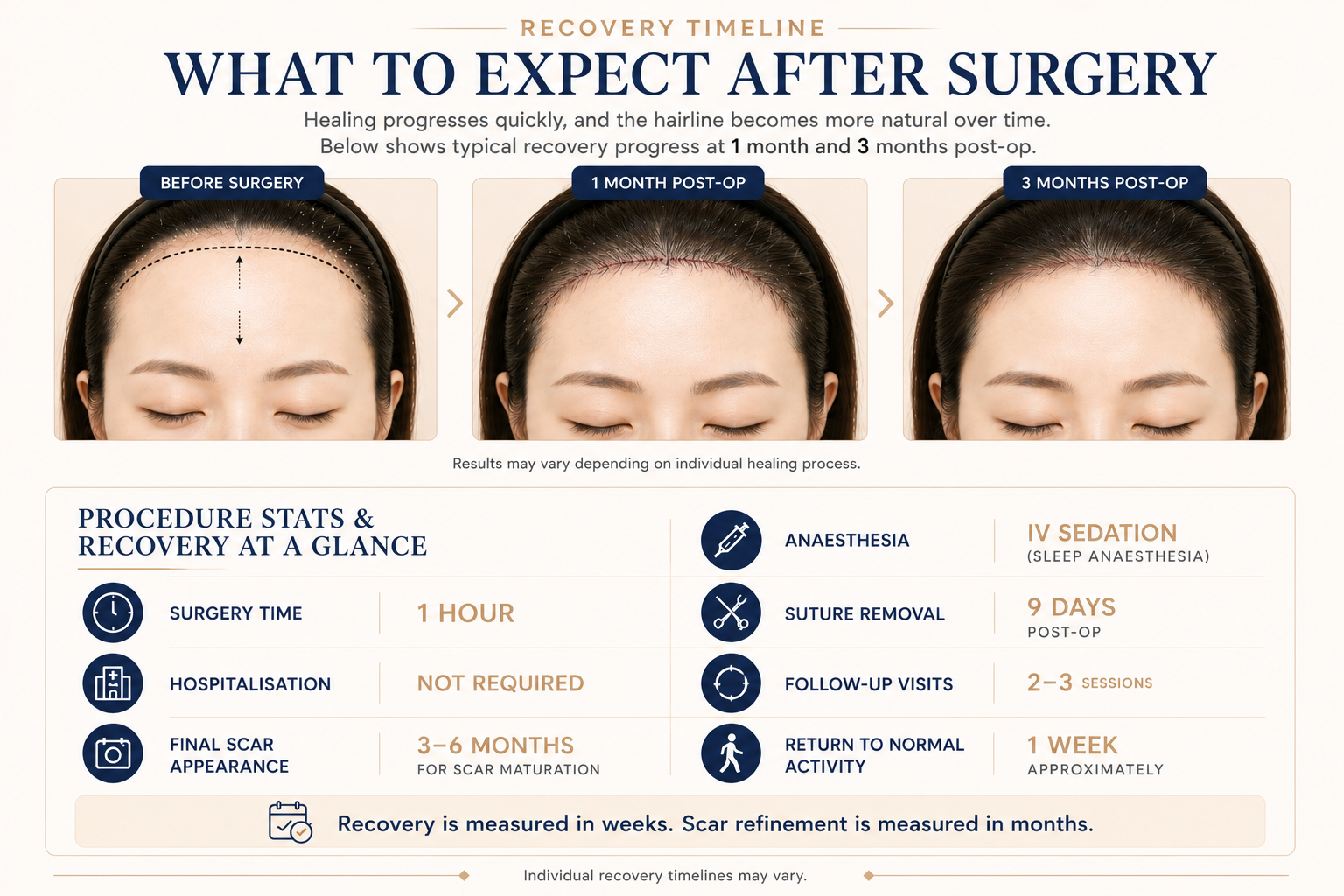
The suture line appears pink for approximately the first month after surgery — which is a normal part of the healing process, not a sign of a problem. As healing progresses, the line fades and thins. By 3 to 6 months post-op, the scar becomes difficult to see in normal conditions — and as hair grows through and over the incision line, it becomes essentially invisible.
Healing milestones:
- Week 1: Mild swelling and tightness. Sutures in place. Most patients return to normal activity.
- Month 1: Suture line visible but pink. Early hair regrowth along incision begins.
- Month 3: Scar significantly faded. Hair growing through the incision line naturally.
- Month 3–6: Scar nearly invisible. Final result fully visible.
Wondering If Forehead Reduction Surgery Is Right for You?
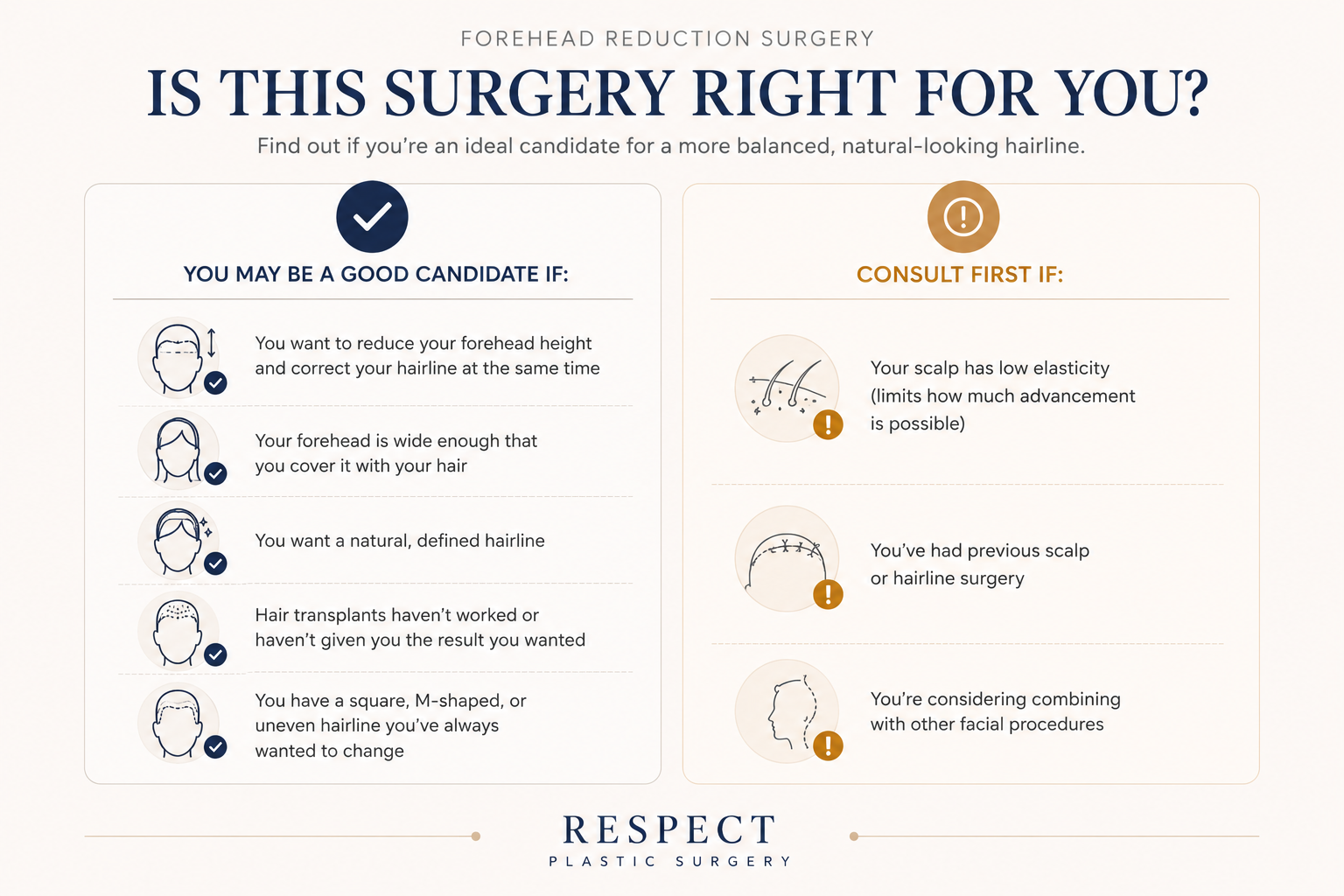
Forehead reduction surgery at Respect is suited for patients who:
- Want to reduce forehead height and correct the hairline simultaneously — one surgery, one result
- Have a wide forehead they've been managing with hairstyles for years
- Want a cleaner, more balanced hairline without the 12–18 month wait of a transplant
- Have an M-shaped, square, or uneven hairline they want softened and lowered
- Previously had a hair transplant that didn't address the forehead height itself
The Results: What Changes
Beyond the obvious reduction in forehead height, patients at Respect describe four consistent changes after surgery:
Forehead reduction — the primary result. The vertical height decreases to a proportion that balances naturally with the mid and lower face.
Hairline correction — the new hairline is shaped as part of the procedure. Square corners soften. M-shaped recession is corrected. The line reads as natural, not surgical.
A fresher, younger appearance — a proportionate forehead changes the overall reading of the face. Patients consistently describe looking more refreshed without anything else having changed.
Quick recovery, fast return — 1 week to normal activity. No prolonged downtime. No months of waiting to see whether the result worked.
Frequently Asked Questions
Q. How much does forehead reduction surgery cost in Korea?
A.At reputable Gangnam clinics, forehead reduction surgery typically ranges from USD $3,500 to $6,000 depending on the degree of advancement needed and whether hairline reshaping is included. International patients receive a preliminary estimate through the online consultation before traveling.
Q.Will there be a visible scar?
A.The incision is made along the hairline. For the first 1–3 months, the suture line is visible and pink. By months 3–6, it fades significantly — and because the incision is made at a 45-degree angle (preserving the follicles), hair grows through the scar line naturally, making it essentially invisible at a normal viewing distance.
Q. How much can the hairline be lowered?
A.This depends on scalp elasticity — which varies significantly between patients. The safe range is typically 1 to 3 cm of advancement. Your surgeon will assess your scalp during consultation and give you a realistic expectation based on your specific anatomy.
Q. Can I combine this with other procedures?
A.Yes. Forehead reduction is commonly combined with hairline reshaping (softening M-shape or square corners), and can be planned alongside other facial procedures. The combination is determined individually based on your proportions.
Q. How long do results last?
A.The surgical repositioning is permanent. The scalp does not return to its original position. The result ages naturally with you.
Q. Is general anesthesia required?
A. Respect uses IV sedation (sleep anesthesia) — not full general anesthesia. You are fully asleep and comfortable during the procedure, but recovery from sedation is typically faster than from general anesthesia.
Coming to Korea for Forehead Reduction Surgery?
Respect provides English consultations for international patients. The process is designed for people making this decision from abroad.
Step 1 — Online photo consultation Send front and side photos with your hairline visible. The surgeon assesses your forehead ratio and scalp characteristics and provides a preliminary recommendation — before you book a flight.
Step 2 — Arrive in Seoul Airport pickup available. Accommodation near the clinic arranged.
Step 3 — In-person consultation Scalp elasticity assessed in person. Final surgical plan confirmed. You meet your surgeon directly before any decision is made.
Step 4 — Surgery 1 hour. IV sedation. Same surgical team throughout.
Step 5 — Recovery week in Seoul 1 week before flying is recommended.
Step 6 — Remote follow-up Post-operative care continues online after you return home.
Click here to schedule a consultation.
English consultations are available for international patients.
 Google Maps