You've seen the results online. You know double eyelid surgery exists. You might even know you want it.
But then you start researching — and suddenly there are four different types, two different methods, and a whole vocabulary you weren't prepared for. In-line. Outline. Incisional. Non-incisional. Semi-outline. And everyone seems to have a different opinion about which one is right.
Here's the thing: they're all right — for different eyes.
Double eyelid surgery isn't one procedure with one result. The crease position, the method used, and the outcome that looks natural on your face all depend on your specific eyelid anatomy — how much fat is present, how thick the lid is, where your natural fold sits, and what kind of change you're actually looking for.
This guide breaks down all four double eyelid types clearly — what each one looks like, who it's for, and how it's created — so you can walk into your consultation knowing exactly what to ask for.
Before the Types: What Does "Double Eyelid" Actually Mean?
A double eyelid is any eyelid that has a visible crease above the lash line, creating a fold when the eye is open. Monolid eyes — more common in East Asian anatomy — have little or no visible crease, which means the eyelid appears smooth and flat when open.
Double eyelid surgery creates that crease surgically — either by placing stitches that connect the skin to the underlying muscle (non-incisional), or by making an incision along the crease line to remove excess skin and fat and create a permanent fold (incisional).
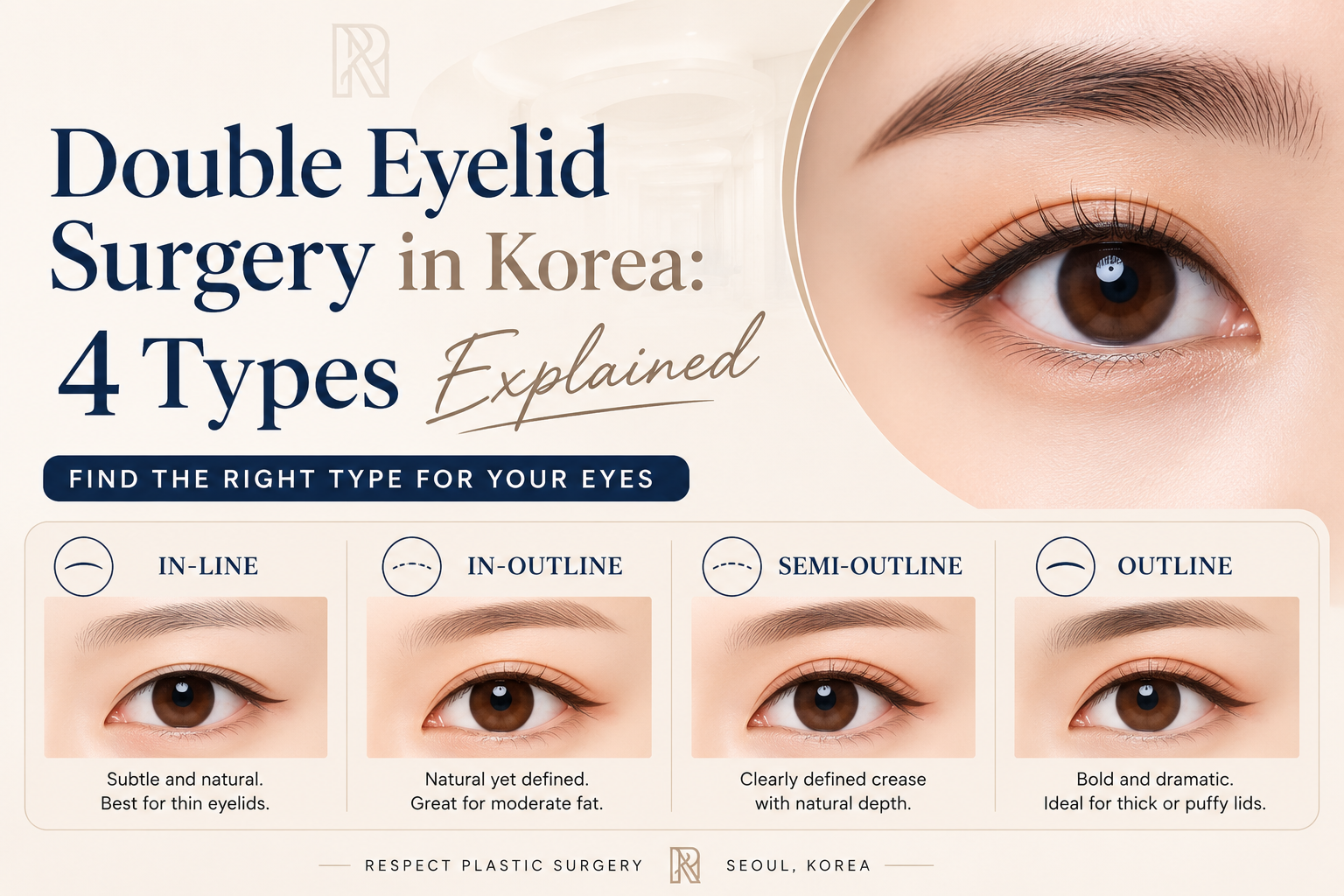
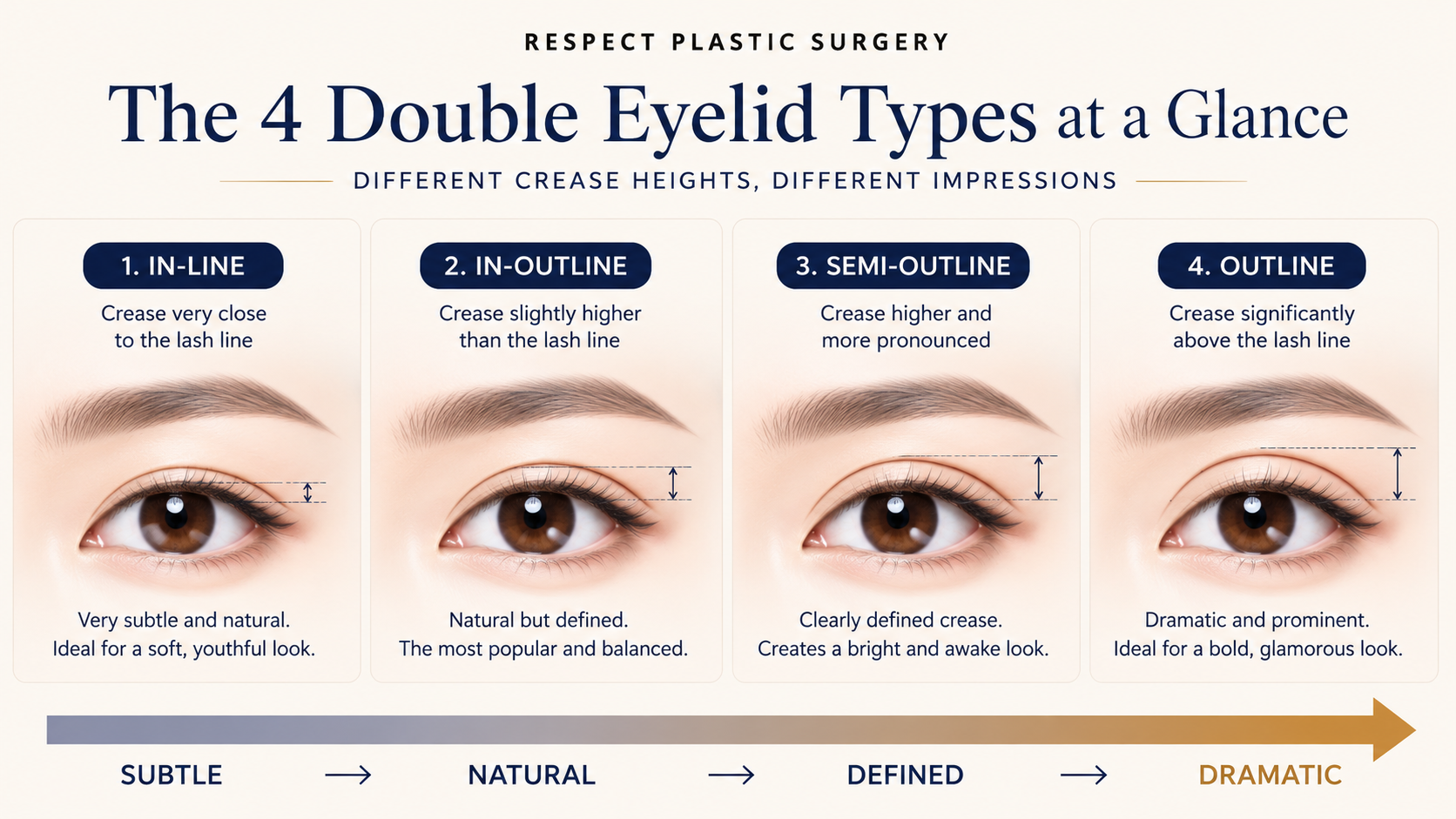
The four types — In-Line, In-Outline, Semi-Outline, and Outline — refer to where the crease is positioned relative to the lash line. The higher the crease, the more prominent and defined the fold. The lower the crease, the more subtle and natural the result.
Which one is right depends entirely on your eyelid — not on trends, not on what looks good on someone else.
Type 01 — In-Line Double Eyelid
The look: The most natural, subtle double eyelid result. The crease sits very close to the lash line — barely visible when the eye is open, present enough to define the lid.
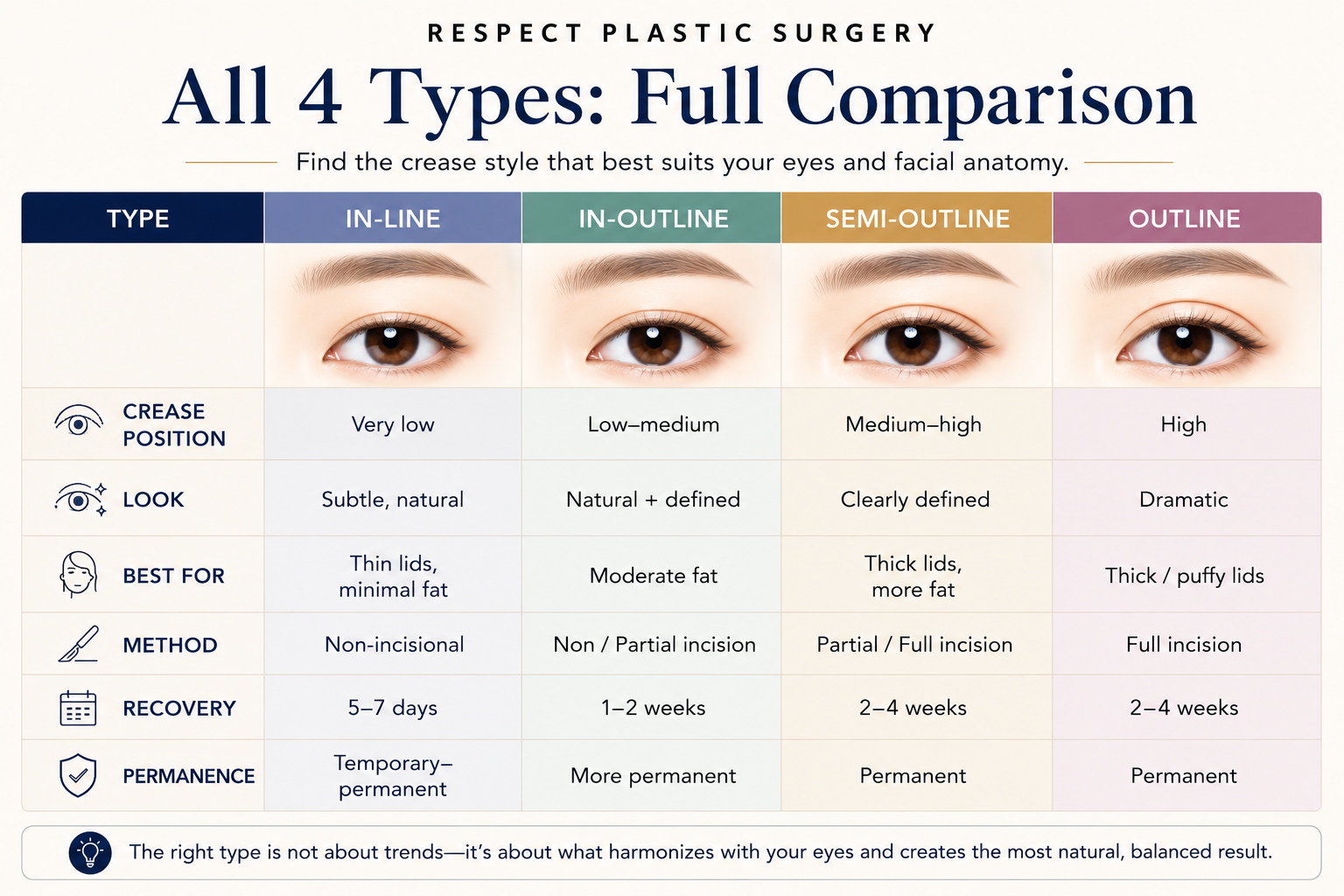
Who it's for: The In-Line crease is best suited for patients with thin eyelids and minimal eyelid fat. Because the fold is low and close to the lash line, it complements a naturally subtle eye shape without overpowering it. It's the choice for patients who want an enhancement that looks like something they were born with — not something they had done.
If you've ever thought "I just want my eyes to look a little more open" without wanting anyone to notice the change, In-Line is likely the direction.
How it's created: In-Line double eyelids are typically created using the non-incisional (burial) method — small stitches placed beneath the skin to connect the eyelid to the underlying muscle, creating a fold without any cutting. For patients wanting a more permanent version, a minimal incisional approach can also be used.
Recovery: Fastest of the four types. Minimal swelling. Most patients return to normal activity within a week.
Longevity: Non-incisional results can soften over time (typically 5–10 years) in some patients. Incisional versions are permanent.
Type 02 — In-Outline Double Eyelid
The look: A slightly higher crease than In-Line — still natural, but with more visible definition. The fold is noticeable when the eye is open, giving the eye a more awake, defined appearance without looking dramatic.
Who it's for: In-Outline sits in the sweet spot between subtle and defined. It works well for patients with moderate eyelid fat who want a crease that's visible and expressive, but still reads as natural on their face. This is one of the most commonly requested crease types — it suits a wide range of eye shapes and enhances without transforming.
If your goal is for people to notice your eyes look better — not to notice you had surgery — In-Outline is often the answer.
How it's created: In-Outline can be achieved with either non-incisional or partial incisional methods. Partial incision involves small cuts to remove a modest amount of excess skin and fat, then stitching to form the crease at the desired height.
Recovery: Slightly longer than In-Line due to the higher crease position. Most swelling resolves within 1–2 weeks.
Longevity: Partial incisional results are more durable than purely non-incisional. Full incisional version is permanent.
Type 03 — Semi-Outline Double Eyelid
The look: A clearly defined, prominent fold. The crease sits noticeably higher than In-Outline, creating a more expressive, open-looking eye with a visible double lid even when the eye is fully open.
Who it's for: Semi-Outline is suited for patients with thicker eyelids and moderate to high eyelid fat. A lower crease on a heavier lid tends to disappear into the fat — Semi-Outline positions the crease high enough to remain visible and defined despite thicker lid tissue. It's also the choice for patients who actively want a more expressive, wider-looking eye — not just a subtle enhancement.
How it's created: Typically performed using partial or full incisional methods. The surgeon makes strategic incisions to remove excess fat and skin, then stitches at the target crease height. Because more tissue is addressed, the result is more pronounced and more durable.
Recovery: Longer than In-Line and In-Outline. Swelling is more significant initially and resolves over 2–4 weeks. Final result fully visible at 3–6 months.
Longevity: Incisional — permanent results.
Type 04 — Outline Double Eyelid
The look: The most dramatic result. The crease is positioned significantly higher above the lash line, creating a deep, bold fold that gives the eye a striking, highly defined appearance.
Who it's for: Outline is for patients who want a genuinely dramatic change — and whose eyelid anatomy supports it. It works best on patients with thicker, puffier eyelids and more eyelid fat, where a bold crease position creates the most impactful transformation. Patients who choose Outline typically know they want a significant change and aren't looking for something that reads as subtle.
How it's created: Outline is achieved exclusively through the full incisional method. A larger incision removes excess skin and fat more extensively, and the high crease is created with precise stitching. This is the most technically demanding of the four types and requires the most recovery time.
Recovery: The longest of the four types. Significant swelling resolves over 2–4 weeks. Final result — including full resolution of residual swelling — visible at 3–6 months.
Longevity: Permanent.
Incisional vs. Non-Incisional: What's the Difference?
The four crease types describe where the fold sits. The method describes how it's created. These are two separate decisions — and both matter.
Non-Incisional (Burial Method) Small stitches are placed beneath the eyelid skin to connect it to the underlying muscle, creating a fold without any cutting. No incision means minimal scarring and faster recovery. The limitation: results can soften over time in patients with more eyelid fat, and it's not suited for patients who need excess skin or fat removed.
Best for: Thin eyelids, minimal fat, patients wanting a subtle In-Line result or their first procedure.
Partial Incisional Small incisions are made at strategic points to remove a modest amount of excess fat, while the crease is formed primarily by sutures. A middle ground between non-incisional and full incisional — more durable than burial, less recovery than full incision.
Best for: Moderate eyelid fat, In-Outline or mild Semi-Outline results.
Full Incisional A complete incision is made along the planned crease line. Excess skin and fat are removed as needed, and the crease is created with precise layered suturing. The most durable method — and the only option for patients needing significant tissue removal or wanting Outline results.
Best for: Thicker eyelids, higher fat volume, Semi-Outline and Outline results, or patients wanting permanent results regardless of lid type.
How to Know Which Type Is Right for You
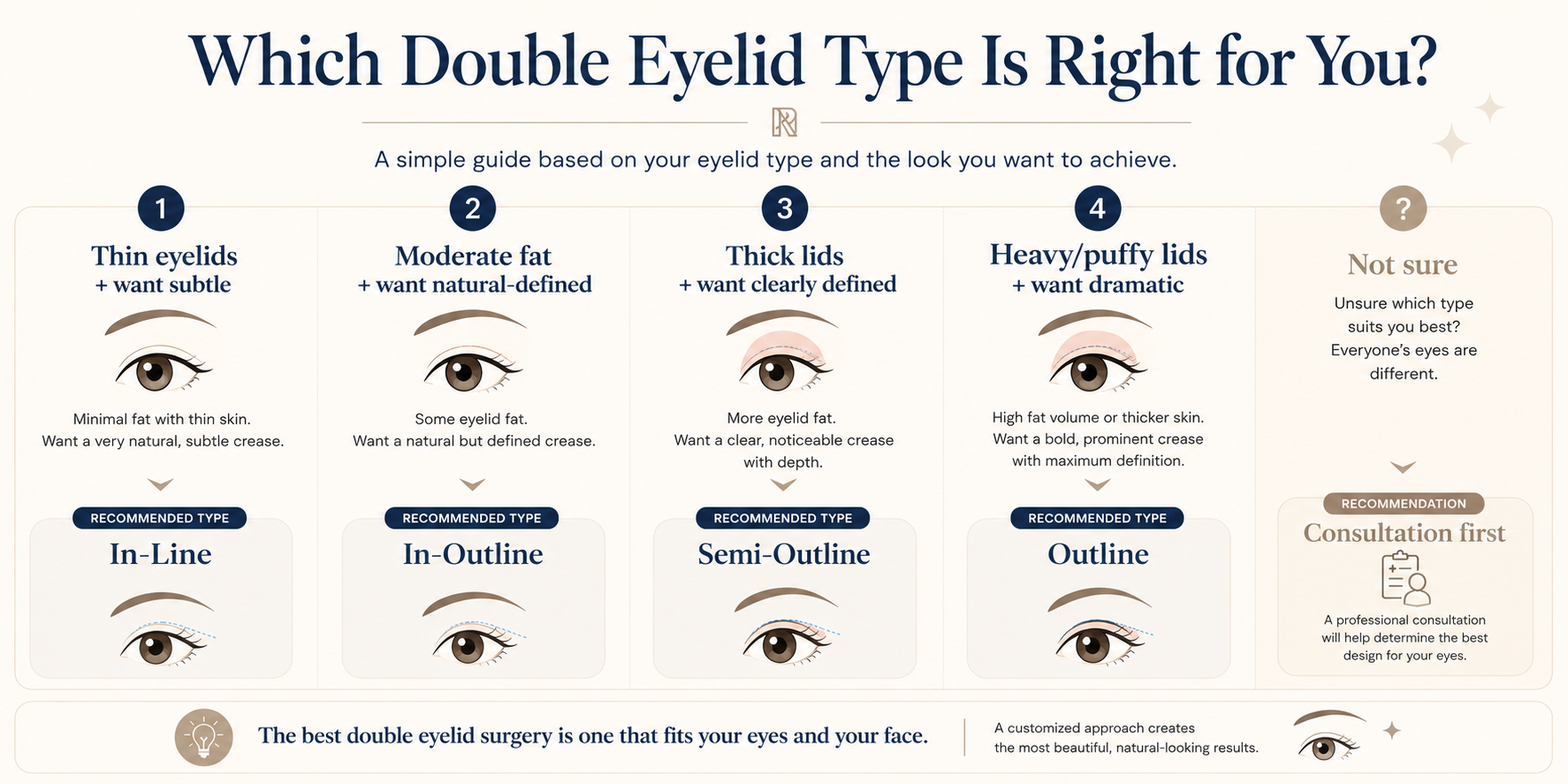
The honest answer: you can't fully know until a surgeon assesses your eyelid anatomy in person. What looks like an In-Outline on one person may need a Semi-Outline approach on another, because the eyelid fat, skin thickness, and natural fold position are different.
That said, here's a useful starting framework:
If you have thin eyelids and want something subtle: → In-Line, non-incisional method
If you want a visible crease that still looks natural: → In-Outline, non-incisional or partial incisional
If your eyelids are thicker and you want a clearly defined fold: → Semi-Outline, partial or full incisional
If you want a dramatic transformation and have puffy or heavy lids: → Outline, full incisional
If you're unsure: → That's exactly what a consultation is for. A surgeon who assesses your specific anatomy will give you a more accurate recommendation than any guide can.
What to Expect: Recovery Timeline
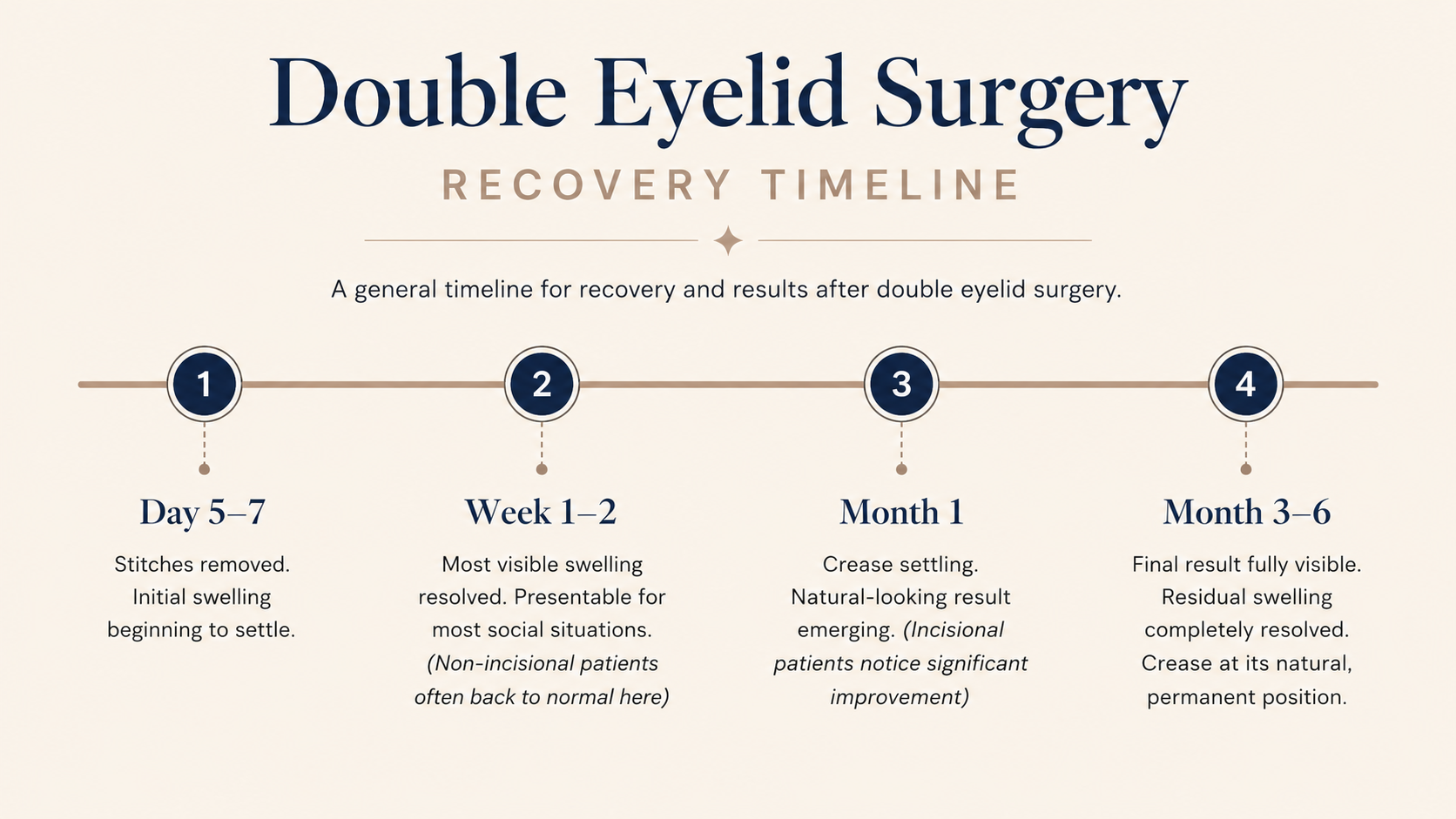
Recovery varies depending on the type and method:
| Non-Incisional | Partial Incisional | Full Incisional | |
|---|---|---|---|
| Stitch removal | 5–7 days | 5–7 days | 5–7 days |
| Return to normal activity | 5–7 days | 7–10 days | 7–14 days |
| Most swelling resolved | 1–2 weeks | 1–2 weeks | 2–4 weeks |
| Final result visible | 1–3 months | 3–6 months | 3–6 months |
Frequently Asked Questions
Q. Is double eyelid surgery painful?
A. The procedure is performed under local anaesthesia with sedation — you won't feel pain during surgery. Post-operatively, mild tightness and swelling are normal. Most patients find the discomfort very manageable and are surprised by how minor it is.
Q.How long do double eyelid results last?
A. Incisional methods (partial and full) produce permanent results. Non-incisional (burial method) results can last many years — but may soften in some patients over 5–10 years, particularly in those with more eyelid fat. A touch-up procedure is possible if needed.
Q. Will there be visible scarring?
A. Non-incisional methods leave no visible scarring. Incisional methods produce a fine scar line along the crease — which is hidden within the fold itself once healed. By 3–6 months post-surgery, the scar is not visible in normal circumstances.
Q. Can double eyelid surgery fix ptosis (drooping eyelid)
A. Mild ptosis is sometimes addressed during double eyelid surgery. Significant ptosis requires a separate ptosis correction procedure — which can be combined with double eyelid surgery in the same session. Your surgeon will assess this during consultation.
Q. Can I combine double eyelid surgery with other procedures?
A. Yes. Double eyelid surgery is frequently combined with epicanthoplasty (inner corner release) or canthoplasty (outer corner lengthening) for a more comprehensive eye-opening result. The right combination is determined at consultation based on your eye anatomy and goals.
Q. How do I know if I need non-incisional or incisional?
A. Your eyelid fat volume is the primary factor. Thin eyelids with minimal fat are good candidates for non-incisional. Thicker eyelids with more fat generally require incision for a result that holds. Your surgeon will assess this directly — it's not something that can be reliably determined from photos alone.
Coming to Korea for Double Eyelid Surgery?
Respect provides English consultations for international patients. The process is designed for people making this decision from abroad.
Step 1 — Online photo consultation Send close-up front-facing photos of your eyes — natural expression, open and closed. The surgical team assesses your eyelid anatomy and provides a preliminary recommendation before you travel.
Step 2 — Arrive in Seoul Airport pickup available. Accommodation near the clinic arranged.
Step 3 — In-person consultation Eyelid anatomy assessed directly. Crease type and method confirmed. You meet your surgeon before any decision is made.
Step 4 — Surgery Performed by the Respect surgical team. Typically 30–60 minutes depending on method.
Step 5 — Recovery in Seoul 5–7 days before flying recommended for non-incisional. 7–10 days for incisional.
Step 6 — Remote follow-up Post-operative care continues online after you return home.
The crease type is determined by your anatomy. The method is matched to your eyelid. The result is built around your face — not a template.
Know what you want. Know what to ask for. Then let's make it happen.
 Google Maps