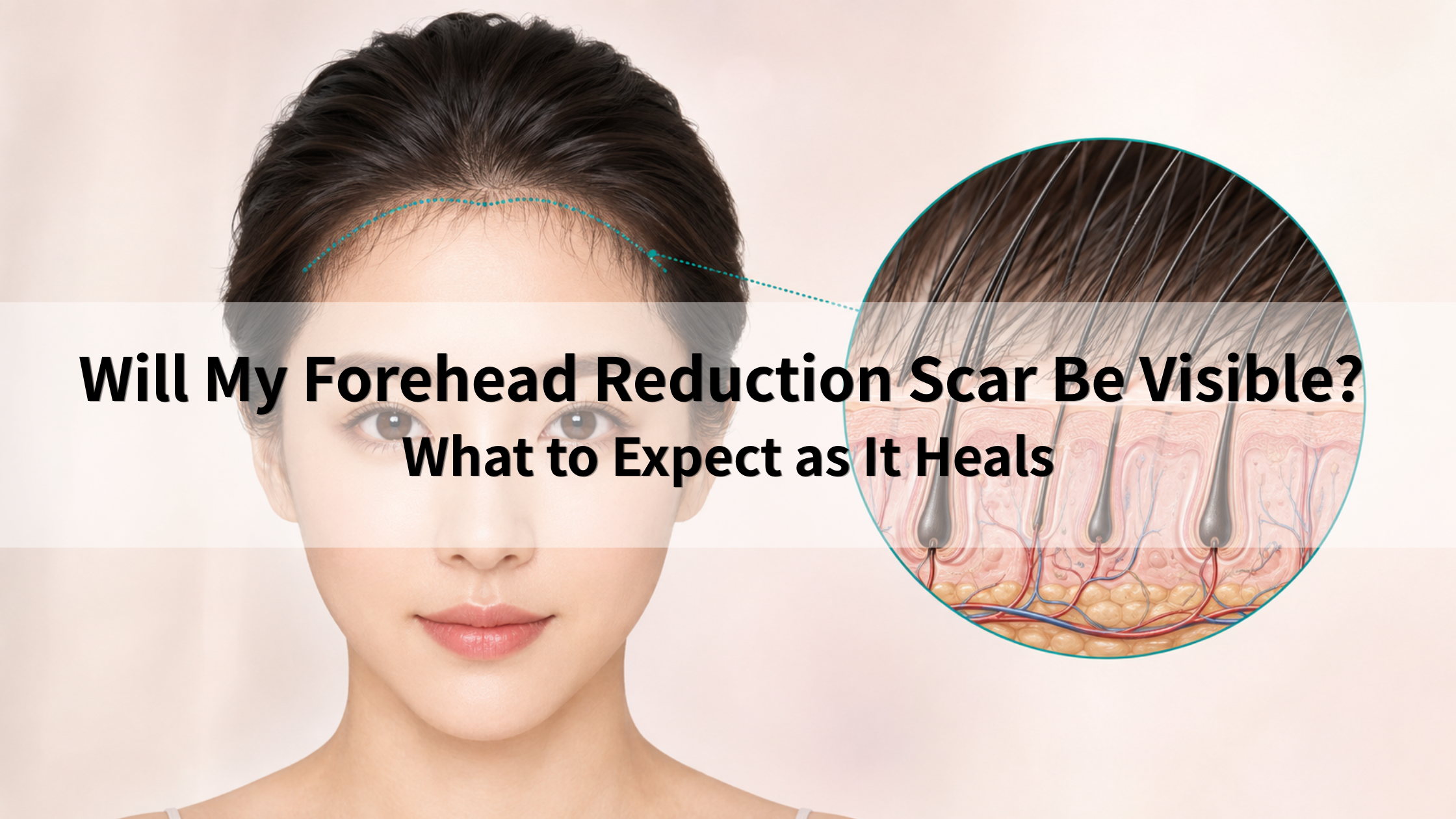
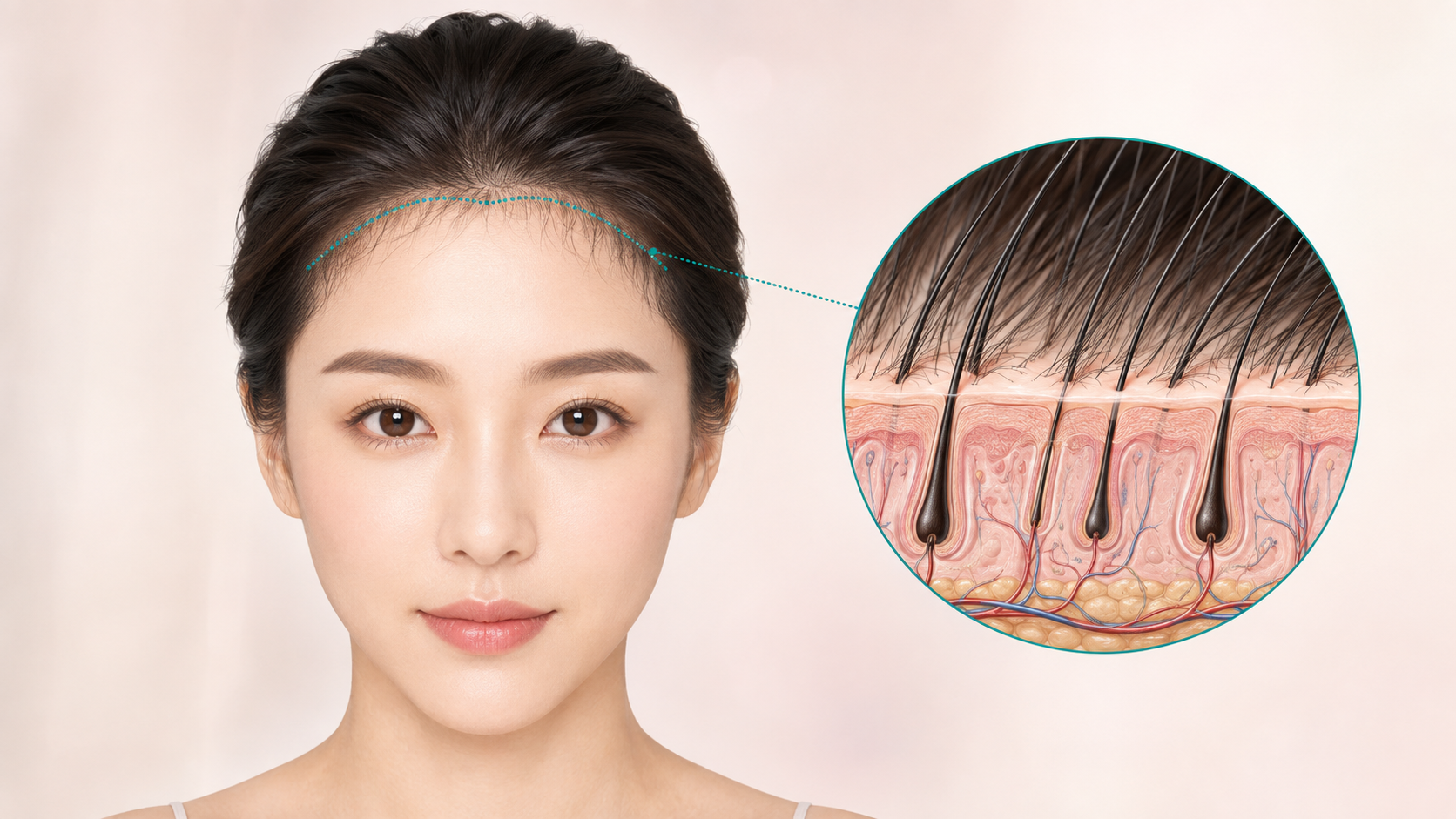
For most people considering forehead reduction (hairline lowering surgery), the thing that keeps them hesitating until the very end is the scar. The incision sits on the hairline, one of the most visible boundaries of the face. "Will I never be able to wear my hair back again?" "Will a line show forever?" These worries are the biggest psychological hurdle of this operation.
The short answer: the scar strategy of forehead reduction is designed not around "hiding" but around "filling with hair." Thanks to a beveled incision that preserves the hair follicles, hair grows on and in front of the scar line, so over time the scar itself blends into the hairline. This article walks through where the incision goes, how the beveled incision works, the course of the redness, and how hair camouflage actually operates, with diagrams at the center.
The Short Answer: Scar Essentials at a Glance
The sections below go through each in detail.
Where Does the Incision Go? The New Hairline Is the Incision Line
The forehead reduction incision runs along the hairline. Skin is removed on the forehead side and the scalp is advanced forward for closure, so the sutured line itself becomes the new hairline.
In other words, the scar's address is, from the start, the border with the hair. It is not a line left in the middle of bare skin, as on a cheek or under the nose; it is a line placed exactly where hair begins. That location is the single biggest reason a forehead reduction scar blends in over time, and the beveled incision described next is what makes the effect decisive.
The Follicle-Preserving Beveled Incision: Filling the Scar with Hair
The heart of this operation's scar strategy is the angle of the cut. Incise perpendicular to the skin, and the follicles along the line are severed, leaving a hairless line where nothing will ever grow.
At Respect Plastic Surgery, forehead reduction instead uses a beveled incision angled to preserve the hair follicles (per the official site). By cutting at an angle that follows the follicles' path rather than straight through the surface, the follicles survive beneath the incision line. After surgery, hair from those follicles grows up through the scar line, so the scar becomes not a hairless line but a line with hair growing in it. The scar sinks into the flow of the hairline. That is the idea: not hiding the scar, but filling it with hair.
Suturing and Tension: The Design That Keeps the Scar Fine
The scar's final state is decided not only by the incision angle but by how the closure and tension are managed. Respect Plastic Surgery uses fine triple-layer suturing that aligns the skin layer by layer (per the official site); supporting the tissue from the deep layers relieves the load on the surface skin, a design that keeps the scar line thin.
The other key is the fixation that holds the advanced scalp in place. The scalp permanently carries tension pulling it back toward its original position, and when that tension concentrates on the suture line, the scar widens. A design in which the fixation absorbs the tension, such as the 7-point, triple-layer fixation (per the official site), shields the surface of the suture line and works in the scar's favor. The fineness of the scar is the combined result of three linked elements: the incision, the suturing, and the fixation.
How the Scar Evolves: How Long Does the Redness Last?
Per the official site, the sutured area carries redness for about one month, then becomes less and less noticeable over 3 to 6 months. The redness in this period is a normal reaction caused by capillaries multiplying during healing; red does not mean failed.
What is distinctive about forehead reduction is the second process running in parallel: hair growth. The hair from the follicles preserved by the beveled incision lengthens on the same timeline as the redness fades, and begins to cover the scar line. A forehead reduction scar, in other words, moves toward inconspicuousness through two overlapping processes: the redness fading and the hair growing in. The right time for a final judgment is once both have progressed.
Hair Camouflage: How the Scar Hides in Daily Life
How the scar reads in everyday life is easiest to grasp as three layers. The first layer is the hair growing up through the scar itself, thanks to the beveled incision; with hair on the scar, the line is hard to identify even up close. The second layer is the hair flow of the new hairline; because the scar sits on the border with the hair, the hairline's natural shadow and texture dissolve the line. The third layer is styling; during recovery, bangs or hair worn down cover it effortlessly, and once the scar matures and the new hair grows out, styles that show the hairline come back into view.
The classic worry, "I'm getting a forehead reduction so I can go without bangs, but won't the scar chain me to bangs forever?", tends to dissolve once this structure is understood. The goal of the scar strategy is not to keep hiding behind bangs; it is a hairline buried in hair, one you can wear up without anyone noticing.
What Makes the Scar More Visible, and How to Prevent It
Even a scar built to blend can tip toward visibility under the wrong conditions. The main factors are four. First, a reduction amount exceeding the scalp's laxity, putting excess tension on the suture line (an over-ambitious lowering). Second, a constitution prone to hypertrophic scars or keloids. Third, behaviors that strain the hairline, such as tightly pulled hairstyles or early hair dye. Fourth, pigmentation from UV exposure and friction.
Prevention is each of these turned around: accept a reduction amount matched to your scalp's laxity; disclose your constitution and how your past wounds healed honestly at the consultation; live in a way that spares the hairline tension and irritation after surgery; and protect the area from the sun until the scar settles. The scar's final state is a joint work spanning not just the day of surgery but the design stage and the way you spend the recovery.
Frequently Asked Questions
Q1. Will my head need to be shaved for the surgery?
A. Forehead reduction is an incision along the hairline, so it is generally not an operation requiring broad shaving. The extent of preparation around the incision varies by clinic policy, so confirm at your consultation if it concerns you. Being able to cover the incision with your remaining hair from right after surgery is one of this operation's advantages.
Q2. Once the scar settles, can I wear a ponytail or slick my hair back?
A. Once the scar matures and the hair preserved by the beveled incision grows out, styles that expose the hairline become a realistic option. During recovery, however, tightly pulled styles put tension on the hairline and can widen the scar, so avoid them. The timing differs with the wound's condition, so bring these styles back in stages while confirming at examinations.
Q3. Can I have forehead reduction if I am prone to keloids?
A. A history of keloids or hypertrophic scars means a higher-than-usual risk of a visible scar, so the decision requires extra caution. Whether surgery is advisable depends on the severity and location of your history. Share photos of how your past wounds healed, have the risks and countermeasures explained thoroughly, and decide from there. Concealing your history and proceeding anyway is the highest-risk choice of all.
Conclusion: Not "Hiding" the Scar, but "Filling It with Hair"
The forehead reduction scar is placed on the hairline, the border with the hair itself; the follicle-preserving beveled incision lets hair grow through the scar; and fine suturing and fixation shield the suture line from tension. As the redness begins settling at about one month and fades to inconspicuous over 3 to 6 months, the hair's growth overlaps with it, and the scar sinks into the hairline (per the official site). No operation leaves zero scar, which is exactly why the right move is to understand the mechanism, then confirm your own constitution and the design of your reduction amount concretely at a consultation before deciding.
If you have concerns about scarring, feel free to reach out through Respect Plastic Surgery's official WhatsApp for an online consultation.
 Google Maps