

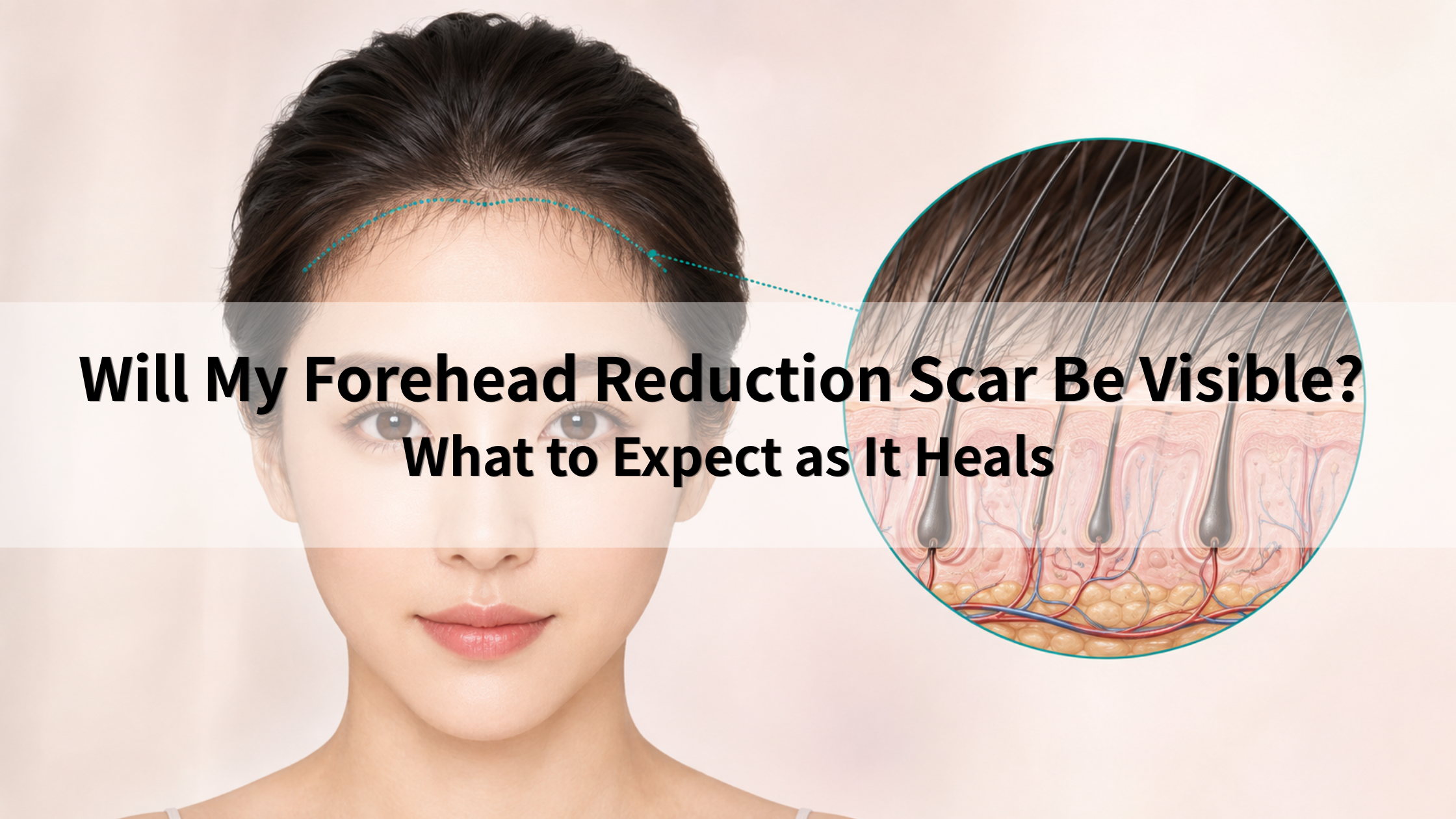
Once you start considering forehead reduction (hairline lowering surgery), the first thing everyone wants to know is a number: how many centimeters can it come down? The honest answer is that there is no one-size-fits-all figure. The amount a forehead reduction can lower the hairline is not set by your wish alone; it is determined, within a range that differs for every person, by three conditions: scalp laxity, the state of the hairline, and the fixation. This article explains how to think about the "how many centimeters" question, the three conditions that set the limit, and the risks of lowering too far, so you can set your expectations correctly before a consultation.
The Short Answer: The Three Conditions That Decide the Number
In other words, the design does not start from your desired number of centimeters; the reduction amount is worked backward from the range that these conditions of your scalp and hairline can safely and securely support. The sections below take them in order.
The Realistic Scale: Forehead Reduction Is a "Centimeter" Operation
Forehead reduction removes skin along the hairline and advances the scalp forward for closure, changing the vertical length of the forehead on a centimeter scale. Compared with millimeter-scale procedures such as a lip lift, the change is large, and because the forehead occupies such a large share of the face's impression, a shift in the ratio alone visibly transforms the whole face.
That said, "the more it comes down, the better" is not how it works. The larger the advance, the greater the tension on the scalp, and the greater the risks of scarring and relapse. Staying within the amount your conditions can support without strain is what ultimately produces the most beautiful result.
Condition 1: Scalp Laxity. Is There Anything to Work With?
The single strongest determinant of the reduction amount is scalp laxity, how much the scalp gives. In forehead reduction, the scalp is drawn forward and sutured by exactly the amount of skin removed. The distance the scalp can stretch and travel is therefore the raw material of the entire operation.
Scalp softness and mobility vary widely between individuals. The same requested amount can be a comfortable design on a mobile scalp and an excessive one on a tight scalp. Force the line down beyond the scalp's laxity, and the suture line sits under sustained heavy tension, which translates directly into a widening scar and a hairline that drifts back toward its original position (relapse). Laxity cannot be judged by self-check; it is evaluated at an examination by actually testing how the scalp moves. The answer to "how many centimeters" begins with that examination.
Condition 2: The Hairline's State. What the Hair and the Line Allow
The second condition is the hairline itself, with two points to assess.
The hair's condition. If hairline recession (AGA/FAGA or traction alopecia) is actively progressing, lowering the position now risks having the result undone by further recession later. In that case the question is not "how far" but "whether now is the time," and a hair diagnosis comes first. The incision is also designed to hide within the hairline's hair, so hair density and direction affect how well the scar conceals, and by extension, how ambitious the lowering can safely be.
The line's shape. With an M-shaped or squared hairline, the design question is not simply "lower everything by X centimeters" but a line design that includes shape correction. Because the amount of lowering then varies by zone, the plan sometimes cannot be expressed as a single number at all.
Condition 3: Fixation. Can the New Line Be Held?
The third condition is the one most often overlooked and yet decisive: fixation. The scalp permanently carries tension pulling it back toward its original position, so whether the lowered hairline stays where it was placed depends on how securely it is anchored. If the fixation loses to the tension, the hairline drifts backward (relapse) and the load concentrates on the suture line, widening the scar.
At Respect Plastic Surgery, forehead reduction uses 7-point, triple-layer fixation, a method that holds the scalp while minimizing the discomfort that conventional Endotine fixation devices used to cause (per the official site). The more solid the fixation design, the less tension reaches the surface of the suture line, which works in favor of both the scar and relapse prevention. Fixation, in other words, is not just one step of the technique; it is the very condition that expands how far the hairline can safely be brought down.
The Risks of Lowering Too Far: More Is Not Satisfaction
Push past what the three conditions allow, and only risk accumulates: a widening scar and relapse from heavy tension; a hairline so low it looks unnatural, making the forehead feel cramped; and a result that overshoots the facial-thirds ratio (the harmonious guideline being upper 0.9-1 : middle 1 : lower 0.8-0.9) and breaks the balance it was meant to fix.
A wide forehead is not solved by "the narrower, the better." It is solved when the hairline arrives at the position that harmonizes with the whole face. A lowering that blows far past the ideal ratio can become a new problem rather than an effect, and that is the single biggest trap of chasing the number alone.
Work Backward from "Where the Line Should Sit," Not "How Many Centimeters"
There is a more productive order than opening a consultation with "please lower it X centimeters." First, using the facial-thirds ratio, set the target: the hairline position that harmonizes with your face. Next, have the three conditions evaluated at an examination: scalp laxity, the hairline's state, and the fixation plan, to confirm whether that line can be reached safely. The actual reduction amount then falls out as the result.
Two people with the identical complaint of "my forehead is too big" will have different combinations of target line and conditions. The number is a result, not a starting point. That is the most accurate answer to "how many centimeters can forehead reduction go?"
Frequently Asked Questions
Q1. Will I know in advance how many centimeters can be lowered?
A. Generally yes, in range terms: after evaluating your scalp laxity, the state of your hairline's hair, and the fixation plan, the surgeon presents a comfortable reduction range and a target hairline for your face. Because scalp give has to be assessed by actually handling the scalp, an in-person examination gives you a far more accurate answer than a photo-only consultation.
Q2. What happens if I ask for the maximum possible lowering?
A. A design that uses up the full limit of your scalp's laxity raises the risks of a tension-widened scar, relapse, and an unnaturally low hairline. A trustworthy clinic will propose not the maximum but the amount that harmonizes with your facial ratio and can be fixed securely. In fact, be cautious of any consultation that accepts your requested number unconditionally.
Q3. If one operation is not enough, can it be lowered again later?
A. Depending on the scalp's condition, an additional reduction can sometimes be considered after an interval, and designs that combine reduction with hairline hair transplantation to reach the target line also exist. A second operation, however, carries considerations the first did not, such as the scar and the scalp's remaining mobility, so the most important step is aligning thoroughly on the target line and the reachable range at the first design stage.
Conclusion: The Number Is a Diagnosis, Not a Starting Point
How far a forehead reduction can narrow the forehead is decided not by your desired centimeters but by three conditions: scalp laxity, the state of the hairline, and the fixation. Precisely because this operation deals in centimeter-scale change, the road to satisfaction is not "lower it more" but "lower it to the harmonious line, by an amount that can be held securely," while overshooting buys only scarring, relapse, and unnaturalness. If you find yourself wondering how many centimeters are possible, start with the diagnosis that determines that number.
If you would like to know your own reduction range and target line, feel free to reach out through Respect Plastic Surgery's official WhatsApp for an online consultation.

 Google Maps