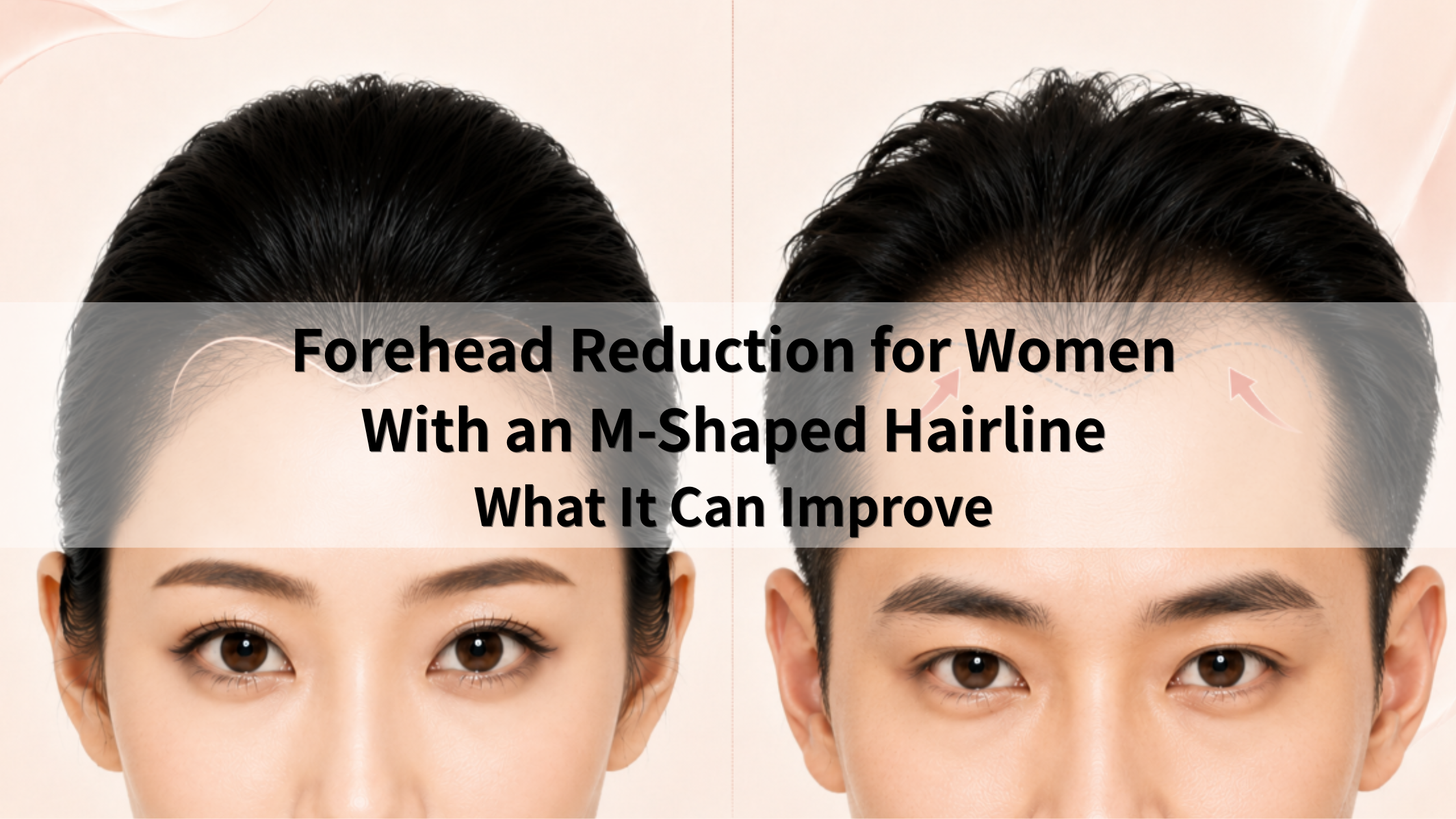
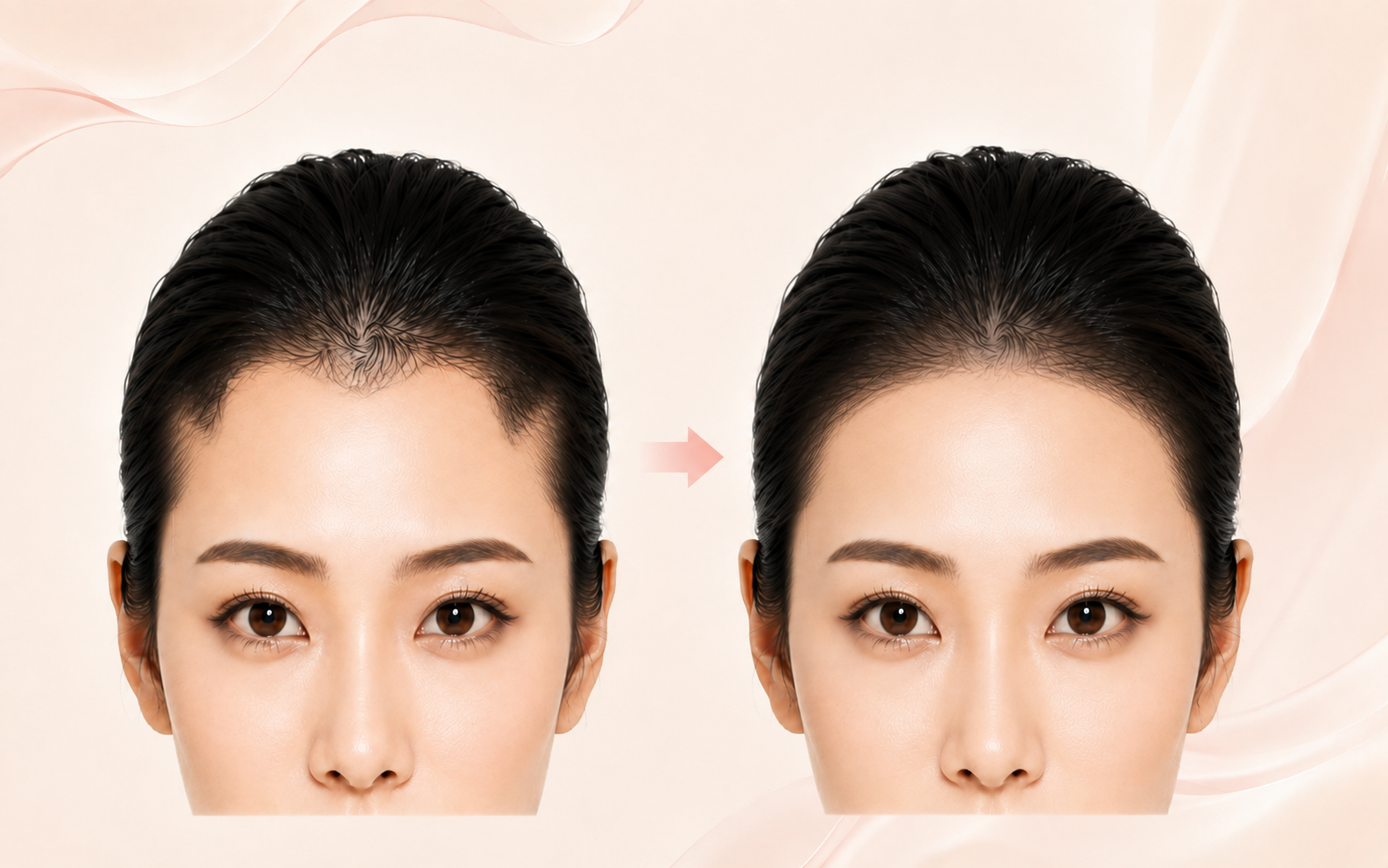
The temple-side M-notch that catches your eye when you pull your hair back or sweep it up. It hides under bangs, but leaves you without confidence the moment you want an updo or a swept-back fringe. This is a common concern.
The first thing to know: a woman's M-shaped hairline calls for different thinking than a man's. Search "M-shaped hairline" and the results center on male pattern hair loss (AGA) and transplantation, but for women the cause and the approach are different. This article explains, from the angle of women's forehead design, the features of a woman's M-shaped hairline and how to tell your type apart, along with what forehead reduction's incision-line design can improve and the tricks for filling the notches.
The Short Answer: Key Points on Women's M-Shaped Hairlines at a Glance
The basic framing: a woman's M-shape is not something to hide, but something to design. The sections below go into detail.
A Woman's M-Shape Differs from a Man's: Setting the Premise First
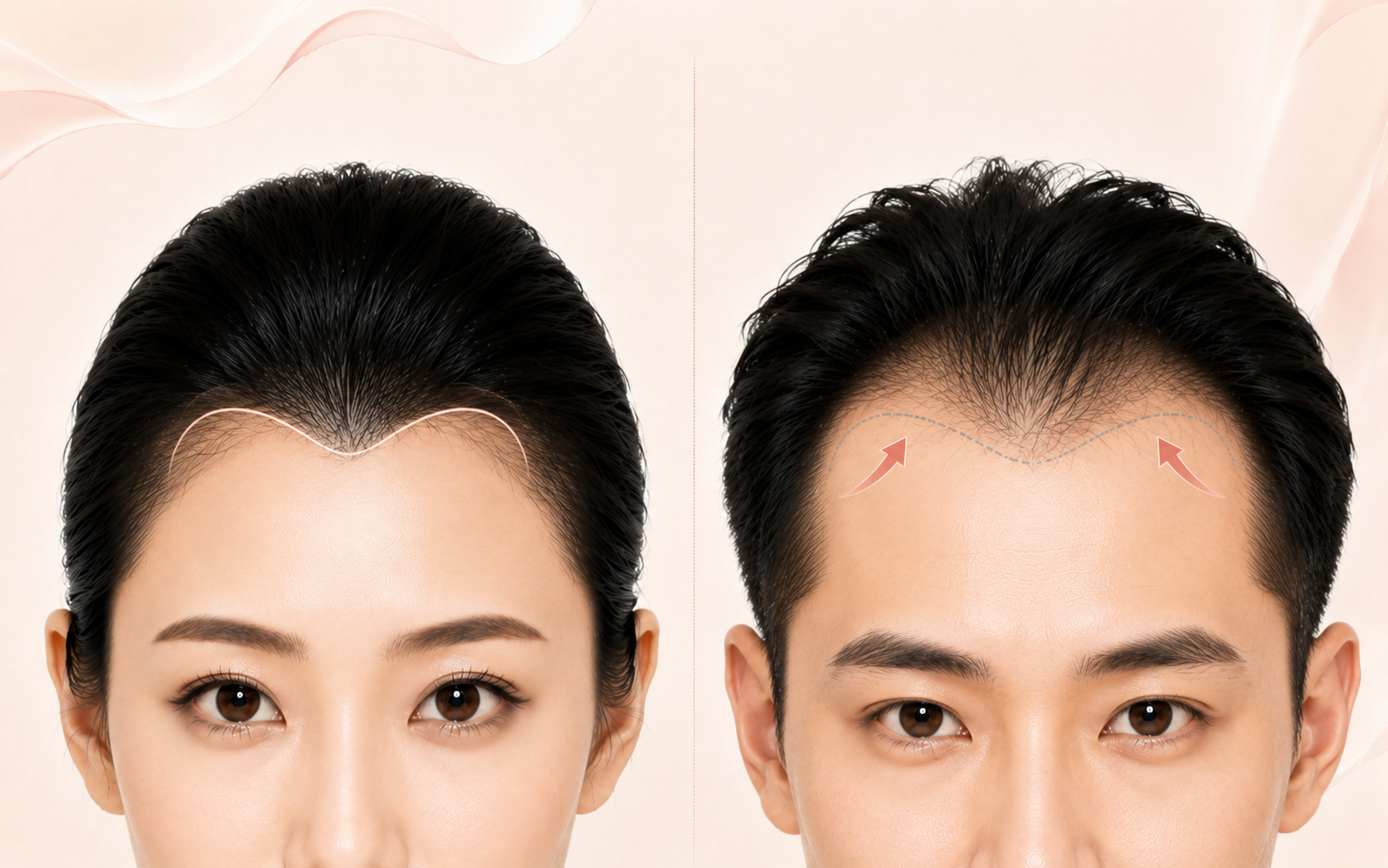
The word "M-shape" is the same, but the substance differs between women and men. A man's M-shape is usually progressive recession from the forehead and temples due to male pattern hair loss (AGA), a change in which the hair volume itself declines. A woman's M-shape, by contrast, is usually not progressive loss but the "shape" of the natural hairline: the center's volume is preserved while only the temple sides notch backward, a matter of shape, more often than not.
This distinction matters because it changes where the response starts. If progressive loss is the main cause, hair care (treatment to slow the progression) comes first. If the inborn shape is the main cause, shape correction through forehead reduction's incision-line design, tidying the hairline including the temple notches, becomes a strong option. That is why telling which type your M-shape is comes first.
Telling Your M-Shape Type Apart
A self-check guideline: has the temple notch "been this shape consistently for as long as you remember," or "changed or widened recently"? If it has been the same shape since childhood, it is likely the shape of your natural hairline, the type that forehead reduction design can tidy readily. If, on the other hand, you notice changes like "the notch is deeper than before" or "there seem to be more fine hairs and the hair feels thinner," recession from traction alopecia (the effect of tightly pulled styles like ponytails) or hormonal factors is possible, and an evaluation through hair care comes first.
This is only a guideline, though. An inborn shape and progressive change can coexist, so leave the accurate judgment to an examination. A forehead reduction consultation, too, will typically confirm this point first.
What Forehead Reduction Can Improve: Designing the Line, Notches Included
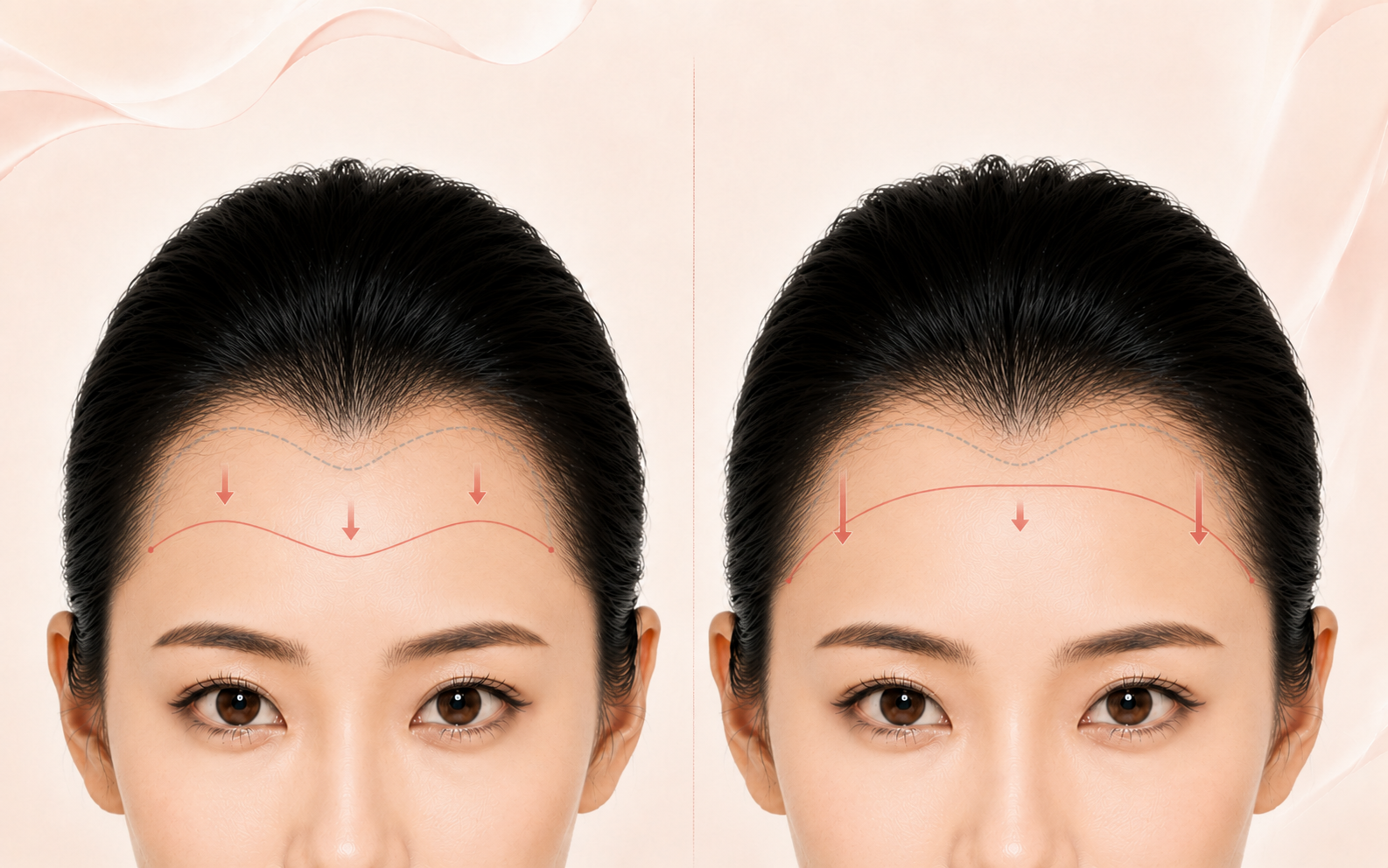
If your M-shape is mainly the inborn shape, forehead reduction becomes a design option. The key is that forehead reduction is an operation where the incision line is the new hairline. Use that property, and rather than lowering the whole forehead uniformly, you can draw the line to fill the temple-side notches specifically.
Concretely, this means keeping the center's lowering conservative while bringing the notched temple sides further forward, or drawing an arch that rounds off the corners of the M, a design that varies zone by zone. This softens the forehead's elongated impression and moves it toward a rounded hairline that stays inconspicuous even in updos. A design that merely shifts the whole line down in parallel tends to leave the M-notch even as the center comes down, so discussing concretely "how the temple-side shape will be designed" is essential.
Along the new line, a follicle-preserving beveled incision lets hair grow through the scar so the border blends in naturally (per the official site).
When the Notch Is Deep: The Transplant Combination Option
When the M-notch is deep and the incision-line design alone cannot reach the target curve, a design that combines hairline transplantation may be considered. Forehead reduction lowers and tidies the base line, then transplantation supplements the temple-side notches with hair to build a natural roundness, a division of labor.
Rather than committing to one method, the realistic approach is to judge at an examination whether forehead reduction, transplantation, or a combination fits, according to the notch's depth and the target line's shape. Notch depth varies widely from person to person, so "M-shape means transplant" or "M-shape means reduction" cannot be decided across the board.
From "Hiding" to "Designing": An Option Beyond Bangs
A woman's M-shaped hairline concern is often managed day to day by "hiding it with bangs." That is one method, but if you want to enjoy updos and swept-back fringes, or not be tied to a bang-based style, designing the shape of the hairline itself is an option.
What matters is the order. First, tell whether your M-shape is "the inborn shape" or "progressive" (if progressive, hair care first). If the inborn shape is the main cause, make how to fill and round the temple-side notches the theme of the design, and choose the fitting means among forehead reduction, transplantation, or a combination. Think in that order, and options beyond "keep hiding it" come into view.
Frequently Asked Questions
Q1. Will a woman's M-shape progress and thin out like a man's?
A. It cannot be said across the board. An M-shape that is the shape of your natural hairline is not, unlike progressive loss, something that thins with time. That said, women can experience recession from traction alopecia or hormonal factors. If you notice changes like "the notch is deeper than before," this may be progression rather than shape, so get evaluated through hair care first.
Q2. Can just the temple-side M be improved, partially?
A. Forehead reduction's incision-line design can be built to fill the temple-side notches more than the center. And when the notch is deep, combining hairline transplantation at that spot is an option. How far each means can address a partial concern depends on the notch's depth and state, so confirm at an examination.
Q3. Besides growing bangs to hide the M, are there other methods?
A. Methods that change the shape of the hairline itself include shape correction through forehead reduction's incision-line design, and hairline transplantation. If your M-shape is mainly the inborn shape, these can tidy the temple-side notches and aim for a state where you can enjoy updos without relying on bangs. If progressive recession is in the background, however, hair care comes first.
Conclusion: A Woman's M-Shape Can Be Designed as a "Shape Concern"
A woman's M-shaped hairline, unlike a man's progressive M-shape from AGA, is usually the individual character of the natural hairline's "shape." That is exactly why, once you have confirmed it is not progressive, it becomes not something to hide but something design can tidy. Because forehead reduction's incision line is the new hairline, it allows a line design that fills the temple-side notches specifically, and when the notch is deep, a transplant combination is also an option. Start by telling whether your M-shape is "shape" or "progressive." A path beyond hiding it with bangs comes into view from there.
If you would like to know your M-shape type and the right design direction, feel free to reach out through Respect Plastic Surgery's official WhatsApp for an online consultation.

 Google Maps