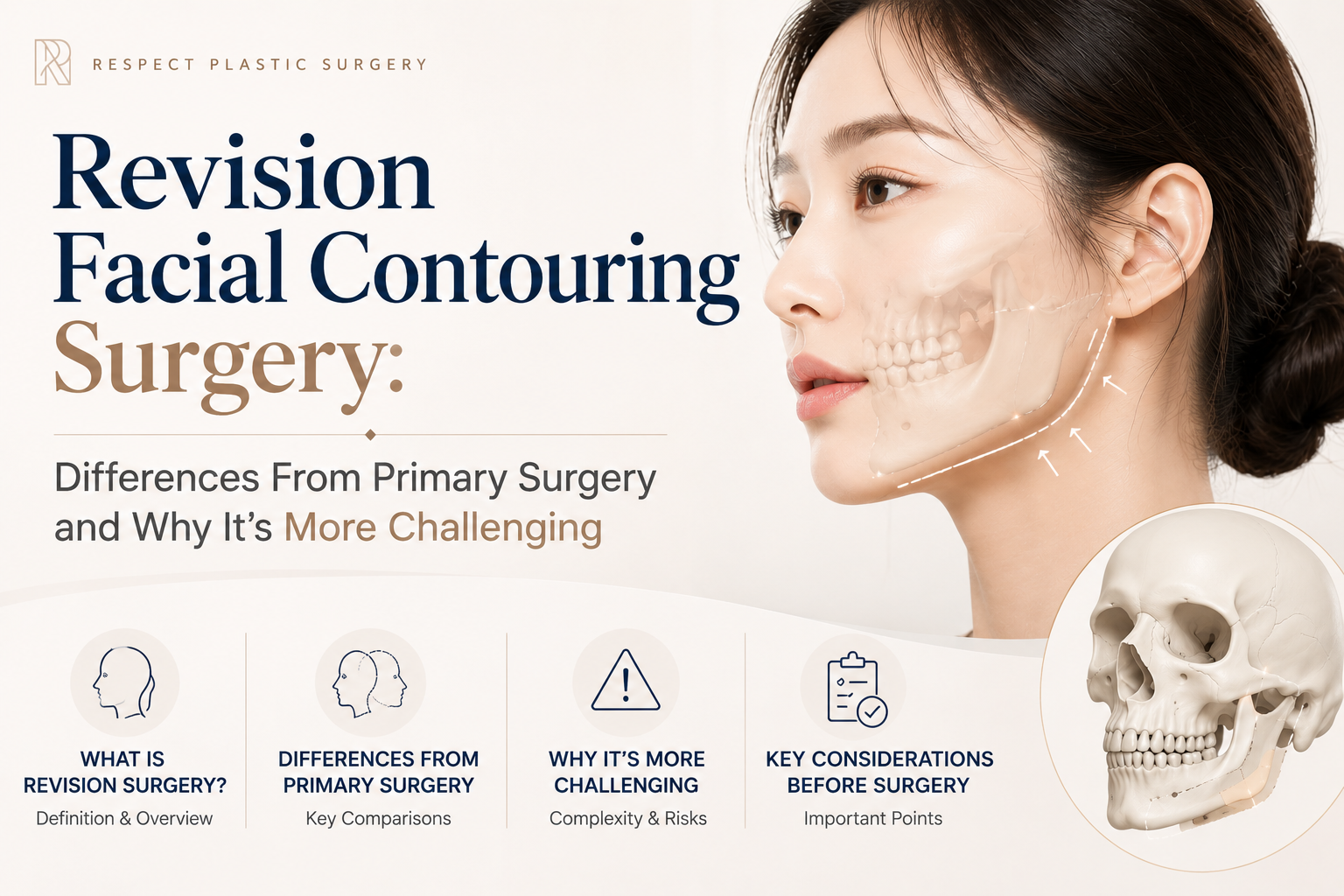
"I had facial contouring surgery, but I didn't see the change I expected."
"I'm left with asymmetry or an uneven contour."
"New concerns showed up as time went on."
Once you've already been through facial contouring surgery, considering a second procedure often feels like it takes even more courage than the first.
Revision facial contouring surgery addresses dissatisfaction or complications from a previous facial contouring procedure. However, revision surgery is considered one of the more technically complex areas of facial contouring — which is why choosing the right surgeon, timing, and approach matters even more than it did the first time.
This article covers why revision facial contouring surgery is more complex, how it differs from a first procedure, and which symptoms by treatment area may warrant considering revision surgery.
What Is Revision Facial Contouring Surgery?
Revision facial contouring surgery refers broadly to corrective procedures addressing the results of an initial facial contouring surgery — such as genioplasty, cheekbone reduction, or jaw reduction. These cases generally fall into two categories:
- Aesthetic dissatisfaction: The results were minimal, or the outcome didn't match what was expected.
- Complications: Issues such as asymmetry, a secondary angle (a new, unintended angle formed at the surgical site), or bone that didn't fully heal in the intended position.
In either case, accurately identifying what caused the original result and choosing a surgical approach suited to that specific issue is essential for a successful revision.
Why Revision Facial Contouring Surgery Is More Complex
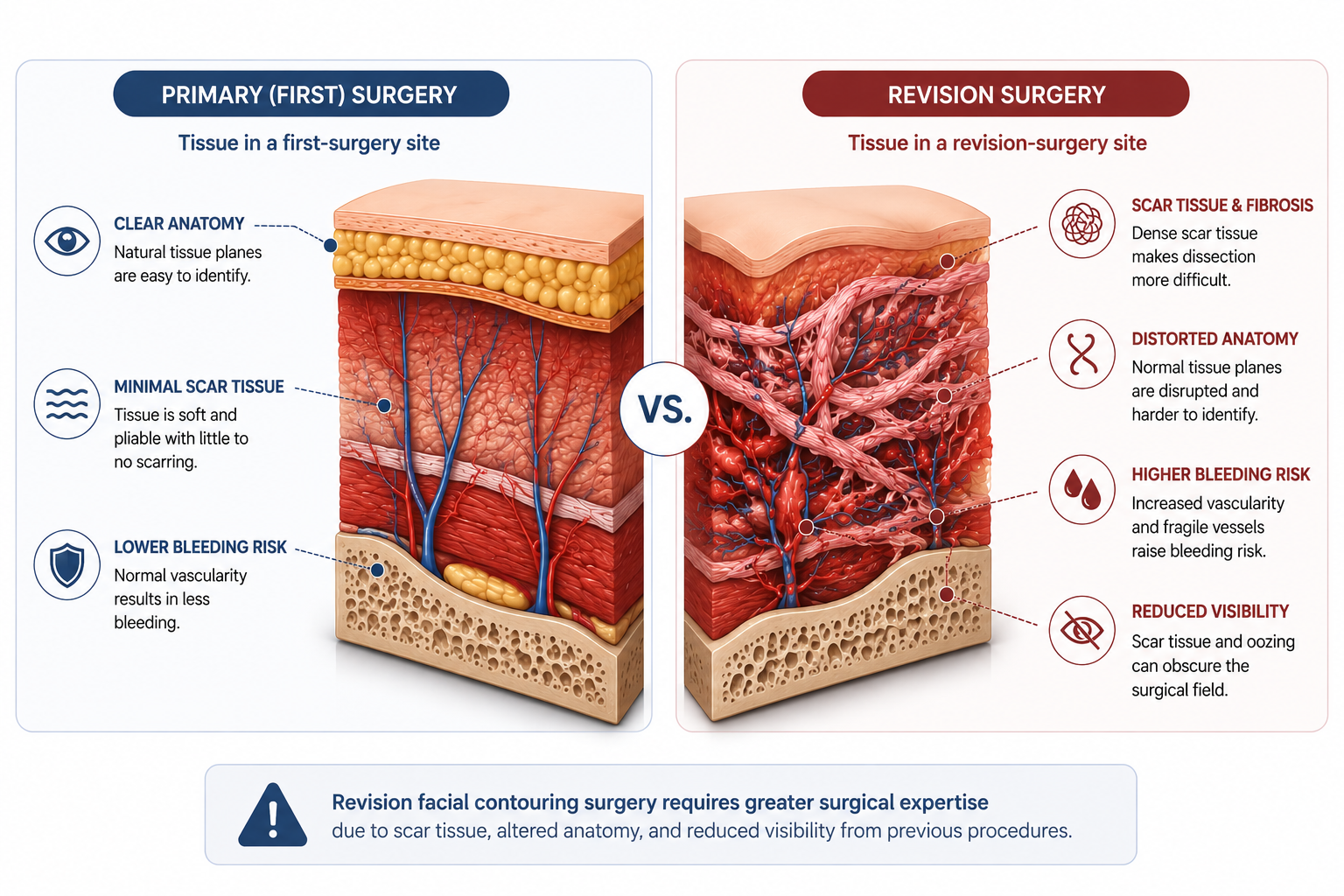
Revision surgery is considered one of the more technically demanding areas within facial contouring, for reasons related to both the surgical environment and the technical work involved:
- Higher likelihood of bleeding: Tissue in a previously operated area has already changed, which can make bleeding more likely than in a first surgery.
- Reduced visibility: Scar tissue and structural changes from the original surgery can limit visibility during the procedure, requiring precise technique in more constrained conditions.
- Higher technical difficulty: Tasks like reconstructing bone that was previously removed, or repositioning bone that healed incorrectly, each require careful judgment and advanced surgical technique.
Because of this, consulting with an experienced facial contouring surgeon about the appropriate timing and approach for revision surgery is essential. Pursuing revision surgery too soon, or without a clear understanding of what caused the original result, can risk further dissatisfaction.
How Revision Surgery Differs From a First Procedure
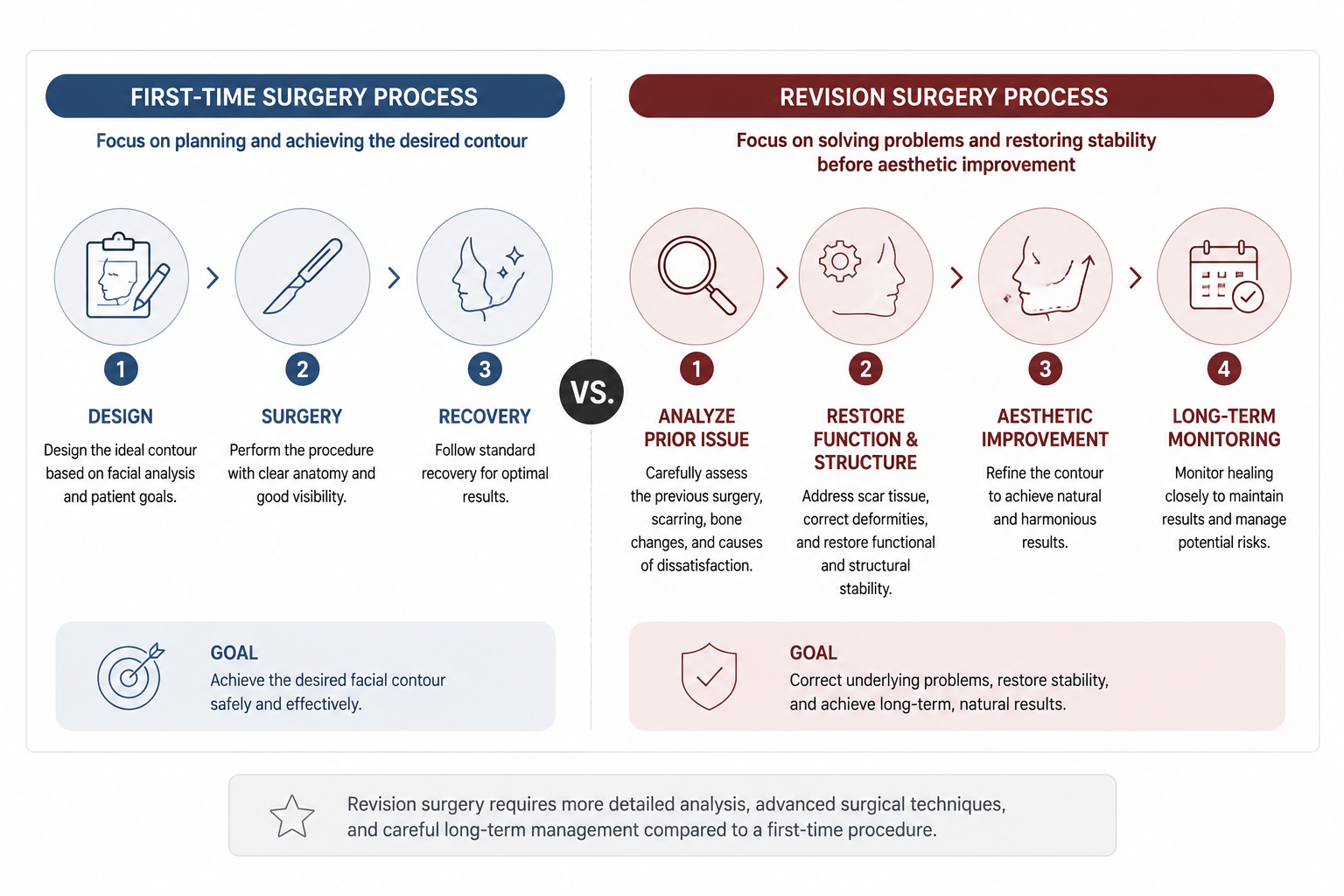
Even though both are called "facial contouring surgery," a first procedure and a revision procedure involve fundamentally different approaches:
| Factor | First Surgery | Revision Surgery |
|---|---|---|
| Starting point | Designing an ideal contour from scratch | Begins with identifying and analyzing issues from the prior surgery |
| Surgical goal | Aesthetic improvement | Addressing functional and aesthetic concerns together |
| Surgical conditions | Standard visibility and bleeding risk | Reduced visibility, higher likelihood of bleeding |
| Surgical work | Cutting, repositioning, and fixing bone | Often includes bone reconstruction or repositioning — more technically demanding |
| Follow-up | Standard post-surgical monitoring | Careful, ongoing monitoring until the surgical site is fully healed and stable |
If you're experiencing any of the following after a previous procedure, it may be worth discussing revision surgery with a surgeon.
Chin (genioplasty) revision
- Little to no improvement in a bulky-looking chin tip
- A chin tip that was left too pointed or too short
- A remaining secondary angle or uneven contour
- Worsened chin-area wrinkling following the original surgery
Cheekbone revision
- Increased asymmetry following cheekbone surgery
- A sunken or depressed groove at the cheekbone osteotomy site
- Recurrence due to fixation hardware shifting, or new sagging in the cheek area
- Inflammation, significant pain, or a clicking sound when chewing
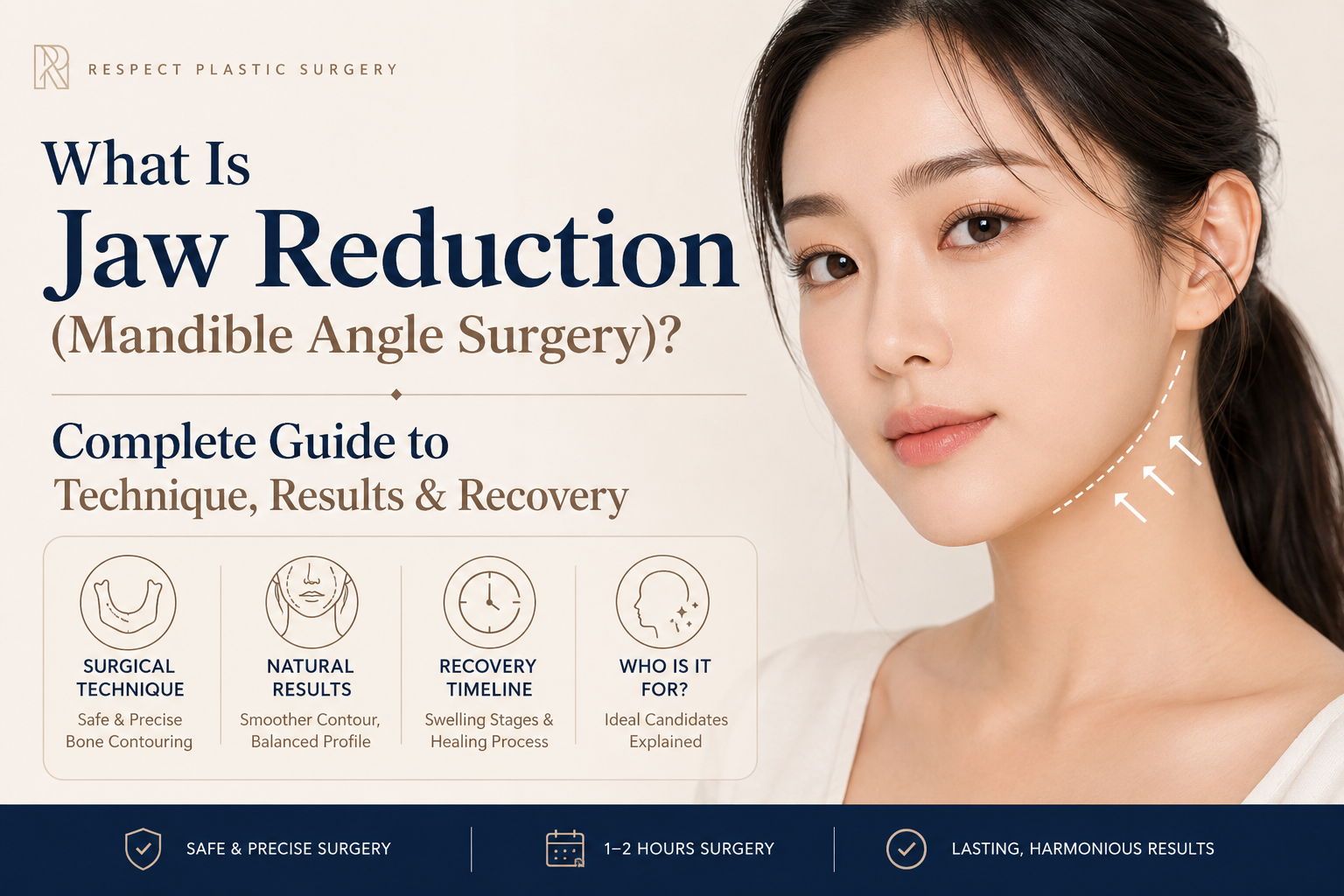
Jaw (mandible angle) revision
- Little to no visible effect from the original jaw surgery
- An overly narrow, unnatural jawline from excessive bone removal
- Significant unevenness or a new secondary angle
- Pronounced asymmetry resulting from the original jaw surgery
Respect's Approach to Revision Facial Contouring: 4 Key Elements
① Identifying and analyzing issues from the original surgery
The surgical team first works to accurately identify what went wrong with the original procedure, then plans a revision approach suited to overall facial balance.
② Restoring function alongside a natural appearance
Rather than focusing on appearance alone, the goal is to address functional concerns while working toward a natural-looking result.
③ Careful, ongoing monitoring through healing
Follow-up monitoring and care continue until the surgical site is fully healed and stable.
④ Performed by surgeons focused specifically on facial contouring
Facial contouring procedures are overseen from start to finish by a medical team focused specifically on this area of surgery.
Precise 3D CT Analysis
The outcome of a revision procedure depends heavily on the accuracy of the initial analysis. At Respect Plastic Surgery, 3D CT imaging is used to evaluate not just bone structure but also muscle, fat, and skin in three dimensions — helping the surgical team understand what happened during the original procedure before planning a revised surgical approach.
What Revision Surgery May Improve
- A smoother contour: Reducing unevenness or a secondary angle
- Improved symmetry: Working toward better facial balance
- A more defined jawline: Redesigning a contour that didn't meet expectations
- Both functional and aesthetic concerns: Addressing appearance alongside functional issues
Individual results vary based on anatomy, the condition of previously operated tissue, and healing. This content is for general education and is not a guarantee of outcome.
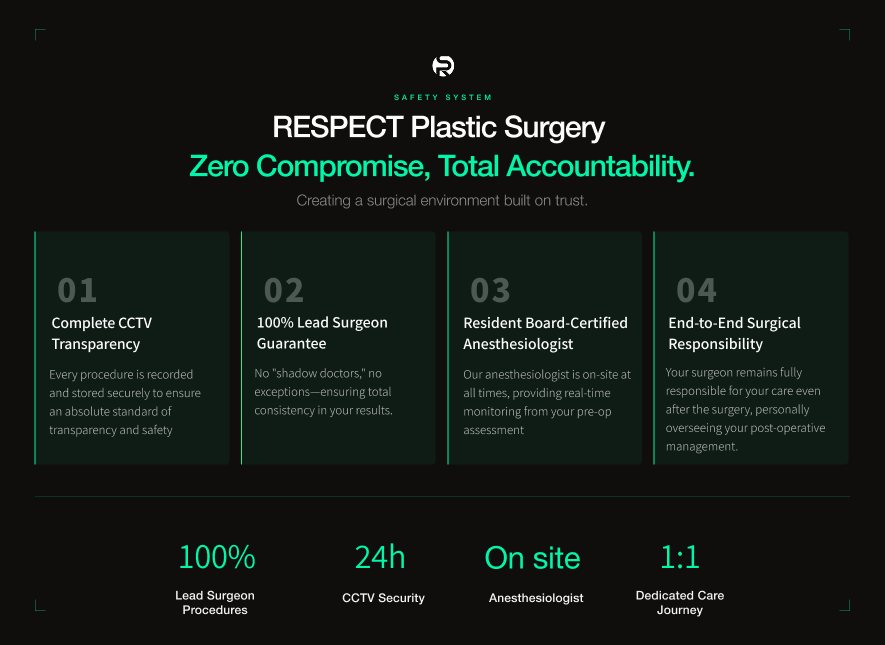
Respect's Safety System
Because revision procedures are more technically demanding, Respect Plastic Surgery maintains safety protocols and monitoring systems designed to help patients feel confident throughout a more complex procedure.
(Placeholder — replace with actual specifics, e.g., board-certified anesthesiologist-managed sedation and intraoperative monitoring, emergency response equipment and backup power systems.)
Frequently Asked Questions
Q: How soon after the first surgery can I have revision surgery?
A: The right timing for revision surgery depends on the original procedure and your current condition. Rather than deciding on your own, it's important to consult with an experienced facial contouring surgeon to determine appropriate timing.
Q: Can I get a consultation for revision surgery if my original procedure was performed at a different clinic?
A: Yes. Revision consultations at Respect Plastic Surgery begin with identifying and analyzing issues from your original procedure, regardless of where it was performed.
Q: Can revision surgery address functional symptoms, like clicking when I chew, and not just appearance?
A: Yes — revision surgery is generally planned to address both aesthetic and functional concerns together. Symptoms like inflammation, pain, or clicking when chewing are evaluated as part of the overall surgical plan.
Q: Can I be confident revision surgery will actually resolve my concerns?
A: The goal of a well-planned revision is for it to be the last one needed. That depends on accurately identifying the underlying cause, choosing a surgical approach suited to your specific symptoms, and consistent follow-up monitoring until the area is fully healed.
Summary: The Outcome of Revision Surgery Depends on Accurate Analysis
Revision facial contouring surgery is one of the more technically challenging areas of facial contouring, given the higher likelihood of bleeding, reduced visibility, and the complexity of reconstructing or repositioning bone. The biggest difference from a first procedure is that revision surgery begins with a thorough analysis of what happened during the original surgery — and that analysis is what shapes the outcome.
If you have concerns or dissatisfaction from a previous facial contouring procedure, Respect Plastic Surgery offers consultations that include 3D CT analysis to help evaluate appropriate timing and approach for revision surgery.
As with any surgical procedure, risks such as bleeding, infection, or inflammation are possible and vary by patient. This article is intended for general informational purposes only; any recommendation for a specific procedure is made following an in-person or virtual medical evaluation.
 Google Maps