"Lip lift gone wrong." "Lip lift regret." The more seriously someone is considering this operation, the more likely they are to end up typing exactly these searches. And that is the right instinct: going in without knowing what can go wrong is the shortest route to regret.
What matters is reading failure stories not to be frightened, but to understand them structurally. Most of what gets called a lip lift failure is not random bad luck; it can be traced back to the removal amount, the design, or the suitability judgment. Once you know the causes, you also know exactly what to verify at a consultation to prevent them. This article organizes the representative failure patterns, their causes, and what you can do before surgery to avoid them.
The Short Answer: The Five Failure Patterns at a Glance
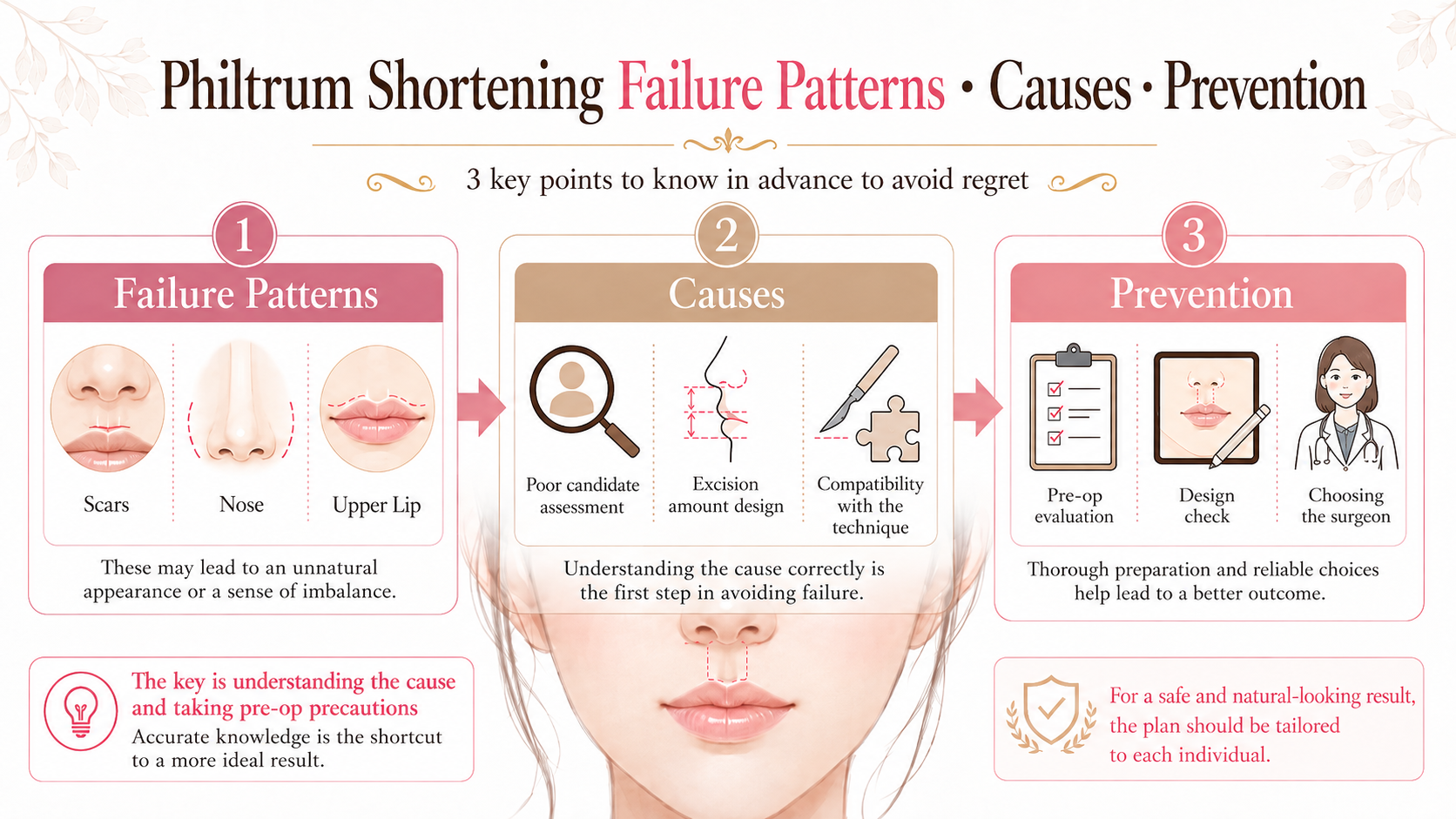
Most of these reduce to one of three things: cutting too much, cutting too little, or not looking at the right places. The sections below take each pattern's causes and prevention in turn.
First, Know That "Failure" Comes in Two Kinds
The word "failure" mixes two different things. One is an objective problem: scar trouble or clear distortion. The other is a gap between expectation and result: "it doesn't look the way I imagined."
The first is mainly a matter of surgical design, technique, skin type, and aftercare. The second is mainly a matter of insufficient alignment at the consultation. Both end in the regret of "it went wrong," but the prevention differs. This article covers both; as you read, notice which of the two you are actually worried about, and your countermeasures will become much clearer.
Pattern 1: A Visible Scar
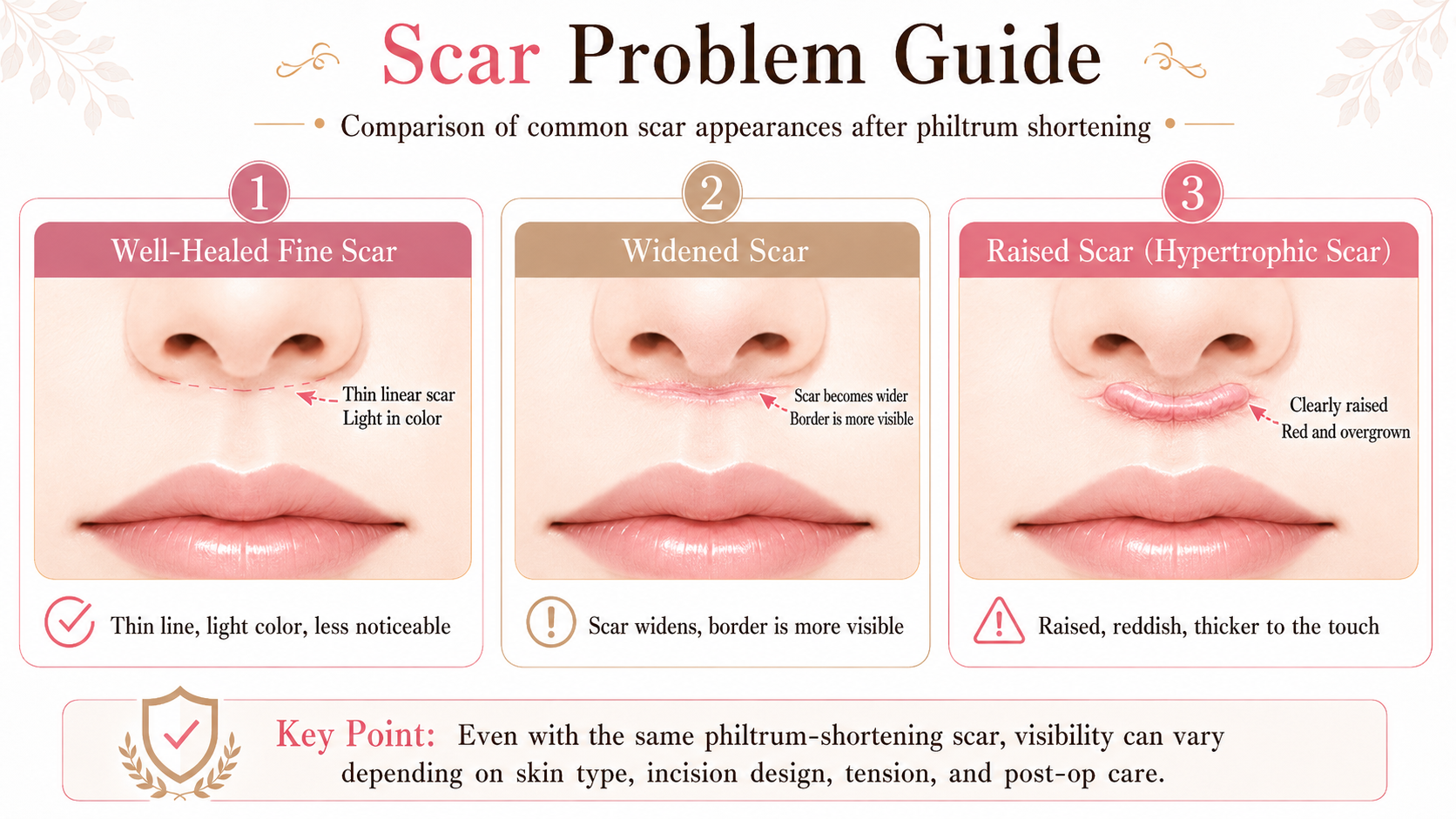
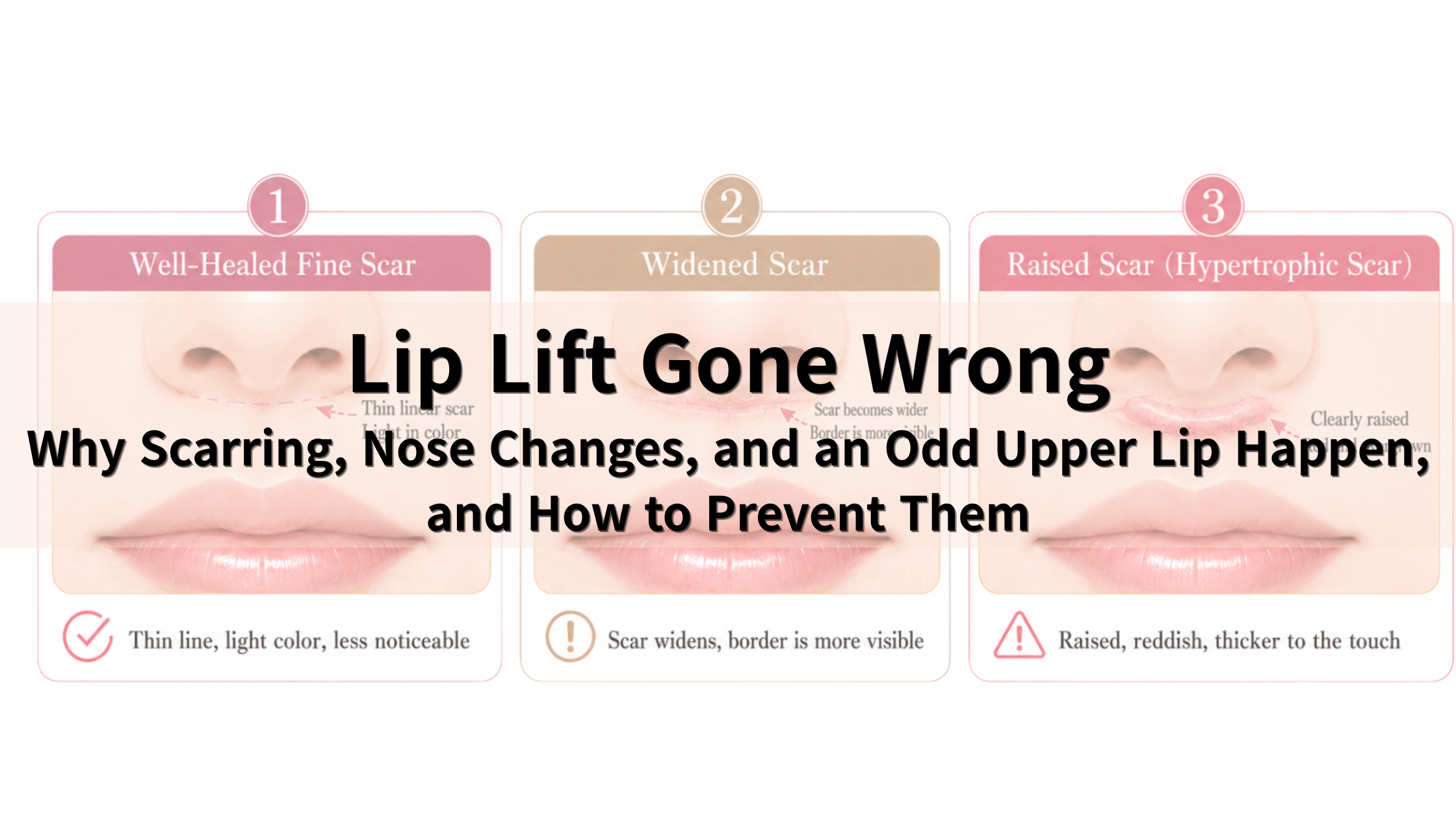
A scar under the nose that spreads into a visible white line, rises red and firm (hypertrophic scarring), or leaves brownish pigmentation: scar trouble is the most talked-about form of lip lift failure.
The main causes are three. First, a removal amount that exceeded the skin's slack, leaving the suture line under sustained tension; tension is the single biggest widener of scars. Second, a constitution prone to scarring (a history of hypertrophic scars or keloids). Third, aftercare problems: UV exposure, friction, smoking.
Prevention: an appropriately sized removal (tension management), honest disclosure of your skin type in advance, and disciplined care until the scar matures. A scar is decided not by "skill" alone but by the multiplication of design, constitution, and care.
Pattern 2: Nose Distortion, Nostrils, Alar Base, Columella
The force that lifts the philtrum skin upward transmits directly to the lower nose just above the incision. When too much is removed, or the design ignores the shape of the nose, the results are the classic distortions: nostrils that show from the front (appearing to open upward), an alar base pulled outward into a flare, a descended columellar base.
The main causes are over-resection and a one-size-fits-all design applied without evaluating the nose type (tip direction, nostril visibility, alar width). People whose tip is already upturned or whose nostrils already show are the high-risk type, where even a small change registers.
Prevention: choose a design that diagnoses the nose along with the philtrum. At your consultation, ask concretely: "With my nose type, will my nostrils or alar base be affected?" An explanation that cannot answer this concretely is itself useful information.
Pattern 3: An Odd Upper Lip and Mouth
An upper lip flipped so far it looks detached from the face, teeth and gums visible even at rest, an impression that the mouth will not quite close. Mouth-related failures are the most regret-prone pattern, because the person notices them in every conversation and every smile.
The main causes are over-resection and a suitability error. In a lip lift, the lifting of the upper lip and the increase in tooth show always occur as a pair, so someone whose front teeth already showed before surgery, or who had a gummy-smile tendency, and who was operated on by the yardstick of "philtrum length alone," lands in this pattern.
Prevention: get diagnosed not just on resting philtrum length but on tooth show at rest and on your smile, and, standing on the premise that removed skin cannot be put back, choose the conservative design whenever in doubt.
Pattern 4: A Weak Result, Less Change Than Expected
The mirror image of over-resection is the regret of "I had it done and can barely tell." The causes split in two.
The first: the philtrum looked long because of the nose all along (a drooping tip, an acute nasolabial angle). Removing philtrum skin does not touch the root of that impression, so the change feels underwhelming. This is less a surgical failure than a pre-op diagnostic failure. The second: a removal made too small out of caution. Conservative design is the right instinct, but drop below the threshold of visible change and satisfaction never arrives.
Prevention: a pre-op diagnosis that isolates which side the cause is on, and an explicit alignment between the change you expect and the amount to be removed. Confirm "how much will this amount actually change?" and proceed only once the answer satisfies you.
Pattern 5: Asymmetry
The pattern of a philtrum or lip line that reads as uneven. An important premise first: the two sides often deswell at different speeds, and most early asymmetry evens out with recovery. Nor was any face perfectly symmetric to begin with.
Structural asymmetry traces to design and suturing precision, and to pre-existing skeletal and muscular differences. As prevention, photograph and note your face's existing asymmetry before surgery and share it with your surgeon; you will then be able to judge post-op changes calmly. Save the verdict for after the swelling settles. Refusing to conclude from the early appearance prevents both needless anxiety and needless revision.
Preventing Failure: Five Things to Prepare Before Your Consultation
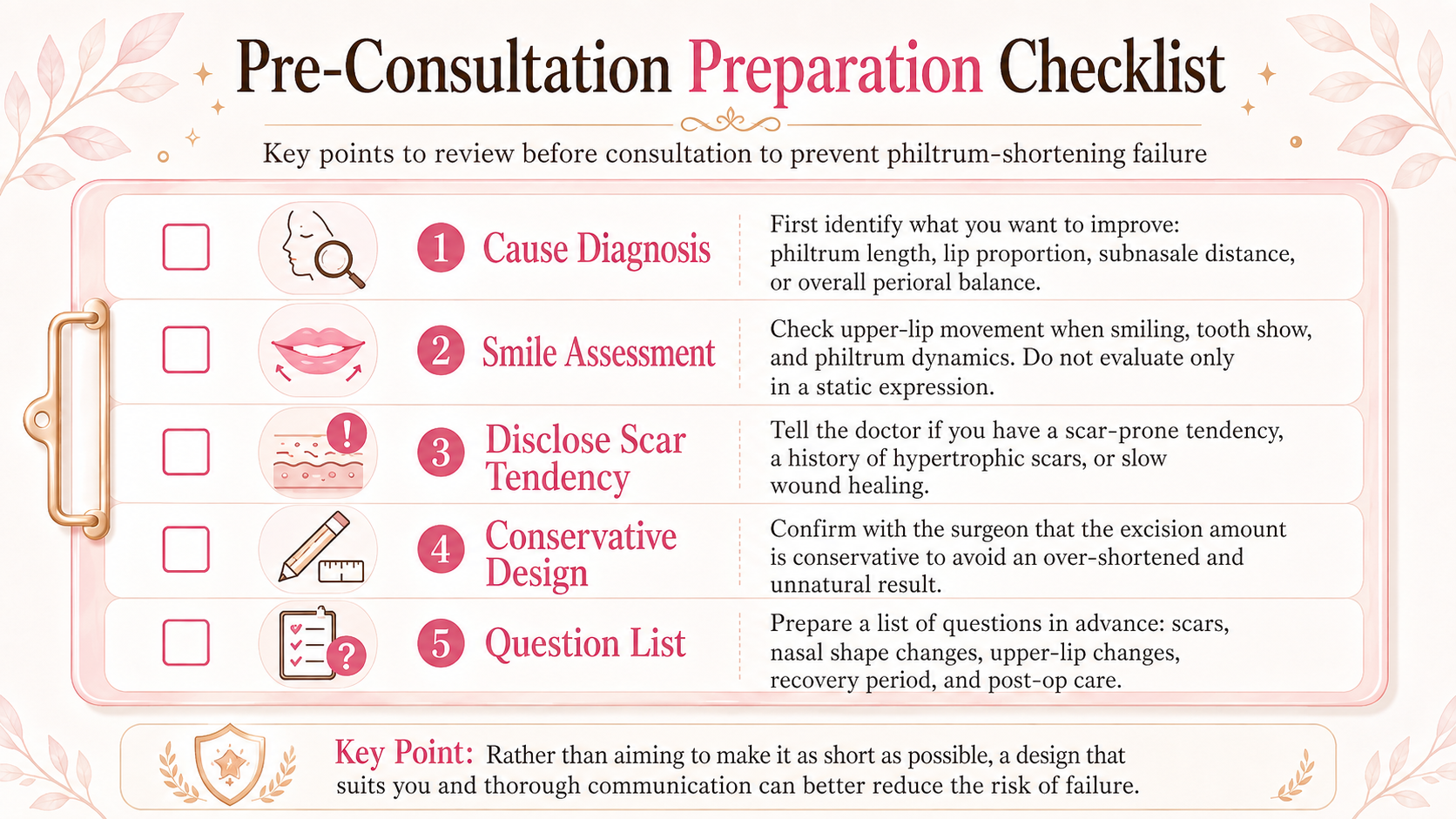
Flip the causes above and the prevention comes down to five moves.
1. Get the cause diagnosed. Have the surgeon isolate whether your philtrum looks long because of the skin or the nose. 2. Have your smile assessed. Not just your resting face: tooth show at rest and gum exposure when you smile. 3. Disclose your constitution and history honestly. A scar-prone constitution and how your past wounds healed must be shared. 4. Accept the conservative design. Choose the consultation that proposes the harmonious amount, not the maximum, and be wary of one that accepts your requested amount unconditionally. 5. Bring a question list. "With my nose type, what is my distortion risk?" "What is the basis for my removal amount?" "How do you guide scar care?" Whether concrete questions get concrete answers is the acid test for choosing a clinic.
If You Already Had Surgery and Fear It "Went Wrong"
Finally, for readers who have already had the operation and are worried. Know first that the early post-op appearance is not the finished result. Swelling pushes the lower nose outward and temporarily exaggerates asymmetry and lip flip; the scar's redness is a stage of healing, not its end state. Much of what feels like "it went wrong" changes character as time passes.
That said, if a clear oddness remains after the recovery has run its course, do not settle the question by self-judgment or internet research: have your operating surgeon evaluate the state first. Revision surgery exists as an option, but the rule is to decide only after the tissue has stabilized, and it is a more complex operation than the first. That is exactly why, before thinking about revision, the crucial step is distinguishing a genuinely structural problem from a stage of recovery. Do not carry the worry alone; start by putting it into words at an examination.
Frequently Asked Questions
Q1. What is the failure rate of a lip lift?
A. There is no single "X% failure rate" that can honestly be quoted. Most of what gets called failure arises from combinations of removal amount, design, suitability judgment, constitution, and aftercare, so the probability differs with each person's conditions and each design. Rather than hunting for a number, verifying at your consultation that the causes listed in this article are being managed in your case is what actually lowers your risk.
Q2. If it goes wrong, can it be revised?
A. Depending on the state, revision options exist. But because removed skin cannot be put back, revising an over-resection is especially difficult, and the operation is more complex than the original. Whether and how revision is possible requires an evaluation first, so start with an examination. And if you have not yet had surgery, put your energy into choosing a design that will not need revision, rather than into asking whether revision is possible.
Q3. What should I ask at a consultation to avoid failure?
A. Three questions are especially effective. "In my case, where does the long look of my philtrum come from?" (cause diagnosis). "Given my nose and my tooth show, how will you design the removal amount?" (the basis of the individual design). "How do you manage the risk of over-resection?" (the safety margin). Whether the answers are specific to your face or remain generalities tells you the quality of the diagnosis.
Conclusion: Failure Is Not Something to Fear, It Is Something to Prevent Structurally
Lip lift failures organize into five patterns, scarring, nose distortion, mouth oddness, a weak result, and asymmetry, and most of their causes trace back to the removal amount, the design, and the suitability judgment. In other words, failure is not luck; it is largely preventable through the quality of the pre-op diagnosis and design. If the negative search results have made you anxious, convert that anxiety directly into your consultation question list. The person who knows the failure stories best is the one best positioned to make the choice they will not regret.
If you would like to review the risks and the right design for your own case, feel free to reach out through Respect Plastic Surgery's official WhatsApp for an online consultation.

 Google Maps