You had rhinoplasty to raise the bridge of your nose, but your profile still doesn't look quite right — or your mouth still seems to protrude. If that's what led you to consider philtrum-nose surgery (rhinoplasty combined with nasolabial angle correction), the next thing on your mind is probably the swelling, the incision, and when you can get back to normal life.
Philtrum-nose surgery doesn't just reshape the nose — it also adjusts the nasolabial angle, the angle formed between the columella (the base of the nose) and the upper lip. Because this treats a wider area than rhinoplasty alone, it's natural to wonder how that affects downtime.
This article organizes the surgery time, anesthesia method, hospitalization and visit requirements, stitch-removal timing, and recovery period, based only on what the clinic's official information confirms. For details that official sources don't specify — such as the exact day swelling peaks — we've noted them as points to confirm directly with the clinic during your consultation. Cost and how to choose between surgical techniques are covered in separate articles.
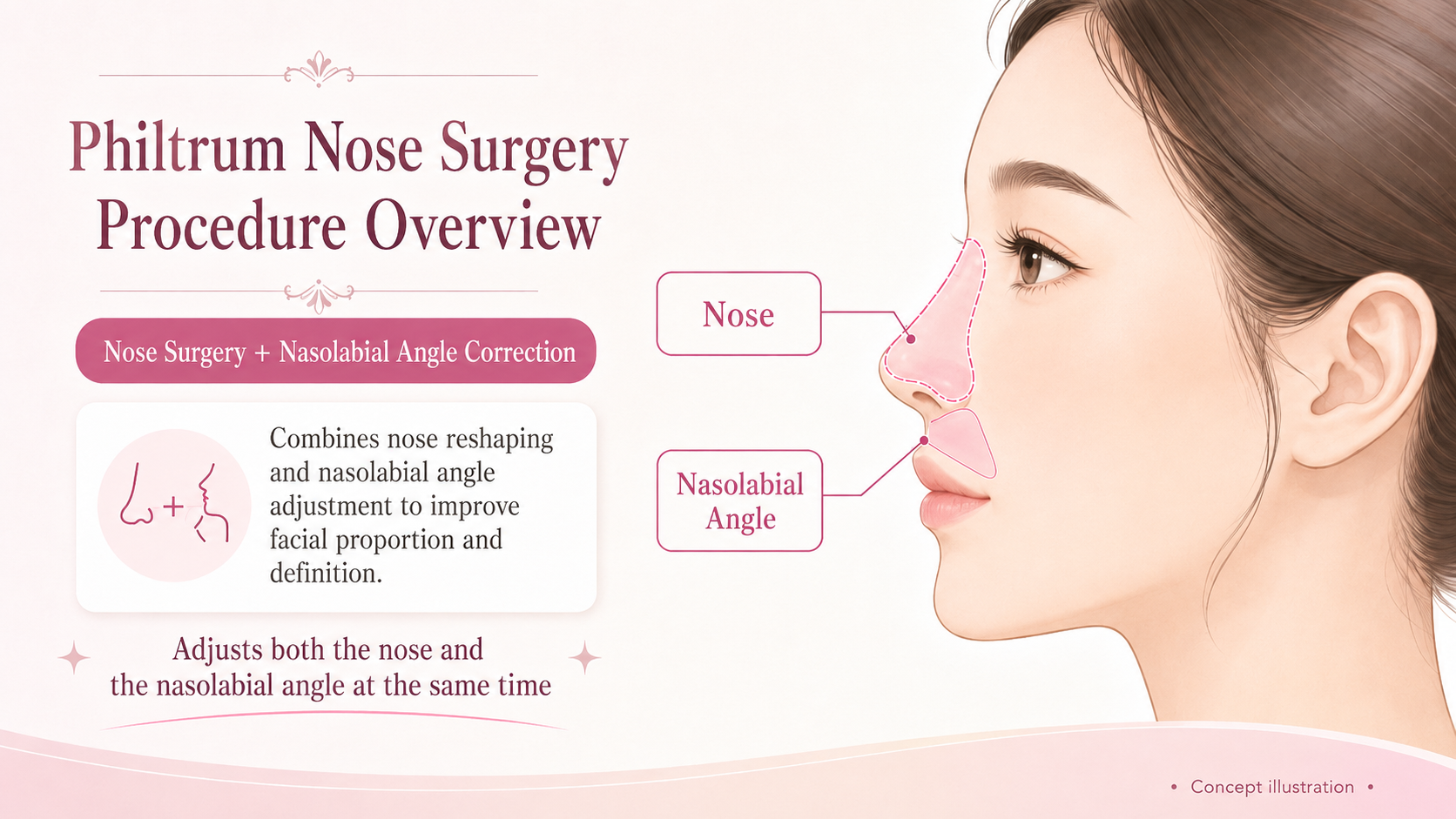
[Illustration 1] Overview of the philtrum-nose procedure
What Is Philtrum-Nose Surgery? Combining Rhinoplasty with Nasolabial Angle Correction
Philtrum-nose surgery reshapes the tip and bridge of the nose (rhinoplasty) while also correcting the nasolabial angle — the angle formed between the columella and the area beneath the nose — in a single procedure.
When the nasolabial angle is shallow (a smaller angle), the mouth can appear to protrude, or the nasal tip can look like it's drooping. Raising the nose alone doesn't change this angle, so the overall balance of the profile may not shift as much as expected. Philtrum-nose surgery addresses both the nose and the nasolabial angle together, aiming to reshape the entire profile line.
Separately, when philtrum reduction alone is performed, a larger reduction can cause the upper lip to appear raised or the nasal tip to appear to sag. Philtrum-nose surgery is also chosen to address this tendency by adjusting the nose shape at the same time.
Basic Facts About Philtrum-Nose Surgery: Surgery Time, Anesthesia, Hospitalization, and Visits
To picture the downtime concretely, here is the basic procedure information as confirmed on the clinic's official website:
Surgery time: approximately 1.5 to 2 hours
Anesthesia: sedation (twilight sleep) anesthesia
Hospitalization: not required
Clinic visits: 2 visits
Stitch removal: around 7 days after surgery
Recovery period: approximately 7 to 10 days
This is an outpatient procedure with no overnight stay, requiring two clinic visits in total. The recovery period is generally cited as 7 to 10 days, though this is a general guideline from official sources — actual healing varies by individual based on swelling and constitution.
[Illustration 2] Downtime timeline
Downtime Timeline: Swelling, Bruising, and Stitch Removal
Stitch Removal Timing
Stitches are typically removed around 7 days after surgery. Until then, keeping the incision clean and avoiding strong stimulation to the area are the basic precautions. For the exact visit date for stitch removal and specific precautions before and after, it's best to confirm directly with your doctor during consultation.
Recovery Period Guidelines
The recovery period is generally around 7 to 10 days. This is understood to be the period during which swelling and bruising settle down, to the point where the procedure becomes less noticeable to those around you. However, official sources don't specify exactly which day swelling peaks or how long it takes for bruising to fully disappear.
Generally speaking, procedures around the nose and mouth are often described as involving noticeable swelling in the first few days after surgery, which then gradually subsides. However, since the specific number of days for philtrum-nose surgery depends on the individual procedure and the patient's constitution, this article avoids stating a definitive timeline.
How This Differs from Rhinoplasty Alone
Rhinoplasty alone and philtrum-nose surgery differ in how much area is treated.
With rhinoplasty alone, the shape of the nasal tip and bridge changes, but the nasolabial angle itself remains the same — so the impression of a protruding mouth or a drooping nasal tip may remain. Philtrum-nose surgery addresses both the nose shape and the nasolabial angle at the same time, aiming to improve the overall profile balance.
That said, because a wider area is treated, there are more areas to be careful of during recovery. Which approach is right for you depends on the condition of your nose and nasolabial angle, as well as the degree of change you're hoping for — so it's important to confirm the right approach for your situation during consultation.
What to Keep in Mind When Returning to Daily Life
While the recovery period is generally 7 to 10 days, when you can return to work or school depends on your job, your schedule, and how comfortable you are with others noticing. Those with primarily desk-based work may be able to return relatively early, while those in client-facing roles sometimes wait until the swelling has settled further.
Official sources don't specify exact timing for resuming face-washing, showering, makeup, alcohol, smoking, or exercise. Because the condition of the incision and swelling varies significantly by individual, [to confirm with the clinic: when you can resume face-washing, showering, makeup, alcohol, and exercise] during your post-op check-up.
Risks and Precautions
As with any surgery, bleeding, infection, and inflammation are possible complications, with the degree varying by individual — this is noted as a precaution on the clinic's official site as well. Because philtrum-nose surgery involves both the nose and the nasolabial angle, the area of adjustment is broader than rhinoplasty alone, requiring more careful judgment to achieve balanced results.
Philtrum-nose surgery isn't necessarily the right choice for everyone. The appropriate technique depends on the condition of the nasolabial angle, the length of the philtrum, and the overall facial proportions. In some cases, adjusting the length of the philtrum alone may be enough; in others, reshaping the nose as well may be necessary. This is why a consultation to assess your individual condition is essential rather than deciding on your own.
Frequently Asked Questions
Q. What exactly is philtrum-nose surgery? A. It's a procedure that reshapes the nasal tip and bridge (rhinoplasty) while also correcting the nasolabial angle — the angle formed between the columella and the upper lip area — at the same time. The goal is to improve the balance of the entire profile, not just the height of the nose.
Q. How long is the downtime? A. The official recovery period guideline is 7 to 10 days. However, since swelling and healing vary by individual, it's best treated as a general guideline rather than a guarantee.
Q. When are the stitches removed? A. Around 7 days after surgery is the general guideline. Please confirm your specific visit date during consultation or post-op check-ups.
Q. Do I need to stay in the hospital or make multiple visits? A. Hospitalization is not required, and the total number of clinic visits is 2.
Q. How is this different from rhinoplasty alone? A. Rhinoplasty alone doesn't change the nasolabial angle, while philtrum-nose surgery adjusts both the nose shape and the nasolabial angle, allowing for an overall reassessment of profile balance. Because it treats a broader area, there are also more things to be mindful of during recovery — so it's worth confirming with your doctor whether this approach suits you.
Q. When does swelling peak? A. Official sources don't specify an exact day, so we can't state this definitively. We recommend asking your doctor directly during your consultation.
Summary
Philtrum-nose surgery combines rhinoplasty with nasolabial angle correction to improve the overall balance of the profile. According to official sources, the surgery takes approximately 1.5 to 2 hours, requires no hospitalization, involves 2 clinic visits, has stitch removal around 7 days after surgery, and a recovery period of approximately 7 to 10 days. That said, details closely tied to daily life — such as when swelling peaks or when you can resume face-washing, makeup, or exercise — vary significantly by individual and aren't something official information alone can determine.
What to Check Next
Even once you understand the general recovery timeline and who this surgery is suited for, deciding which technique fits your specific nose and nasolabial angle is something that's hard to determine without an in-person consultation involving photos and a look at your profile. It's worth confirming the specific timing for peak swelling and returning to daily activities directly during your consultation, so you can plan your recovery with more confidence.


 Google Maps