Why Is My Philtrum Long? Ideal Length, Ratios, and a Self-Check

"My philtrum feels long." "My mouth area somehow looks elongated and slack." Have you ever felt this way?
The length of the philtrum (the area around the vertical groove between the nose and the upper lip) has a large influence on the impression of the central face. However, there is more than one reason a philtrum can look long. It may come from innate bone structure, from aging—and in some cases, the actual cause is the nose.
This article sorts out the main reasons a philtrum is long or looks long, explains guideline figures for ideal length and ratios, and walks through a self-check you can do at home.
What Is the Philtrum, and Where Is It Measured?
In the narrow sense, the philtrum is the vertical groove between the nose and the upper lip. In an aesthetic context, however, "philtrum length" generally refers to the distance from the base of the nose (the root of the columella) to the peaks of the upper lip (the Cupid's bow).
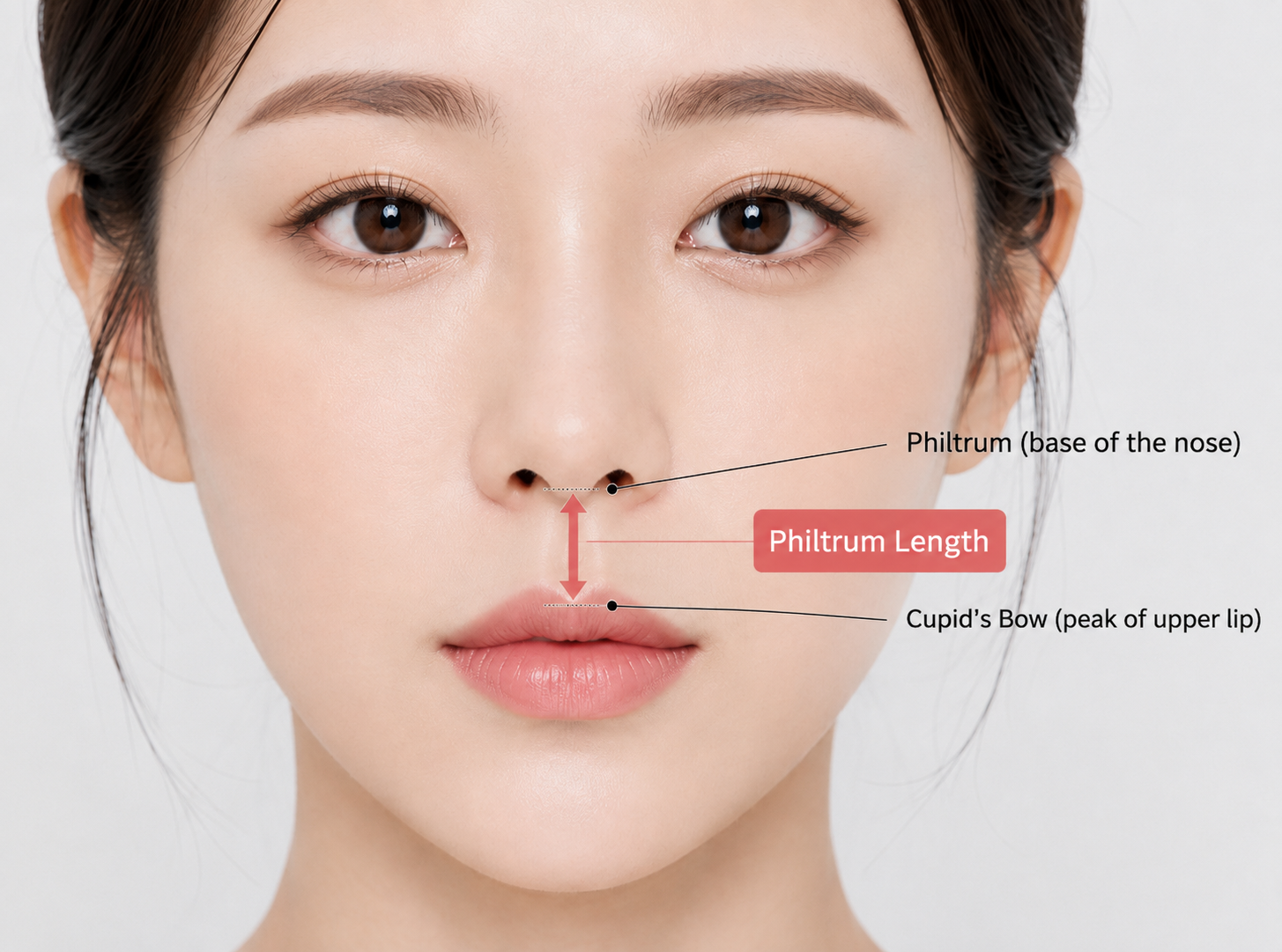
When this distance is long, "empty space" appears between the nose and mouth, which tends to make the lower half of the face look elongated and slack, and can create a long-faced or aged impression. Conversely, when it is moderately short, the mouth area looks defined, youthful, and well balanced.
Four Reasons a Philtrum Is Long or Looks Long
The reasons a philtrum looks long can be broadly divided into the following four.
1. Sagging Skin and Tissue Due to Aging
With age, the skin and muscles around the upper lip gradually lose their firmness and stretch downward under gravity. As a result, the philtrum becomes longer than in youth, and the upper lip can appear thinner, as if rolled inward. If you feel that "my philtrum seems longer than it used to be," this age-related change is often involved.
2. Innate Bone Structure and the Shape of the Upper Jaw
People whose upper jaw (midface) is structurally long in the vertical direction tend to have a longer distance from the nose to the mouth. In this case, the length comes from bone structure rather than sagging skin, so even young people may be bothered by the length of their philtrum.
3. A Drooping Nasal Tip / the Nasolabial Angle (Cases Where It Merely "Looks" Long)
This is the pattern that is most easily overlooked. When the nasal tip droops downward, or when the angle formed by the columella and the upper lip (the nasolabial angle) is sharp and closed, the tip appears to cover the upper part of the philtrum, making the philtrum look longer than it actually is.
In this case, the philtrum skin itself is not long, so approaching the problem from the nose side—rather than the philtrum side—can be the fundamental solution.
4. A Thin Upper Lip / Lack of Volume
When the upper lip is thin or lacks volume, the "empty space" between the nose and the lips looks relatively wide, creating the impression of a long philtrum. The same phenomenon occurs when lip volume decreases with age
Guidelines for Ideal Philtrum Length and Ratios
There is no absolute standard such as "X centimeters is long," but there are commonly used guidelines for assessing balance.
Nose-to-chin ratio: when the ratio of "base of the nose to the upper lip (center of the mouth)" versus "lower lip to the tip of the chin" is roughly 1:2, the balance is generally considered good. The larger the philtrum-side share, the more elongated and slack the face tends to look.
Guideline philtrum length: for adults, roughly 1.1–1.5 cm is often cited as the average range; noticeably exceeding this tends to read as "on the long side."
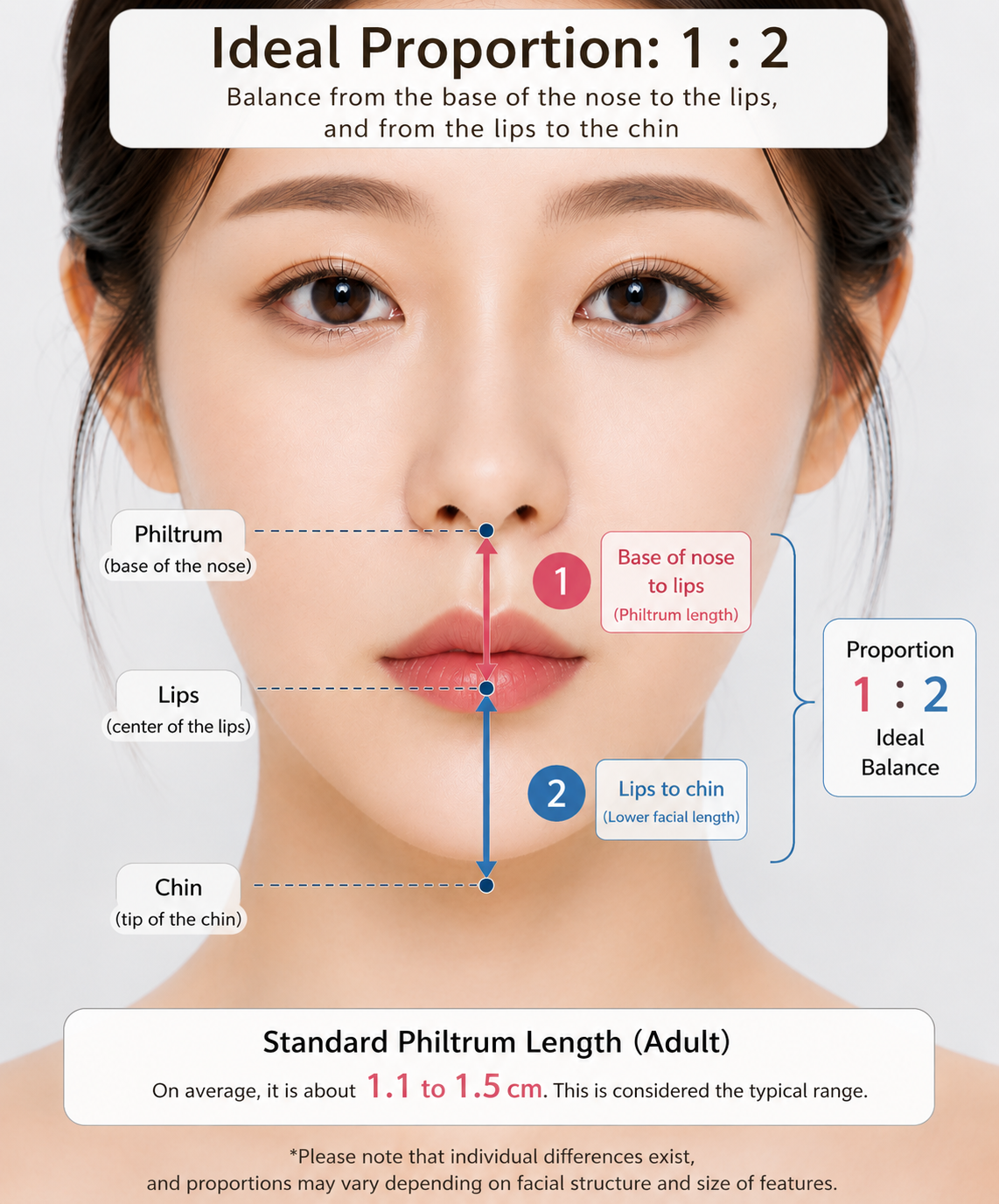
※ These are only general guidelines. The ideal balance varies by individual—bone structure, sex, and overall facial harmony all matter—and "matching the numbers" does not equal beauty.
A Philtrum Self-Check You Can Do at Home
With a mirror and a ruler (or tape measure), you can check in three simple steps.
Measure the length: facing forward, measure the distance from the base of the nose (root of the columella) to the peaks of the upper lip. If it noticeably exceeds 1.5 cm, it may be "on the long side."
Look at the ratio: measure "base of the nose to the center of the mouth" and "lower lip to the tip of the chin," and check whether the ratio deviates greatly from 1:2.
Check the nose in profile: turn sideways and see whether the nasal tip points downward, and whether the angle between the columella and the upper lip (the nasolabial angle) looks cramped and closed. If this applies, the cause may be the nose rather than the philtrum itself.
A self-check is only a rough guide. Accurately determining whether the cause of a long-looking philtrum lies on the philtrum side or the nose side requires analysis through a physician's consultation.
Improvement Approaches by Cause
The appropriate approach changes depending on the cause.
When the philtrum skin itself is long due to sagging or bone structure → philtrum reduction (lip lift), which excises skin below the nose to physically shorten the philtrum, becomes an option.
When it "looks" long due to a drooping tip or a sharp nasolabial angle → the Philtrum-Nose concept—designing the bridge, tip, and nasolabial angle together and making the philtrum look shorter by shaping the nose—may be the better fit.
When a thin upper lip is the main cause → approaches that restore lip volume may also be considered.
Multiple causes often overlap, so in practice the optimal combination is designed after checking the balance of the philtrum, the nose, and the whole face in a consultation.
Summary
The reasons a philtrum looks long fall into four broad categories: age-related sagging, bone structure, the nose (drooping tip / nasolabial angle), and a thin upper lip.
The balance guideline is nose-to-mouth : mouth-to-chin at roughly 1:2; a philtrum length of about 1.1–1.5 cm is often cited as the average range.
With a mirror and a ruler, you can self-check three points: length, ratio, and the profile (nose).
If the cause is on the philtrum side, philtrum reduction; if on the nose side, Philtrum-Nose—the best approach changes with the cause.
The reasons a philtrum looks long fall into four broad categories: age-related sagging, bone structure, the nose (drooping tip / nasolabial angle), and a thin upper lip.
The balance guideline is nose-to-mouth : mouth-to-chin at roughly 1:2; a philtrum length of about 1.1–1.5 cm is often cited as the average range.
With a mirror and a ruler, you can self-check three points: length, ratio, and the profile (nose).
If the cause is on the philtrum side, philtrum reduction; if on the nose side, Philtrum-Nose—the best approach changes with the cause.
If the length of your philtrum bothers you, the first step is knowing which cause type applies to you. Accurate assessment requires analysis in a consultation, so if you are concerned, feel free to get in touch.

 Google Maps