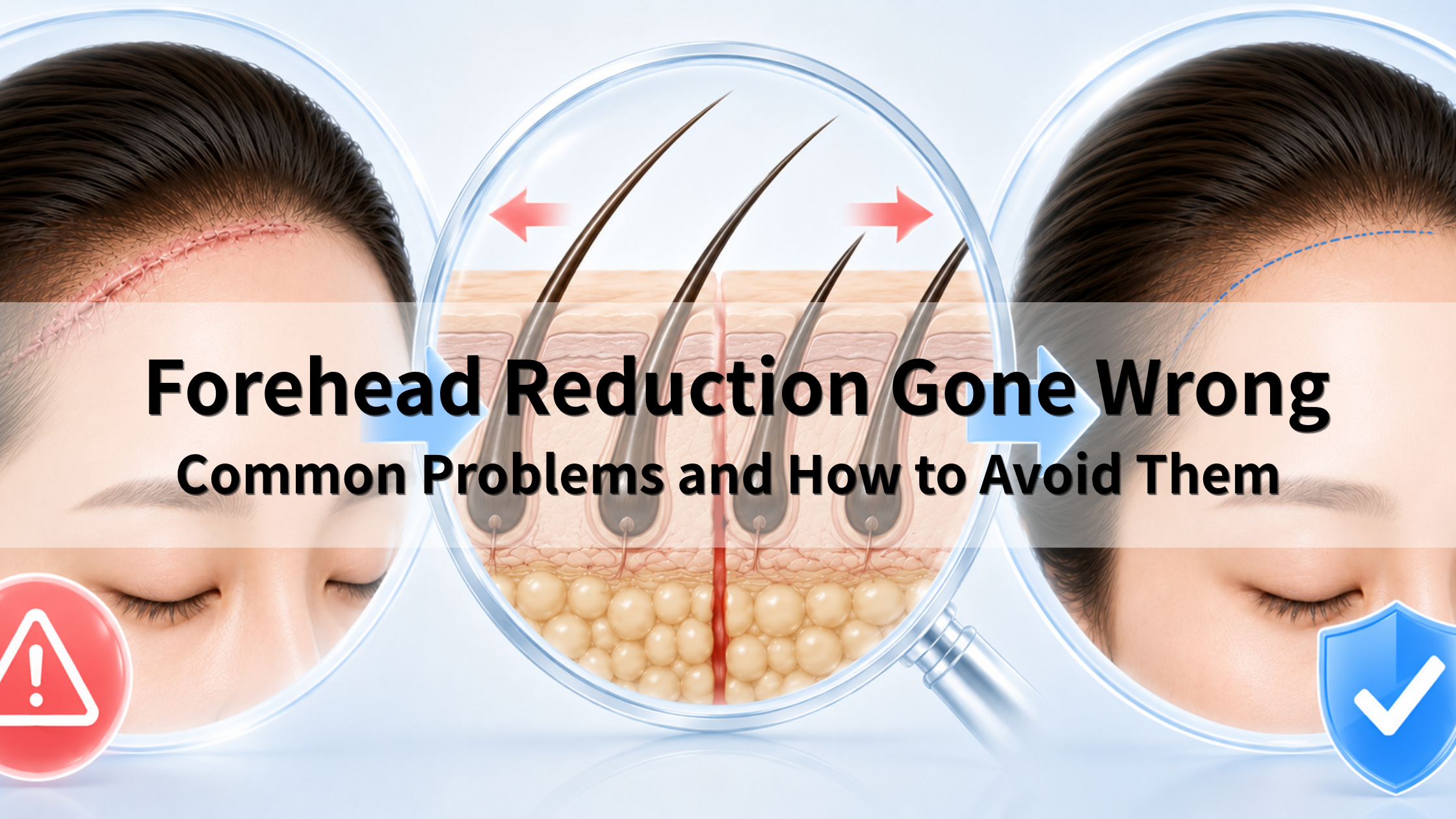
"Forehead reduction gone wrong." "Forehead reduction regret." The more seriously someone is considering this operation, the more likely they are to end up typing exactly these searches. And that is the right instinct: going in without knowing what can go wrong is the shortest route to regret.
What matters is reading failure stories not to be frightened, but to understand them structurally. Most of what gets called a forehead reduction failure is not random bad luck; it can be traced back to the incision method, the tension management, the fixation, or the design. Once you know the causes, you also know exactly what to verify at a consultation to prevent them. This article organizes the representative failure patterns, their causes, and what you can do before surgery to avoid them.
The Short Answer: The Five Failure Patterns at a Glance
Most of these reduce to one of four things: how the incision was made, how tension and fixation were handled, the design, and the timing judgment. The sections below take each pattern's causes and prevention in turn.
First, Know That "Failure" Comes in Two Kinds
The word "failure" mixes two different things. One is an objective problem: scar trouble or relapse. The other is a gap between expectation and result: "the line's shape isn't what I imagined."
The first is mainly a matter of surgical design, technique, skin type, and aftercare. The second is mainly a matter of insufficient alignment at the consultation. Both end in the regret of "it went wrong," but the prevention differs. This article covers both; as you read, notice which of the two you are actually worried about, and your countermeasures will become much clearer.
Pattern 1: A Visible Scar, a White Line or a Widened Line
A crisp white line along the hairline; a scar that spreads wide. Scar trouble is the most talked-about form of forehead reduction failure.
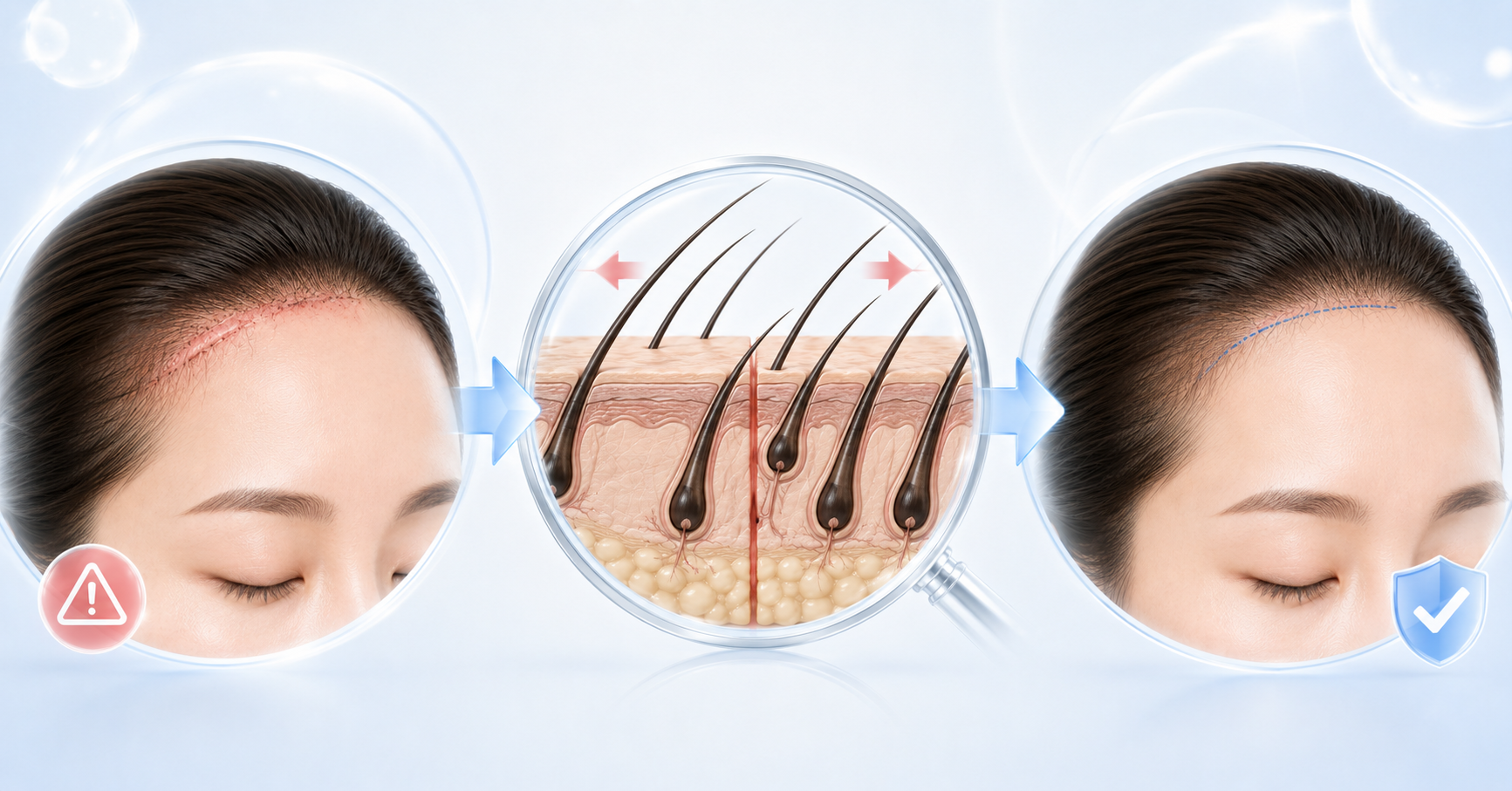
The main causes are three. First, the incision method. Cut perpendicular to the skin, and the follicles along the line are severed, leaving a hairless white line where nothing will grow. A beveled incision that preserves follicles at an angle allows hair to grow through the scar and conceal it (per the official site). Second, a reduction amount that exceeded the scalp's laxity, leaving the suture line under sustained heavy tension; tension is the single biggest widener of scars. Third, constitution (a history of hypertrophic scars or keloids) and care lapses (tightly pulled hairstyles, UV exposure, smoking).
Prevention: confirm the incision method (is it a follicle-preserving design?), a reduction amount matched to your laxity, honest disclosure of your skin type, and disciplined recovery-period care.
Pattern 2: Relapse, the Lowered Hairline Drifts Back
The failure specific to forehead reduction is relapse. The scalp permanently carries tension pulling it back toward its original position; if the force holding the lowered hairline is insufficient, the line creeps backward and the hard-won result shrinks. Relapse is not only an effect problem: with tension concentrating on the suture line, it also widens the scar.
The main causes are two: insufficient fixation, and a lowering that exceeded the scalp's laxity. The harder the line is forced down, the stronger the pull back, and if the fixation cannot hold it, the line relapses.
Prevention: verify the fixation method, and do not overreach on the amount. At Respect Plastic Surgery, the lowered scalp is held with 7-point, triple-layer fixation (per the official site). At your consultation, ask concretely how, and with what method, the scalp will be fixed. Be cautious of any consultation that promises a large lowering while staying vague about the fixation.
Pattern 3: An Unnatural Hairline, the "Constructed" Look
The position came down, yet somehow the result reads as "surgical." The culprit is usually the quality of the line. A natural hairline is not a straight line; it is built from a gentle curve, fine irregularities, and a gradient from soft baby hairs to full-thickness hair. A ruler-straight line with a hard edge produces an artificial impression even when the position is correct.
The other failure here is "too low." Lower the line far past the facial-thirds ratio (the harmonious guideline being upper 0.9-1 : middle 1 : lower 0.8-0.9, per the official site) and the forehead looks cramped, breaking the very balance the surgery was meant to fix. Asymmetry, rooted in design and suturing precision, also belongs to this category.
Prevention: confirm not only the position (how many centimeters) but the design of the line's shape. Have the surgeon explain, with design sketches or case-thinking, what curve the line will take on your face and how the baby-hair transition will be built.
Pattern 4: Thinning Around the Hairline
The pattern of reduced hair volume or patchy density near the line after surgery. The main causes split in two. One is follicle damage at the incision: a perpendicular cut or rough handling permanently destroys follicles along the line. The other is shock loss, temporary shedding of surrounding hair from the stress of surgery; when the follicles survive, this hair usually regrows over time.
Prevention: confirm that the incision method preserves follicles. If you notice it after surgery, the meaning differs entirely depending on whether it is permanent damage or temporary shedding, so do not self-judge; have the course followed at examinations to tell them apart.
Pattern 5: An Undone Result, Recession Was Still Progressing
Satisfied right after surgery, then the forehead widens again over time. This pattern is usually not the surgery itself but the suitability judgment. If hairline recession from AGA/FAGA or traction alopecia is still progressing when only the position is changed, the subsequent recession steadily cancels the result.
Prevention is simple: a hair diagnosis before surgery. If your sense is "my forehead has gotten bigger than it used to be," the cause may be recession rather than an inborn hairline, so alongside the forehead reduction consultation, confirm whether recession is active and whether treatment can stabilize it. The order is: stabilize the recession first, change the position second.
Preventing Failure: Five Things to Prepare Before Your Consultation
Flip the causes above and the prevention comes down to five moves.
1. Get the recession question diagnosed. Whether your forehead is big by birth or by recession decides whether now is even the time. 2. Have your scalp laxity assessed. The comfortable reduction amount is set by laxity, not by your wish. 3. Confirm the incision and the fixation. "Is the incision follicle-preserving?" "How will you fix the scalp?" Concrete answers to these two connect directly to preventing the scar and the relapse. 4. Confirm the line design. Not just the position: the curve, the irregularities, the baby-hair transition. 5. Disclose your constitution and history honestly. A scar-prone constitution and how your past wounds healed must be shared.
Whether concrete questions get concrete answers is the acid test for choosing a clinic.
If You Already Had Surgery and Fear It "Went Wrong"
Finally, for readers who have already had the operation and are worried. Know first that the early post-op appearance is not the finished result. Swelling and tightness change how the line reads, the scar's redness is a stage of healing, and hair-volume changes from shock loss can recover with time. Much of what feels like "it went wrong" changes character as the recovery progresses.
That said, if a clear problem remains after the course has run (definite relapse, a widened scar, permanent thinning, an unnatural line), do not settle the question by self-judgment or internet research: have your operating surgeon evaluate the state first. Revision options exist, but part of the scalp's laxity has already been spent by the first operation, so a second surgery faces stricter conditions than the first. That is exactly why, before thinking about revision, the crucial step is distinguishing a structural problem from a stage of recovery. Do not carry the worry alone; start by putting it into words at an examination.
Frequently Asked Questions
Q1. What is the failure rate of forehead reduction?
A. There is no single "X% failure rate" that can honestly be quoted. Most of what gets called failure arises from combinations of the incision method, tension, fixation, design, suitability judgment, constitution, and aftercare, so the probability differs with each person's conditions and each design. Rather than hunting for a number, verifying at your consultation that the causes listed in this article are being managed in your case is what actually lowers your risk.
Q2. If the hairline relapses, can it be operated on again?
A. Depending on the state, a repeat reduction can sometimes be considered. But part of the scalp's laxity has been used by the first operation, so the second procedure can generally move the line less than the first. And repeating the surgery without first evaluating why the relapse happened (fixation, tension, timing) risks the same outcome again. The first step is an examination that assesses the cause.
Q3. What should I ask at a consultation to avoid failure?
A. Four questions are especially effective. "Is my forehead big by birth, or is it recession?" (suitability diagnosis). "Given my scalp laxity, what reduction amount is comfortable?" (the basis of the amount). "Is the incision follicle-preserving, and how will you fix the scalp?" (scar and relapse prevention). "How will you design the line's curve and the baby-hair transition?" (naturalness). Whether the answers are specific to your conditions tells you the quality of the diagnosis.
Conclusion: Failure Is Not Something to Fear, It Is Something to Prevent Structurally
Forehead reduction failures organize into five patterns, a visible scar, relapse, an unnatural hairline, thinning, and an undone result, and most of their causes trace back to the incision method, tension and fixation, the design, and the suitability judgment. In other words, failure is not luck; it is largely preventable through the quality of the pre-op diagnosis and design. If the negative search results have made you anxious, convert that anxiety directly into your consultation question list. The person who knows the failure stories best is the one best positioned to make the choice they will not regret.
If you would like to review the risks and the right design for your own case, feel free to reach out through Respect Plastic Surgery's official WhatsApp for an online consultation
 Google Maps