You edit every photo from the chin down. You've tried contouring makeup, specific hairstyles, angles that hide it. And yet — in the wrong light, in a candid photo, on a video call — it's still there. That thing your face does that you can't quite fix with anything external. Maybe it's that your face looks longer than it should. Maybe the front view feels wide and flat, even though you're not. Maybe your profile has never looked the way you imagined it would from the front. Here's the question most people never think to ask: Is the problem actually your chin — or is it the way your chin sits relative to everything else? Because those are two completely different issues. And they need two completely different solutions. Most facial contouring consultations start with "how much do you want to reduce?" At Respect, it starts with a 3D CT scan — because until the bone structure is mapped, no one actually knows what the right answer is for your face.
Why the Chin Defines the Entire Face
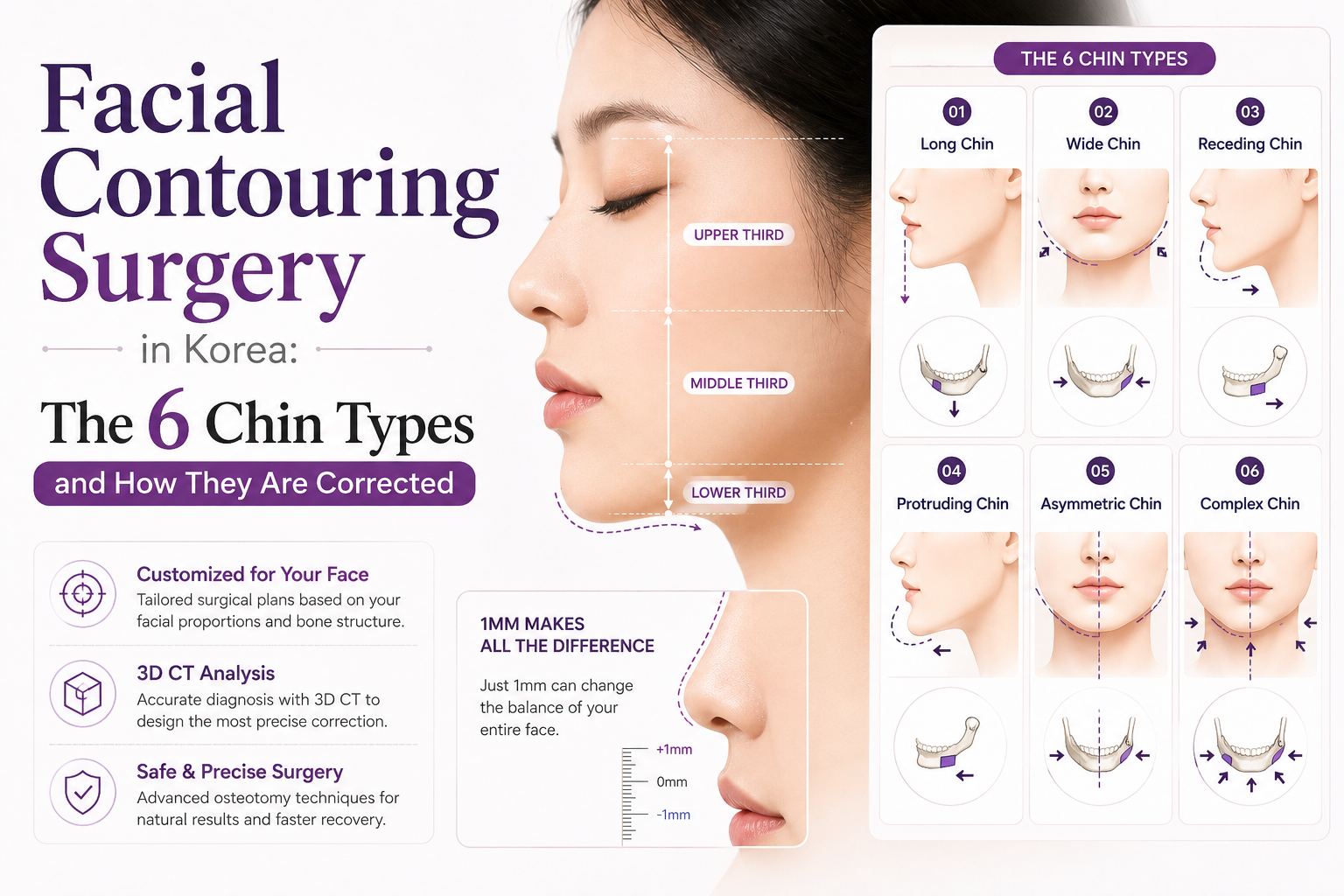
The chin occupies the lowest point of the face — and the lower third is what most people's eyes land on last when reading a face. But "last" doesn't mean "least important." In facial proportion terms, the lower third defines whether the face reads as refined or unresolved.
The chin's width and length directly affect left-right symmetry. When the chin's centre doesn't align with the facial midline — even fractionally — the entire face reads as structurally unbalanced. When the chin is too long, the face appears elongated and heavy. When it's too short, the profile loses the definition that creates a clean, elegant line.
This is why Respect's approach to facial contouring surgery is built on one principle: not simply cutting and reducing, but applying the right surgical method for each individual chin type to create a naturally beautiful V-line.
3D CT Analysis: Why Every Facial Contouring Surgery Starts Here
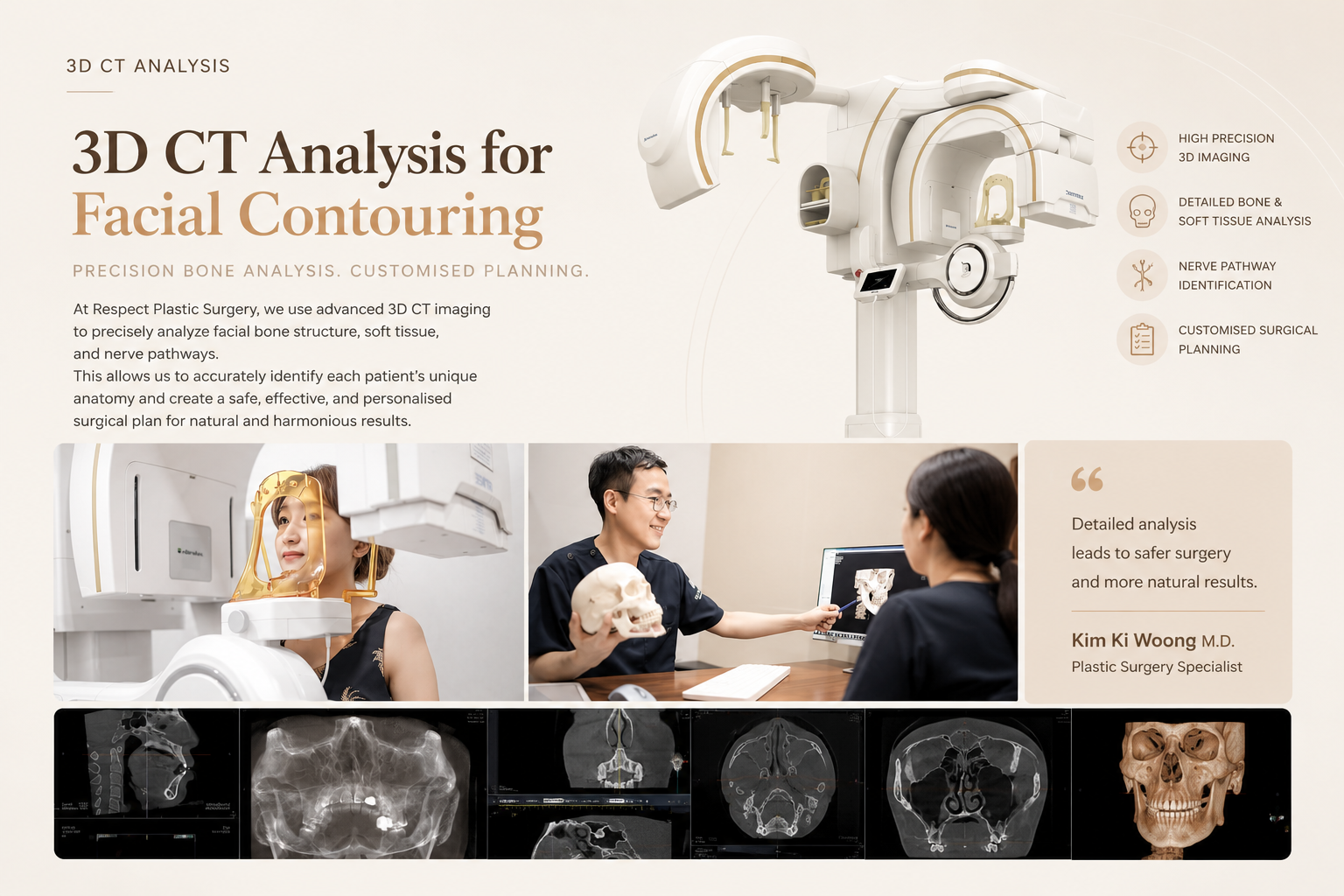
Before any surgical plan is made, Respect performs a 3D CT scan of the patient's facial bone structure.
Standard consultation relies on visual assessment and photographs. 3D CT analysis goes further: it maps bone, muscle, fat, and soft tissue in three-dimensional detail — identifying the exact position of the chin relative to the facial midline, the degree of any asymmetry, the length and width relative to facial proportion, and the nerve pathways that must be preserved during surgery.
This data forms the foundation of the surgical plan. Without it, any plan is an approximation. With it, the osteotomy lines — the precise paths along which the bone will be cut — are determined before a single incision is made.
Dr. Kim Ki Woong, who leads facial contouring surgery at Respect, is a member of the AO Foundation CMF — the leading international organisation for craniomaxillofacial surgical technique development. CT-driven surgical design is not a marketing claim at Respect. It is the clinical standard.
The 6 Chin Types — and Why Each Needs a Different Approach
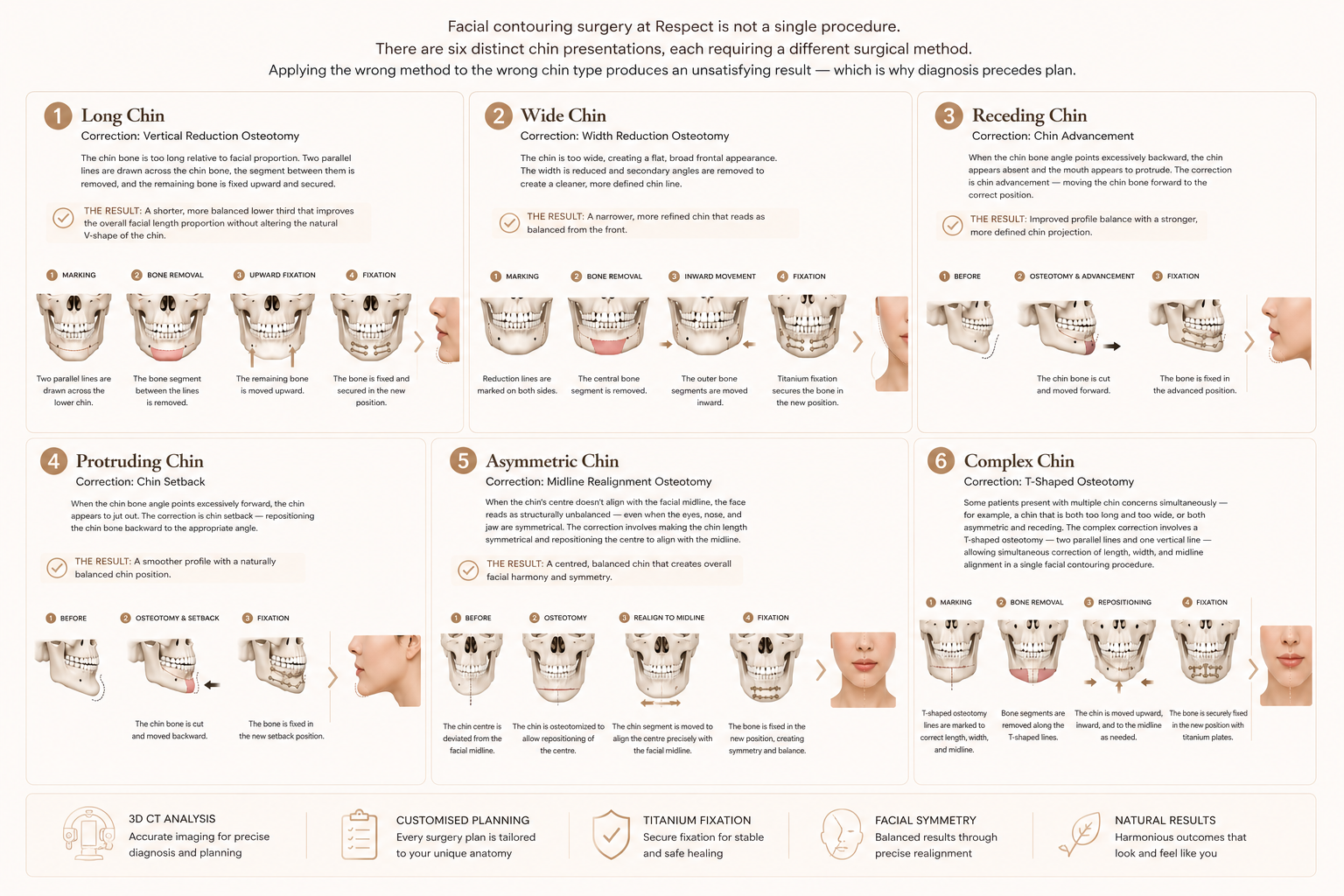
Long Chin
The chin bone is too long relative to facial proportion. Two parallel lines are drawn across the chin bone, the segment between them is removed, and the remaining bone is fixed upward and secured.
The result: a shorter, more balanced lower third that improves the overall facial length proportion without altering the natural V-shape of the chin.
Wide Chin
The chin is too wide, creating a flat, broad frontal appearance. The width is reduced and secondary angles are removed to create a cleaner, more defined chin line.
The procedure involves a 4-step process: marking the reduction lines, removing the central bone segment, bringing the outer segments inward, and securing with titanium fixation. The result is a narrower, more refined chin that reads as balanced from the front.
Receding Chin
When the chin bone angle points excessively backward, the chin appears absent and the mouth appears to protrude. The correction is chin advancement — moving the chin bone forward to the correct position.
This is one of the most impactful changes in facial contouring surgery: patients who have compensated for a receding chin with posture or hairstyle for years often describe this result as the most significant improvement in how their face reads overall.
Protruding Chin
When the chin bone angle points excessively forward, the chin appears to jut out. The correction is chin setback — repositioning the chin bone backward to the appropriate angle.
Both receding and protruding chin corrections are approached from the side profile, addressing the bone angle that determines the chin's position relative to the face.
Asymmetric Chin
When the chin's centre doesn't align with the facial midline, the face reads as structurally unbalanced — even when the eyes, nose, and jaw are symmetrical. The correction involves making the chin length symmetrical through osteotomy and repositioning the chin's centre to align precisely with the facial midline.
This is among the most technically demanding facial contouring procedures, because the surgeon must simultaneously address length symmetry and midline alignment — two separate variables that interact with each other during fixation.
Complex Chin
Some patients present with multiple chin concerns simultaneously — for example, a chin that is both too long and too wide, or both asymmetric and receding. The complex correction involves a T-shaped osteotomy — two parallel lines and one vertical line — allowing simultaneous correction of length, width, and midline alignment in a single facial contouring procedure.
The Respect Approach to Facial Contouring Surgery
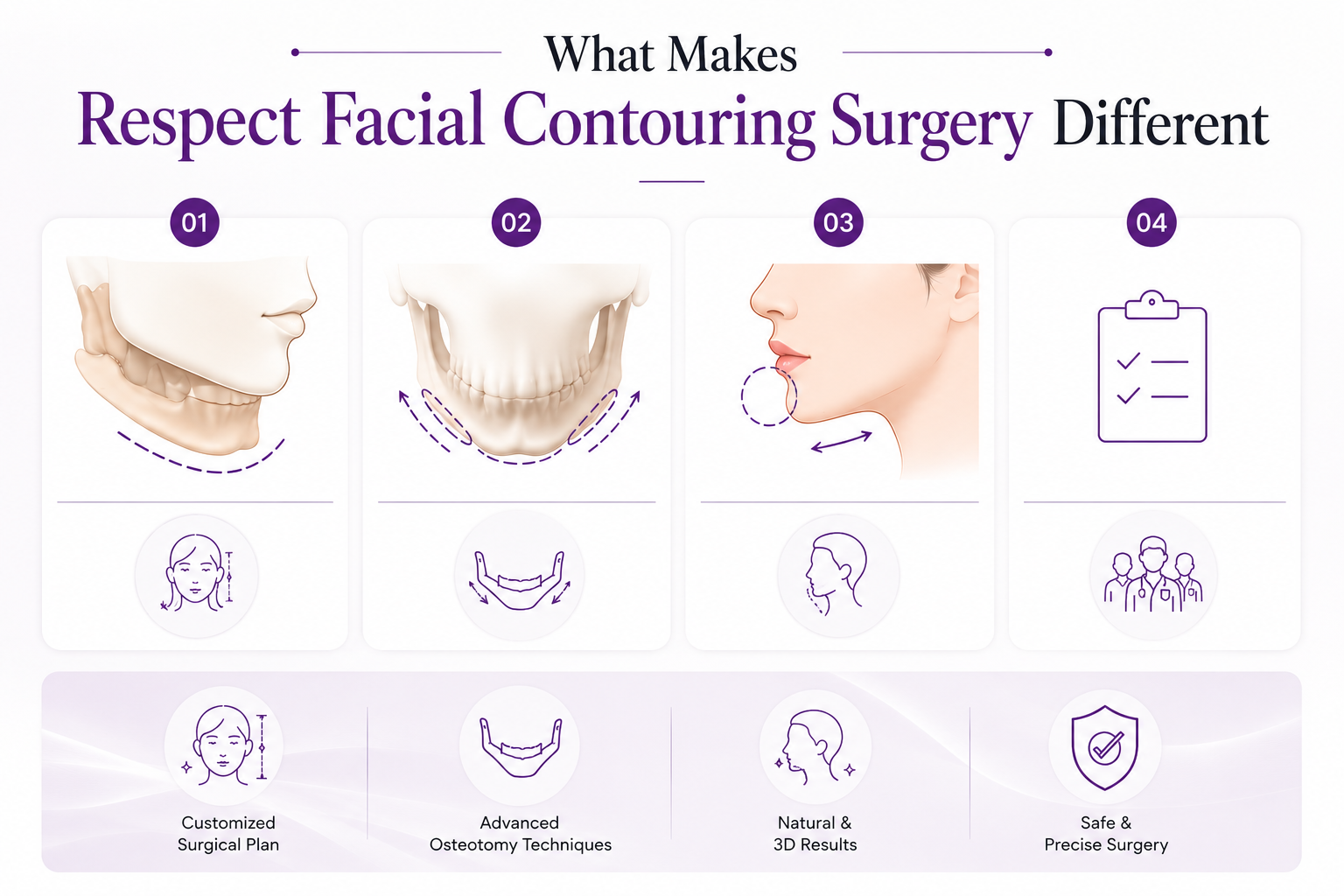
01 — Balanced V-line tailored to your facial ratio.
Customised facial contouring surgery plans match each individual's facial proportion — not a standard V-line template. The width and length of the chin are adjusted together to create a balanced, naturally beautiful jawline.
02 — Multiple osteotomy techniques applied.
Individual chin shape and patient preference determine which combination of osteotomy and resection techniques is used. The five chin type categories provide a framework; the actual surgical plan is specific to each patient.
03 — Lip protrusion improvement and facial three-dimensionality.
Correcting chin position — particularly in receding chin cases — naturally improves the appearance of lip protrusion without any lip procedure. The face gains structural depth and dimension as a result of restoring the correct chin angle.
04 — Facial contouring specialists.
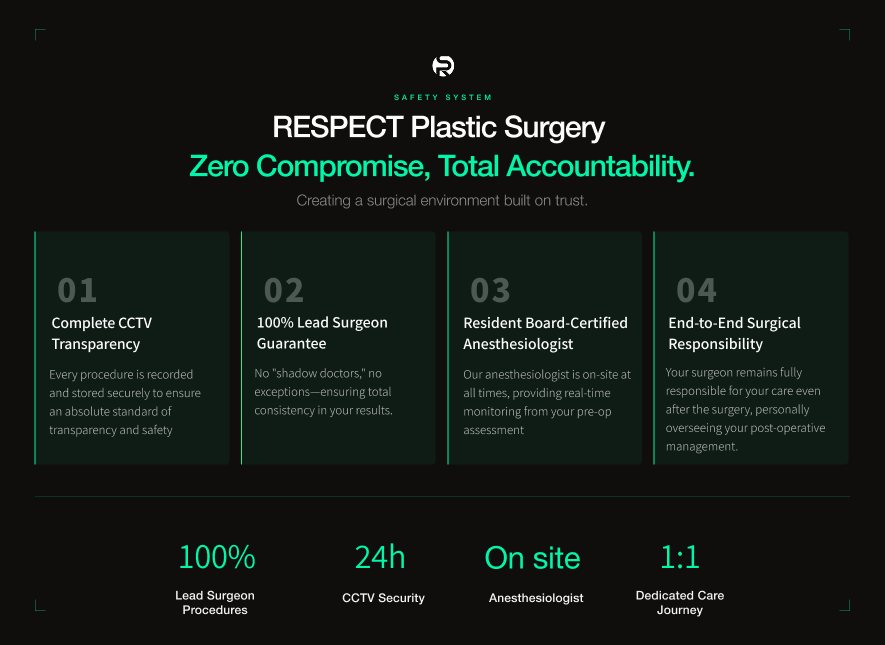
Respect's medical team combines clinical expertise and confidence in facial contouring surgery. Every procedure is managed from start to finish by the same surgical team — no handoffs, no delegation.
"The problem isn't always the size of the chin. Sometimes, it's the proportion."
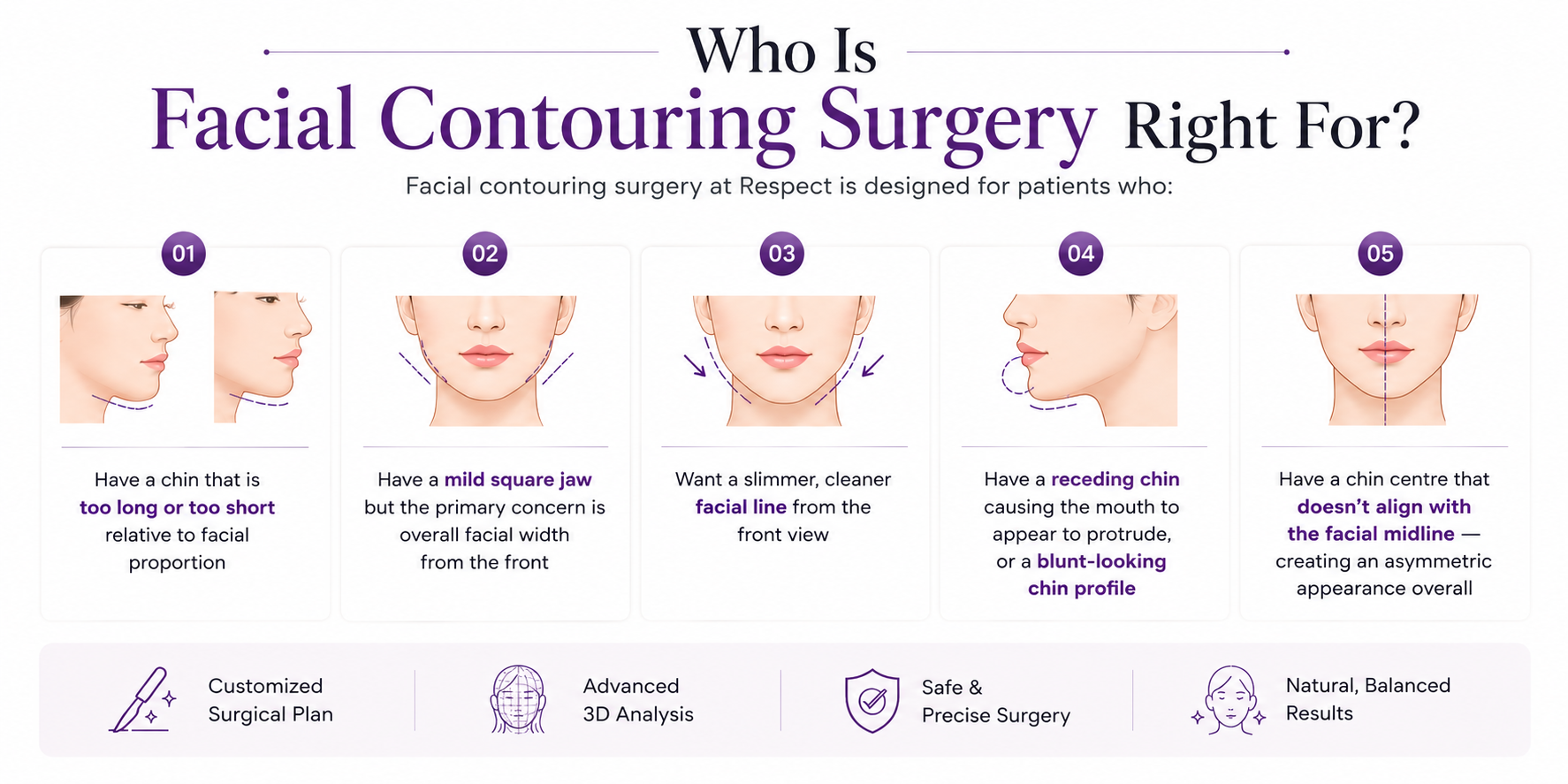
Facial contouring surgery is not only for patients with a prominent square jaw. The ideal candidate may have a chin that appears too long, too short, recessed, or asymmetrical relative to the rest of the face. At Respect Plastic Surgery in Seoul, facial contouring procedures are customized based on each patient's facial proportions, jaw shape, chin position, and aesthetic goals. Whether the concern is overall facial width, a weak chin profile, or facial asymmetry, a personalized surgical plan can help create a slimmer, more balanced facial contour.
The Procedure: What to Expect
Surgery time: 1 hour
Anaesthesia: General anaesthesia
Hospitalisation: Not required
Suture removal: 2 weeks post-op
Follow-up visits: 2–3 sessions
Recovery: 1 week before returning to normal activity
All incisions are made inside the oral mucosa — no visible external scarring. The surgical plan, including all osteotomy lines and fixation points, is confirmed from the 3D CT data before the procedure begins.
Facial contouring surgery is only as precise as the surgeon behind it.
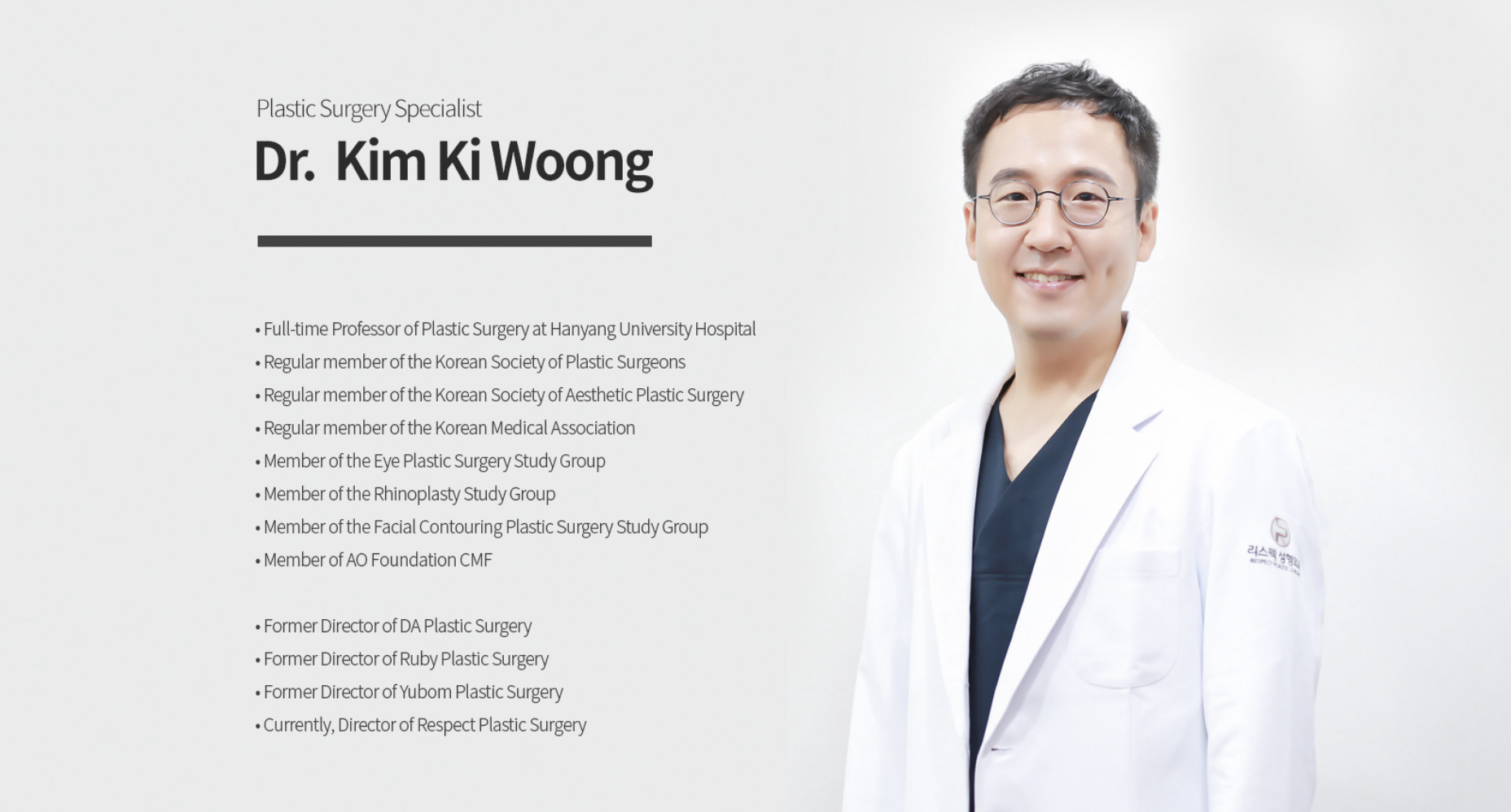
Facial contouring surgery at Respect is led by Dr. Kim Ki Woong — whose clinical background is specifically and directly relevant for patients considering this procedure.
Academic and professional background:
- Former full-time Professor of Plastic Surgery, Hanyang University Hospital
- Member, AO Foundation CMF — the international body for craniomaxillofacial surgical technique
- Member, Facial Contouring Plastic Surgery Study Group
- Member, Rhinoplasty Study Group
- Member, Eye Plastic Surgery Study Group
- Former Director: DA Plastic Surgery · Ruby Plastic Surgery · Yubom Plastic Surgery
- Currently Director, Respect Plastic Surgery
Academic presentations:
- "For the Safe Facial Contouring Surgery" — Korea Plastic and Reconstructive Surgery
- "Endoscopic Orthognathic Surgery Using Skin Incision" — PRS Korea
Published research:
- Endoscopic zygomatic bone reduction — Korea Plastic and Reconstructive Surgery
- Fractured facial bone reduction and resorbable plate fixation using tapper
- Micro Vascular Anastomosis using Fibrin Glue
The AO Foundation CMF membership is the most directly relevant credential for facial contouring surgery patients. The AO Foundation defines how craniomaxillofacial osteotomies are technically planned, executed, and taught internationally. Membership requires demonstrated expertise at this level.
The published research on endoscopic zygomatic bone reduction and facial bone fixation reflects the same anatomical and technical territory as facial contouring surgery: precise bone cutting, accurate repositioning, and stable fixation that holds long-term.
"No pins, just precision. CT-driven design focused on safety and perfect balance."
Frequently Asked Questions
Q. How much does facial contouring surgery cost in Korea?
A. Facial contouring surgery at reputable Gangnam clinics typically ranges from USD $3,500–$7,000, depending on the complexity — single correction vs. combined type, and whether additional procedures are planned. International patients receive a preliminary estimate through the online consultation before traveling.
Q.Is facial contouring surgery the same as jaw reduction?
A.They are related but distinct. Jaw reduction (mandibular angle reduction) addresses the jaw angle — the back corners of the jaw. Facial contouring surgery as described here addresses the chin bone — the front portion of the lower jaw. They are sometimes combined, but each addresses a different anatomical area.
Q.Will there be visible scarring?
A. All incisions are made inside the oral mucosa. There is no external scarring. The only visible sign after recovery is the result itself.
Q.How long does recovery take? Swelling is most significant in the first 3–5 days. Most patients return to normal activity within one week. Final result, including complete resolution of residual swelling, takes 3–6 months.
Q.Can facial contouring surgery be combined with other procedures?
A.Yes. Facial contouring surgery is commonly combined with jaw reduction, cheekbone reduction, or rhinoplasty as part of a comprehensive facial proportion plan. The combination is designed individually based on CT data. When all three areas are addressed in one design, this is called three-point facial contouring.
Q.What is the difference between chin reduction and chin advancement in facial contouring surgery?
A.Chin reduction removes bone to shorten, narrow, or reshape the chin. Chin advancement moves the chin bone forward to correct a receding chin and improve the facial profile. Both are performed through the same intraoral approach with no external scarring.
Coming to Korea for Facial Contouring Surgery?
Respect provides English consultations for international patients. The process is designed for people making this decision from abroad.
Step 1 — Online photo consultation. Send front, side, and 45-degree photos. Dr. Kim reviews your chin type and facial proportions — and provides a preliminary assessment before you travel.
Step 2 — Arrive in Seoul. Airport pickup available. Accommodation near the clinic arranged. A point of contact from the moment you land.
Step 3 — In-person consultation and 3D CT. CT scan performed on-site. Precise measurements taken. Surgical plan confirmed. You meet Dr. Kim directly before any decision is made.
Step 4 — Surgery. Performed by Dr. Kim. A dedicated board-certified anesthesiologist — trained at Seoul National University — is present throughout.
Step 5 — Recovery in Seoul. 1 week recommended before flying.
Step 6 — Remote follow-up. Post-operative care continues online after you return home.
The bone structure is mapped. The technique is matched to your specific anatomy. The surgical team is the same from consultation to recovery.
Click here to schedule a consultation.
English consultations are available for international patients

 Google Maps